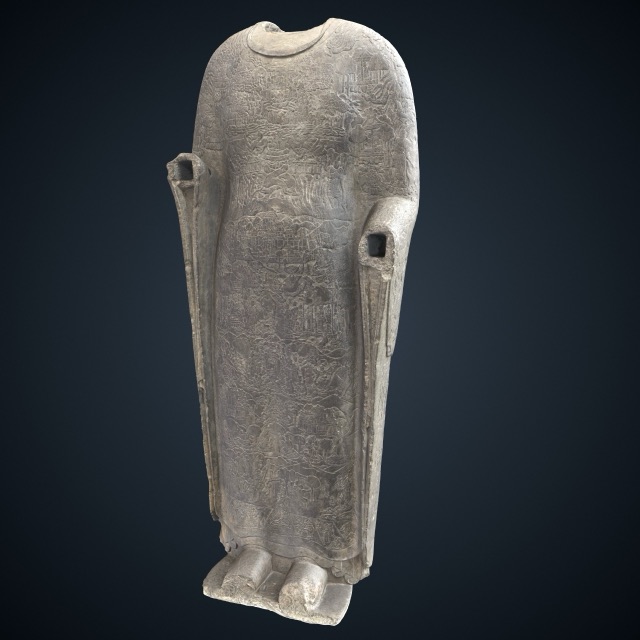
Buddha draped in robes portraying the Realms of Existence
Stop 1 · First look
First Look
Look at the front of the robe, below the chest. The whole surface is carved with small scenes, row above row, like pages laid on the cloth. This Buddha was made in China between five fifty and five seventy-seven, during the Northern Qi dynasty. The head and hands are missing. What remains is a body dressed in a map of the Buddhist universe, with the heavens near the shoulders and the hells at the hem.
Stop 2 · Technique
Closer Reading
Walk slowly around to the back. The carving does not stop at the sides. It continues over the whole robe, and most visitors to the real statue never see this part clearly, because the relief is so shallow that it almost disappears in ordinary light. That is one reason the Smithsonian scanned it. In the scan the scenes can be traced one by one: palaces and seated Buddhas above, the great mountain at the centre of the world, people and animals on the earth, and the punishments of hell below. Teachers may once have used the figure as a kind of illustrated sermon, pointing from scene to scene. It is carved from a single block of limestone, probably in Henan province, and stands just over one and a half metres high. The Freer Gallery bought it in Beijing in nineteen twenty-three.
Stop 3 · Museum record
Catalog Summary
A life-size stone Buddha whose robe is covered, front and back, with scenes in low relief: the heavens at the top, the earth between, and the hells at the hem. The head and hands were lost long ago. Limestone, probably from Henan province; 151.3 cm high. Shown at full size from the Smithsonian's scan.
Recorded physical scale: 63.6 × 151.5 cm (25.0 × 59.6 in · 0.64 × 1.51 m).
Stop 4 · Historical Context
China, Northern Qi dynasty
No sculptor is named for the Atlas's stone Buddha; the museum places it in China under the Northern Qi dynasty, 550 to 577.
Buddhist sculpture: Figures of the Buddha and pictures of Buddhist teaching, carved for devotion.
First Look
Look at the front of the robe, below the chest. The whole surface is carved with small scenes, row above row, like pages laid on the cloth. This Buddha was made in China between five fifty and five seventy-seven, during the Northern Qi dynasty. The head and hands are missing. What remains is a body dressed in a map of the Buddhist universe, with the heavens near the shoulders and the hells at the hem.
Closer Reading
Walk slowly around to the back. The carving does not stop at the sides. It continues over the whole robe, and most visitors to the real statue never see this part clearly, because the relief is so shallow that it almost disappears in ordinary light. That is one reason the Smithsonian scanned it. In the scan the scenes can be traced one by one: palaces and seated Buddhas above, the great mountain at the centre of the world, people and animals on the earth, and the punishments of hell below. Teachers may once have used the figure as a kind of illustrated sermon, pointing from scene to scene. It is carved from a single block of limestone, probably in Henan province, and stands just over one and a half metres high. The Freer Gallery bought it in Beijing in nineteen twenty-three.
Catalog Summary
A life-size stone Buddha whose robe is covered, front and back, with scenes in low relief: the heavens at the top, the earth between, and the hells at the hem. The head and hands were lost long ago. Limestone, probably from Henan province; 151.3 cm high. Shown at full size from the Smithsonian's scan.
About the Artist
China, Northern Qi dynasty
No maker's name is recorded for this figure. The National Museum of Asian Art gives its origin as China, probably Henan province, in the Northern Qi dynasty, 550 to 577.
The life-size limestone Buddha wears a monk's plain robe, carved front and back with scenes from the life of the historical Buddha and with pictures of the Buddhist cosmos. On the chest is Mount Sumeru, the sacred mountain believed to join heaven and earth, with two serpents wound round it. The museum's label links the figure to the Lotus Sutra, in which a vision of the whole cosmos appears when the Buddha preaches.