Model of the Greek Slave
Stop 1 · First look
First Look
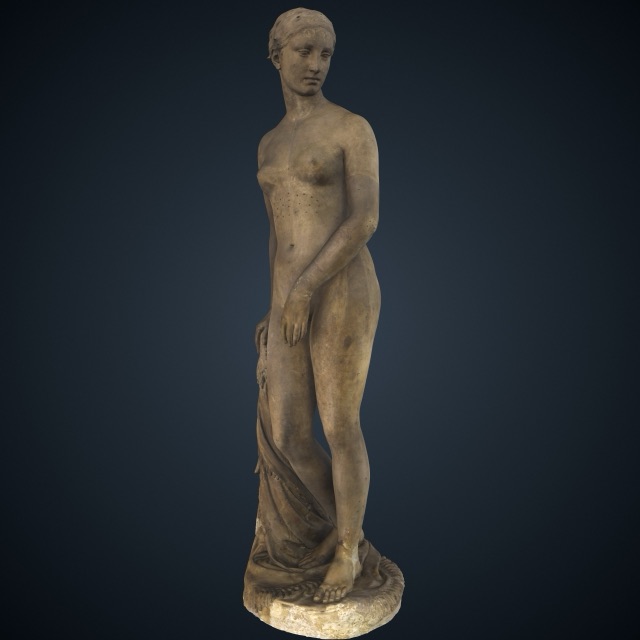
Look at the small dark points scattered over the shoulders, the hips and the knees. They are metal pins, set into the plaster as measuring marks. This is the model that Hiram Powers’s studio used to carve his most famous statue, the Greek Slave, in marble. He finished the figure in clay in March eighteen forty-three, and this cast was taken directly from that clay. It is as close as anyone can come to the original.
Stop 2 · Technique
Closer Reading
Find the figure’s right thigh, where the surface is scraped. Powers did not model the chains in plaster. He hung real metal chains on the figure instead, and they scratched it. For the same reason the locket, the cross and the drapery are only roughed in, because the carvers could work from real objects when they reached those parts. The pins and the small pencilled crosses are the key to how the marbles were made. A carver set a pointing machine against the model, measured the position of each mark, and drilled to the same depth in a block of marble. Between eighteen forty-four and eighteen sixty-nine, carvers working under Powers made six full-size marble versions this way for private buyers. The subject is a Greek woman captured in the war of independence and put up for sale in a slave market in Constantinople. In America the statue was quickly linked with slavery at home, and abolitionists used pictures of it to argue their cause.
Stop 3 · Museum record
Catalog Summary
Plaster model with metal pins, made in Powers’s studio as a reference for carving marble versions. The scan preserves the plaster surface and its marks.
Recorded physical scale: 54.6 × 168.6 cm (21.5 × 66.4 in · 0.55 × 1.69 m).
Stop 4 · Historical Context
Hiram Powers (1805–1873)
American sculptor in Florence whose marble statue The Greek Slave made him one of the first American artists to win international fame.
Neoclassicism (about 1750 to 1850): A return to the plain, balanced forms of ancient Greek and Roman art, in building, sculpture and painting across Europe and America from about 1750.
First Look
Look at the small dark points scattered over the shoulders, the hips and the knees. They are metal pins, set into the plaster as measuring marks. This is the model that Hiram Powers’s studio used to carve his most famous statue, the Greek Slave, in marble. He finished the figure in clay in March eighteen forty-three, and this cast was taken directly from that clay. It is as close as anyone can come to the original.
Closer Reading
Find the figure’s right thigh, where the surface is scraped. Powers did not model the chains in plaster. He hung real metal chains on the figure instead, and they scratched it. For the same reason the locket, the cross and the drapery are only roughed in, because the carvers could work from real objects when they reached those parts. The pins and the small pencilled crosses are the key to how the marbles were made. A carver set a pointing machine against the model, measured the position of each mark, and drilled to the same depth in a block of marble. Between eighteen forty-four and eighteen sixty-nine, carvers working under Powers made six full-size marble versions this way for private buyers. The subject is a Greek woman captured in the war of independence and put up for sale in a slave market in Constantinople. In America the statue was quickly linked with slavery at home, and abolitionists used pictures of it to argue their cause.
Catalog Summary
Plaster model with metal pins, made in Powers’s studio as a reference for carving marble versions. The scan preserves the plaster surface and its marks.
About the Artist
Hiram Powers (1805–1873)
Hiram Powers was born on a farm in Woodstock, Vermont. In 1818 his family moved to Cincinnati, Ohio. As a young man he fitted wax figures with machinery for a local museum, so that they seemed alive, and studied with the sculptor Frederick Eckstein. The patron Nicholas Longworth sent him to Washington in 1834, where his portrait of President Andrew Jackson brought more orders.
In 1837 he settled in Florence, Italy, drawn by its fine marble and skilled stone carvers. He never went home. There he made nude figures from history, the Bible and literature, in a style modelled on ancient Greek and Roman statues.
He finished the clay model of The Greek Slave in March 1843. It shows a Greek woman captured by Ottoman forces and chained for sale. Carvers in his studio used a pointing machine, a measuring tool, to copy his plaster model into six full-size marbles. More than a hundred thousand Americans saw it on tour between 1847 and 1849, and American campaigners against slavery took up its image. Powers died in Florence in 1873.