Abraham Lincoln, life mask
Stop 1 · First look
First Look
Look at the hollows of the cheeks, and at the lines running down beside the mouth. This is a cast of Abraham Lincoln’s face, made while he was alive. The sculptor Clark Mills took it on the eleventh of February eighteen sixty-five, near the end of the Civil War. Lincoln was fifty-five, and the war had aged him. Two months later he was dead. People often take this for a death mask. It is not.
Stop 2 · Technique
Closer Reading
Come close and look at the eyes. They are closed, and the skin around them is smooth, because the eyelids had to stay shut while the mould was made. A life mask was taken by oiling the face, covering it with a thin layer of wet plaster, and waiting while it set. The sitter breathed through the nose and kept still. The mould was then lifted off and filled, and what came out was every pore and crease at its real size. Before photography was common, this was the most exact portrait there could be, and sculptors used such casts as models for busts and statues. The National Portrait Gallery notes that this one makes Lincoln look gaunt and careworn. Its plaster was cast about nineteen seventeen from Mills’s original. An earlier life mask, taken in eighteen sixty before he was president, shows a much fuller face.
Stop 3 · Museum record
Catalog Summary
A cast of Abraham Lincoln's face taken from life by the sculptor Clark Mills on 11 February 1865, two months before the president's death. It is often mistaken for a death mask. Plaster, cast about 1917 after the 1865 original; 29.8 cm long. Shown at full size from the Smithsonian's scan.
Recorded physical scale: 21.2 × 17.7 cm (8.3 × 7.0 in · 0.21 × 0.18 m).
Stop 4 · Historical Context
Clark Mills (1810–1883)
American sculptor and bronze founder in Washington who cast the Statue of Freedom for the Capitol dome and took a cast of Abraham Lincoln's face.
Plaster casts and models: Works in plaster: a sculptor's model for a marble statue, and a face cast from life.
First Look
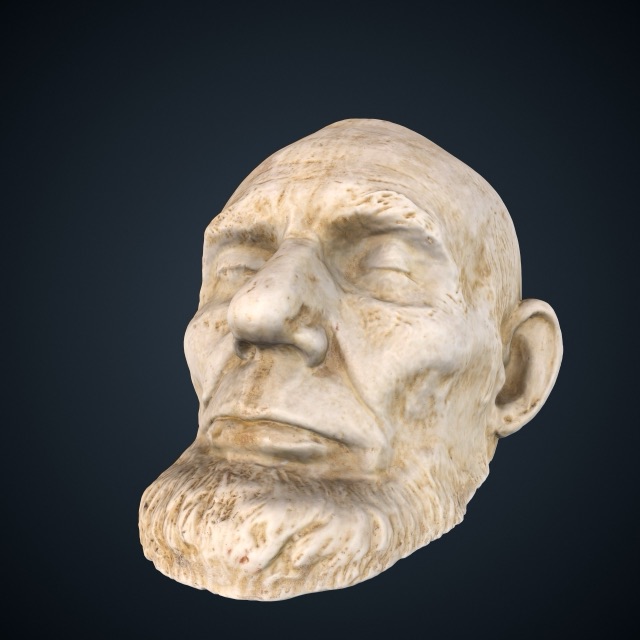
Look at the hollows of the cheeks, and at the lines running down beside the mouth. This is a cast of Abraham Lincoln’s face, made while he was alive. The sculptor Clark Mills took it on the eleventh of February eighteen sixty-five, near the end of the Civil War. Lincoln was fifty-five, and the war had aged him. Two months later he was dead. People often take this for a death mask. It is not.
Closer Reading
Come close and look at the eyes. They are closed, and the skin around them is smooth, because the eyelids had to stay shut while the mould was made. A life mask was taken by oiling the face, covering it with a thin layer of wet plaster, and waiting while it set. The sitter breathed through the nose and kept still. The mould was then lifted off and filled, and what came out was every pore and crease at its real size. Before photography was common, this was the most exact portrait there could be, and sculptors used such casts as models for busts and statues. The National Portrait Gallery notes that this one makes Lincoln look gaunt and careworn. Its plaster was cast about nineteen seventeen from Mills’s original. An earlier life mask, taken in eighteen sixty before he was president, shows a much fuller face.
Catalog Summary
A cast of Abraham Lincoln's face taken from life by the sculptor Clark Mills on 11 February 1865, two months before the president's death. It is often mistaken for a death mask. Plaster, cast about 1917 after the 1865 original; 29.8 cm long. Shown at full size from the Smithsonian's scan.
About the Artist
Clark Mills (1810–1883)
Clark Mills was an American sculptor, born in 1810, who had a bronze foundry on the outskirts of Washington.
Beginning in 1860 he cast the Statue of Freedom, designed by Thomas Crawford for the dome of the United States Capitol, in five main sections. Work stopped in 1861 because of the Civil War. By the end of 1862 the statue was finished, with the help of Philip Reid, an enslaved man. Its last section was raised onto the dome on 2 December 1863.
On 11 February 1865, the day before Abraham Lincoln's fifty-sixth birthday and about two months before the president was killed, Mills took a cast of his face from life. The face looks so thin and worn that the cast is often taken for a death mask. Mills died in 1883, and in 1889 his son gave a casting of the mask to the Smithsonian.