1843 · 1 work · Smithsonian American Art Museum
Form in Plaster
Stop 1 of 1 · Hiram Powers · 1843
Model of the Greek Slave
First Look
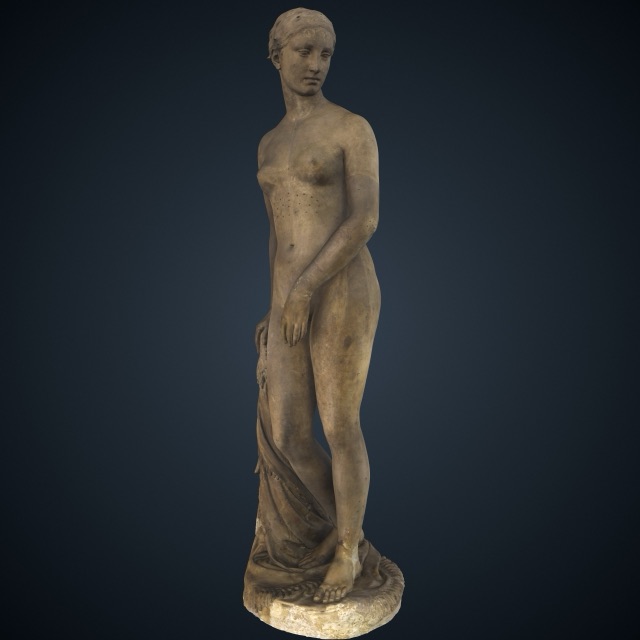
Look at the small dark points scattered over the shoulders, the hips and the knees. They are metal pins, set into the plaster as measuring marks. This is the model that Hiram Powers’s studio used to carve his most famous statue, the Greek Slave, in marble. He finished the figure in clay in March eighteen forty-three, and this cast was taken directly from that clay. It is as close as anyone can come to the original.
A closer look
Find the figure’s right thigh, where the surface is scraped. Powers did not model the chains in plaster. He hung real metal chains on the figure instead, and they scratched it. For the same reason the locket, the cross and the drapery are only roughed in, because the carvers could work from real objects when they reached those parts. The pins and the small pencilled crosses are the key to how the marbles were made. A carver set a pointing machine against the model, measured the position of each mark, and drilled to the same depth in a block of marble. Between eighteen forty-four and eighteen sixty-nine, carvers working under Powers made six full-size marble versions this way for private buyers. The subject is a Greek woman captured in the war of independence and put up for sale in a slave market in Constantinople. In America the statue was quickly linked with slavery at home, and abolitionists used pictures of it to argue their cause.
Plaster model with metal pins, made in Powers’s studio as a reference for carving marble versions. The scan preserves the plaster surface and its marks.
Other exhibitions
The Sistine Chapel: Ceiling, Altar, and Wall Cycles
Michelangelo’s ceiling and Last Judgment alongside the fifteenth-century north and south wall narratives by Botticelli, Perugino, Ghirlandaio, Rosselli, and Signorelli.
1765–1857 · 7 worksEdo: Pictures of the Floating World
Seven woodblock prints from the city of Edo, 1765 to 1857: Harunobu, Kiyonaga, Sharaku, Utamaro and Hiroshige, from the Art Institute of Chicago.
1867–1893 · 7 worksImpressionism: Painters of Modern Life
Seven painters and seven views of modern France, 1867 to 1893: Monet, Renoir, Morisot, Caillebotte, Degas, Cassatt and Pissarro, from the Art Institute of Chicago.
1782–1893 · 6 worksFrom Edo to Paris: Ukiyo-e and the Impressionist Eye
How Japanese woodblock masters Hiroshige and Kiyonaga inspired the cropped framing, asymmetric diagonals, and rain-swept streets of Caillebotte, Degas, and Cassatt.