1867–1893 · 7 works · Art Institute of Chicago
Impressionism: Painters of Modern Life
Stop 1 of 7 · Claude Monet · 1867
The Beach at Sainte-Adresse
First Look
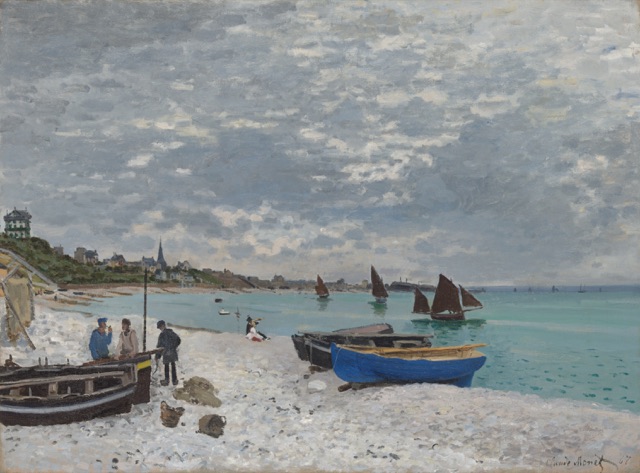
Find the two small figures sitting on the shingle, between the beached boats. He is looking out to sea through a telescope, and her straw hat carries a red ribbon. Claude Monet painted this beach in the summer of eighteen sixty-seven, at Sainte-Adresse, near the port where he grew up. The fishermen belong to the old village. The seated pair are visitors, and the new railway was bringing more of them every year.
A closer look
Stay with the sky for a moment. More than half the canvas is cloud, laid down in broad strokes of grey and white. Monet was twenty-six. He began the picture outdoors and, as the Art Institute’s conservators have found, changed his mind while he worked. Under the paint are more tourists and pleasure yachts, which he covered over, leaving the fishermen, their dark sails and their gear on the shore. That choice keeps two worlds in one view: working boats in front, and leisure only hinted at by the couple with the telescope. Nine years later he chose this painting for the second Impressionist exhibition, in eighteen seventy-six. Look once more at the blue boat drawn up on the stones. It is the most saturated colour on the beach.
Monet spent the summer of 1867 with his aunt at Sainte-Adresse, beside the port of Le Havre where he grew up. Fishermen and their dark-sailed boats fill the shingle, and two seated holidaymakers, small at the water’s edge, mark the village’s new life as a resort. Oil on canvas, 75.8 × 102.5 cm.
Stop 2 of 7 · Pierre-Auguste Renoir · 1875
Lunch at the Restaurant Fournaise (The Rowers' Lunch)
First Look
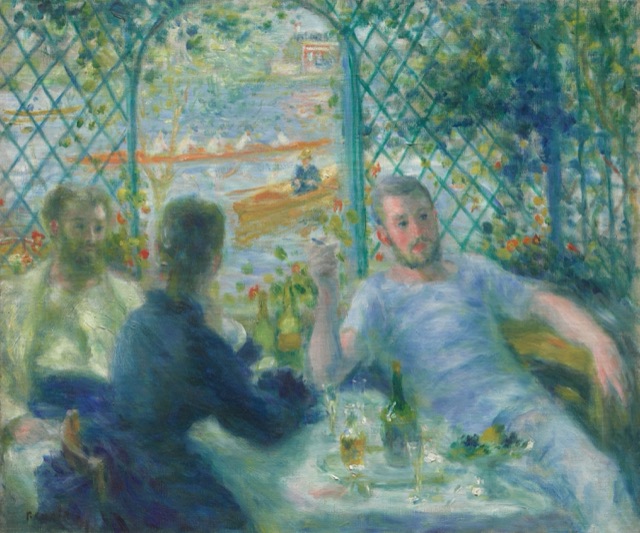
Look through the trellis, past the three people at the table, to the river. A rowing boat is crossing the gap, warm orange against the water. Pierre-Auguste Renoir painted this lunch in eighteen seventy-five at the Restaurant Fournaise, on the Seine just outside Paris, where rowers came to eat. The meal is nearly over: glasses, fruit, a bottle. Nobody is posing. The man in white leans back in his chair, in the middle of a conversation.
A closer look
Notice how little of this picture is drawn with lines. The men’s jackets, the woman’s dark blue dress and the leaves of the arbour are all built from short, soft touches of colour, and the shadows are blue and violet rather than brown or black. That was the manner Renoir and his friends had shown in Paris the year before, at the exhibition that gave the Impressionists their name. The setting is the Restaurant Fournaise at Chatou, a short train ride from the city, where Parisians hired boats on the Seine. Renoir came back to it for years, and in eighteen eighty and eighty-one he painted his large Luncheon of the Boating Party at the same restaurant. This smaller canvas keeps to one table and one quiet half hour after the meal.
Three friends linger at a table under a trellis at the Restaurant Fournaise, a meeting place for rowers on the Seine at Chatou, just outside Paris. Renoir dissolves the end of the lunch into dappled blues and greens, with a skiff sliding past on the river behind them. Oil on canvas, 55 × 65.9 cm.
Stop 3 of 7 · Berthe Morisot · 1875–80
Woman at Her Toilette
First Look
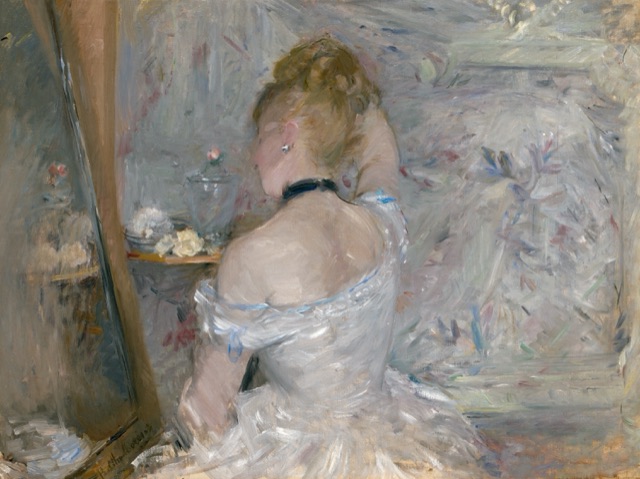
Look at the mirror on the left, and then at its lower edge. Berthe Morisot signed her name there, as if it were written on the glass. The mirror shows no clear reflection, only the same feathery strokes of grey, pink and lavender as the wall behind. A woman is undoing her hair, still wearing a black ribbon at her neck. Morisot showed this painting at the Impressionist exhibition of eighteen eighty.
A closer look
Follow the single dark note in this picture: the ribbon at the woman’s neck. Almost everything around it is pale, and brushed so loosely that wallpaper, bedspread and dress nearly merge. The Art Institute describes her as a fashionable Parisian after a ball, reaching up to take down her hair. Painters of the time often used a woman at a mirror as an emblem of vanity. Here the glass gives back almost nothing. Morisot was a founding member of the Impressionist group and exhibited in seven of its eight shows, more than most of her colleagues. At the exhibition of eighteen eighty her work was highly praised. Look again at the shoulder and the back of the neck. A few strokes of white and blue, and the skin seems to catch the light.
A woman seen from behind lifts a hand to her hair at her dressing table, a black ribbon still at her neck. Morisot paints the room, the dress and the mirror in the same quick, silvery strokes, and signs her name along the mirror’s lower edge. Oil on canvas, 60.3 × 80.4 cm.
Stop 4 of 7 · Gustave Caillebotte · 1877
Paris Street; Rainy Day
First Look
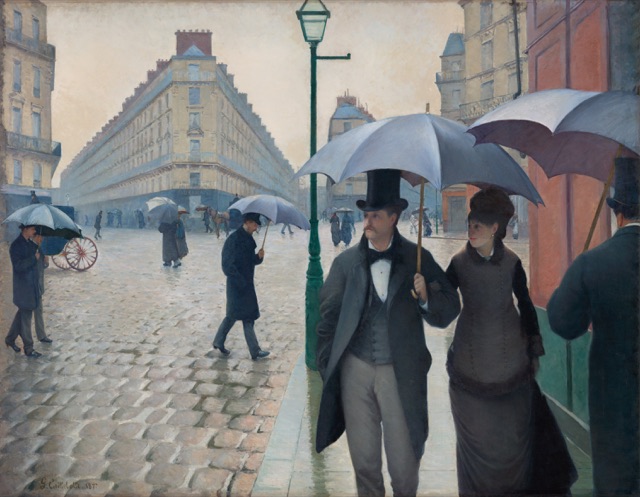
Look down, at the cobblestones. Gustave Caillebotte painted no falling rain in this picture. You know the weather from the umbrellas, and from the light lying on the wet stone. This is Paris in eighteen seventy-seven, at a broad new intersection a short walk from the painter’s home. The canvas is almost three metres wide. Stand where you are, and the couple on the right seem about to walk past you.
A closer look
Find the green lamp post in the middle of the painting. It divides the canvas almost exactly in half. On the left are open street and distant walkers. On the right are three figures so close that one is cut off by the frame. The Art Institute suggests that this abrupt cropping may owe something to photography, which was then becoming popular. The streets themselves were new. A rebuilding of Paris lasting decades had replaced narrow medieval lanes with long, straight boulevards like these, and the retractable umbrella was a recent invention. Caillebotte showed the painting at the third Impressionist exhibition, in eighteen seventy-seven, which he also helped to pay for. His brushwork is smoother than his friends’, but the subject is theirs: an ordinary moment in the modern city. Look at the couple once more. They are both glancing at something we cannot see.
Caillebotte’s largest painting shows a broad new intersection in Paris, a short walk from his home. No raindrops are painted: the weather is told by the umbrellas and by the sheen on the cobblestones. Oil on canvas, 212.2 × 276.2 cm.
Stop 5 of 7 · Hilaire Germain Edgar Degas · 1879-86
The Millinery Shop
First Look
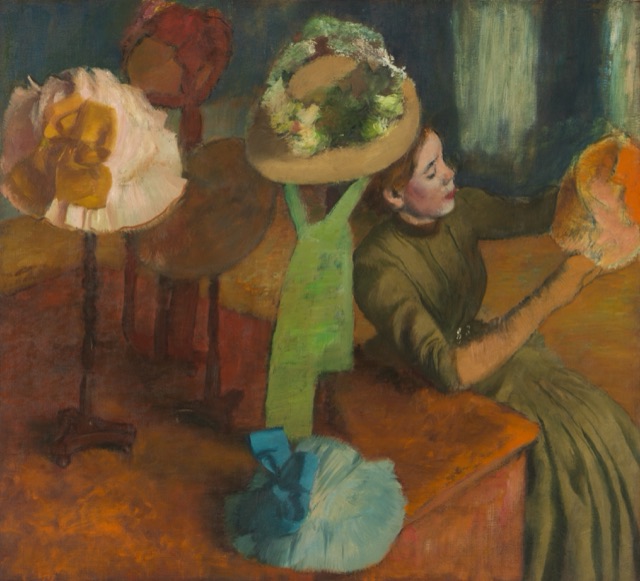
Look at the hat with the green trimmings, just above the woman’s head. It is on a stand behind her, but Edgar Degas has placed it so that it seems to be hers. She is absorbed in another hat, held up in her gloved hands. We see her from above and a little to one side, as if we had just stopped at the counter. Degas worked on this painting between eighteen seventy-nine and eighteen eighty-six.
A closer look
Count the hats. There are six, on stands at different heights, and together they take up more of the canvas than the woman does. Degas made many drawings and pastels for this one figure, adjusting her pose and her clothes. The Art Institute points to a small uncertainty he left in place. Hat making was a respected trade that could raise a young woman’s standing, and her green dress and long gloves would suit a customer as well as an employee. A lady of the time would be wearing a hat of her own. She is not, so Degas lets one from the display hover over her. Is she buying, or working? The steep view from above and the table sliced by the frame make us feel we have only just walked up. Look at the ribbons. A few quick strokes, left almost unfinished.
The largest of Degas’s paintings of milliners looks down on a young woman studying a hat among the shop’s displays. Degas placed a second hat, trimmed in green, so that it seems to sit on her own head. Oil on canvas, 100 × 110.7 cm.
Stop 6 of 7 · Mary Cassatt · 1893
The Child's Bath
First Look
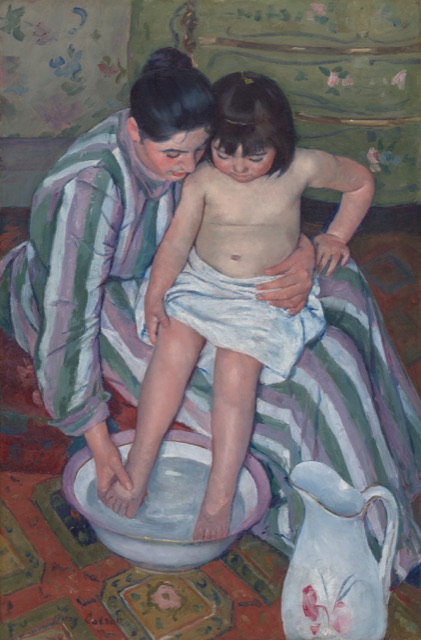
Look at the basin, and at the two hands meeting in the water. The woman’s hand is closed around the child’s foot, and both of them are looking down at the same spot. Mary Cassatt painted this in eighteen ninety-three. We see the pair from above, so the patterned carpet seems to stand upright behind them. Stripes, flowers and carpet press close on every side, and the child’s bare skin is the one plain surface.
A closer look
Step back and take in the angle. We are looking almost straight down, as if standing over the two figures, and the floor tilts up towards us like a wall. The Art Institute traces this to Cassatt’s close study of Japanese woodblock prints in the eighteen nineties: the high viewpoint, the strong outlines, the cropped shapes, and the pleasure in pattern set against pattern. Cassatt was born in Pennsylvania and settled in Paris, and she was the only American invited to exhibit with the original Impressionist group. Women caring for children became her best known subject, and she painted it without sweetness. Nothing here is posed for us. The Art Institute bought this canvas in nineteen ten, the first of her works to enter its collection. Look at the jug in the corner. Its painted flowers are among the few loose, soft passages in a very firmly built picture.
A woman steadies a child on her lap and washes one small foot in a basin. Cassatt, the only American invited to exhibit with the French Impressionists, sets the scene steeply from above and fills it with pattern, lessons she drew from Japanese woodblock prints. Oil on canvas, 101.3 × 67.3 cm.
Stop 7 of 7 · Camille Pissarro · 1893
The Place du Havre, Paris
First Look
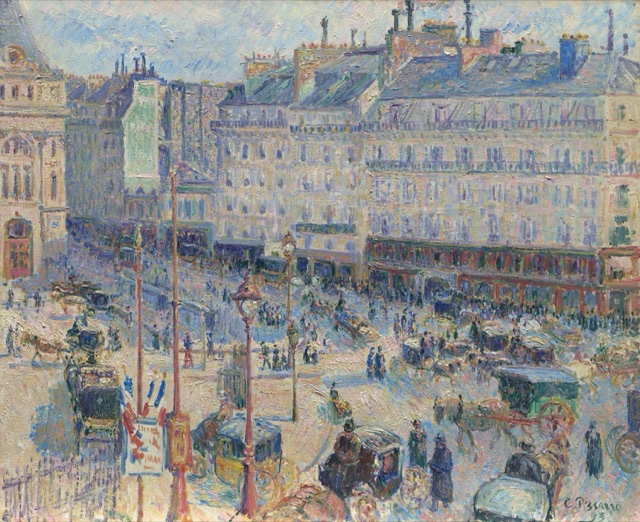
Look down into the square and try to follow one carriage through the traffic. It is hard to do. Camille Pissarro has made every cab, horse and walker from a few small touches of paint, so the whole square seems to be moving at once. He painted this view in eighteen ninety-three from the window of his hotel in Paris. At the far left edge is the Saint-Lazare railway station.
A closer look
Notice the height we are looking from. Pissarro was in his sixties, and an eye complaint had made working outdoors difficult, so he took to painting from upper windows. For a few weeks early in eighteen ninety-three that window was at the Hôtel Garnier, above the Place du Havre. Some years before, he had tried the method of the younger painter Georges Seurat, building pictures from small separate dots. Here, the Art Institute notes, he has gone back to the looser strokes of his earlier years, laid in many directions. The subject was a return too. By the eighteen nineties most of his colleagues had left the modern city behind. Pissarro, the oldest of the group and the only one to show in all eight of its exhibitions, came back to it, and went on painting city views for the rest of his life.
Early in 1893 Pissarro took a room at the Hôtel Garnier in Paris and painted the traffic below his window. The building at the far left edge is the Saint-Lazare railway station. Oil on canvas, 60.1 × 73.5 cm.
1867The Beach at Sainte-Adresse
Monet spent the summer of 1867 with his aunt at Sainte-Adresse, beside the port of Le Havre where he grew up. Fishermen and their dark-sailed boats fill the shingle, and two seated holidaymakers, small at the water’s edge, mark the village’s new life as a resort. Oil on canvas, 75.8 × 102.5 cm.
1875Lunch at the Restaurant Fournaise (The Rowers' Lunch)
Three friends linger at a table under a trellis at the Restaurant Fournaise, a meeting place for rowers on the Seine at Chatou, just outside Paris. Renoir dissolves the end of the lunch into dappled blues and greens, with a skiff sliding past on the river behind them. Oil on canvas, 55 × 65.9 cm.
1875–80Woman at Her Toilette
A woman seen from behind lifts a hand to her hair at her dressing table, a black ribbon still at her neck. Morisot paints the room, the dress and the mirror in the same quick, silvery strokes, and signs her name along the mirror’s lower edge. Oil on canvas, 60.3 × 80.4 cm.
1877Paris Street; Rainy Day
Caillebotte’s largest painting shows a broad new intersection in Paris, a short walk from his home. No raindrops are painted: the weather is told by the umbrellas and by the sheen on the cobblestones. Oil on canvas, 212.2 × 276.2 cm.
1879-86The Millinery Shop
The largest of Degas’s paintings of milliners looks down on a young woman studying a hat among the shop’s displays. Degas placed a second hat, trimmed in green, so that it seems to sit on her own head. Oil on canvas, 100 × 110.7 cm.
1893The Child's Bath
A woman steadies a child on her lap and washes one small foot in a basin. Cassatt, the only American invited to exhibit with the French Impressionists, sets the scene steeply from above and fills it with pattern, lessons she drew from Japanese woodblock prints. Oil on canvas, 101.3 × 67.3 cm.
1893The Place du Havre, Paris
Early in 1893 Pissarro took a room at the Hôtel Garnier in Paris and painted the traffic below his window. The building at the far left edge is the Saint-Lazare railway station. Oil on canvas, 60.1 × 73.5 cm.
Other exhibitions
The Sistine Chapel: Ceiling, Altar, and Wall Cycles
Michelangelo’s ceiling and Last Judgment alongside the fifteenth-century north and south wall narratives by Botticelli, Perugino, Ghirlandaio, Rosselli, and Signorelli.
1765–1857 · 7 worksEdo: Pictures of the Floating World
Seven woodblock prints from the city of Edo, 1765 to 1857: Harunobu, Kiyonaga, Sharaku, Utamaro and Hiroshige, from the Art Institute of Chicago.
1782–1893 · 6 worksFrom Edo to Paris: Ukiyo-e and the Impressionist Eye
How Japanese woodblock masters Hiroshige and Kiyonaga inspired the cropped framing, asymmetric diagonals, and rain-swept streets of Caillebotte, Degas, and Cassatt.
1653–1665 · 5 worksDutch Golden Age: Light and Likeness
Five paintings from the Dutch Republic, 1653 to about 1670: Rembrandt, Vermeer and Ruisdael, from The Metropolitan Museum of Art.