1765–1857 · 7 works · Art Institute of Chicago
Edo: Pictures of the Floating World
Stop 1 of 7 · Suzuki Harunobu · 1765
A Young Woman in a Summer Shower
First Look
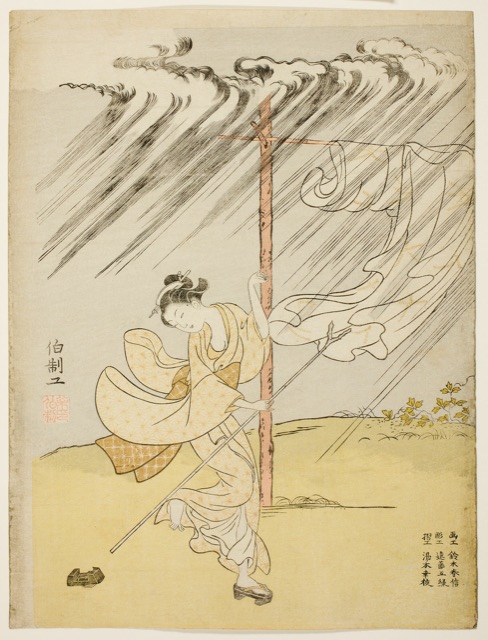
Look at the ground behind the running woman. One of her sandals lies there, lost as she hurries to pull the washing from the line. The rain is drawn as hard slanting lines, and the wind lifts her sleeves and the cloth above her. Suzuki Harunobu designed this print in seventeen sixty-five, the year full-colour printing began in Edo, the city we now call Tokyo.
A closer look
Look closely at the robe flying from the line. The pale marks scattered over it are numerals, worked into the pattern. In seventeen sixty-five, poetry circles in Edo commissioned picture calendars as gifts, and their designers competed to hide the numbers of the year’s long months inside the image. This sheet is one of them. At the left edge is the name of the patron who devised it. At the lower right, unusually, the designer, the block carver and the printer are each named. Calendars like this called for more colours and finer printing than anything sold in the shops. Within months the same workshops were selling prints made this way to the public, under the name brocade pictures. Suzuki Harunobu became their first master, and until his death five years later his slender figures set the fashion.
A sudden shower sends a young woman running to save the washing, and she loses a sandal on the way. This sheet was privately commissioned in 1765, the year in which Harunobu’s full-colour printing first appeared in Edo. Colour woodblock print, 28.8 × 21.7 cm.
Stop 2 of 7 · Torii Kiyonaga · c. 1787
Sudden Shower at Mimeguri Shrine
First Look
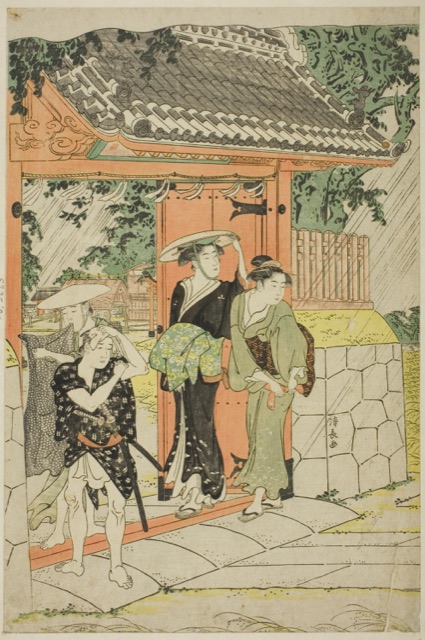
Look under the roof of the red gate, where the dry ground begins. Two women stand there, one still holding the brim of her hat. Two men are just arriving, and the one in front shields his head with both hands, his robe hitched up for running. This is the Mimeguri Shrine, beside the Sumida River in Edo. Torii Kiyonaga designed the scene around seventeen eighty-seven.
A closer look
Notice how tall these figures are. Kiyonaga drew the people of Edo long-limbed and unhurried, even in a downpour, and for a decade his way of drawing them was the fashion. This sheet is the left third of a larger picture. Two more sheets continued the scene to the right, with more people running for cover and, in the clouds above them, the spirits of the storm. The shrine was a real place on the east bank of the Sumida River, and it had a story attached. A century earlier a well known poet was said to have written a verse there asking for rain, and to have been answered the next day. Buyers of the print would have smiled at the joke: at Mimeguri, of all places, a sudden shower. Look at the stone wall at the right. The artist has signed it.
Caught by a cloudburst, passers-by crowd under the gate of the Mimeguri Shrine, beside the Sumida River. This is the left sheet of a three-sheet design. Kiyonaga’s tall, calm figures set the style for prints of fashionable Edo in the 1780s. Colour woodblock print, 37.9 × 25.1 cm.
Stop 3 of 7 · Tōshūsai Sharaku · 1794
The actor Otani Oniji III as Edobei
First Look
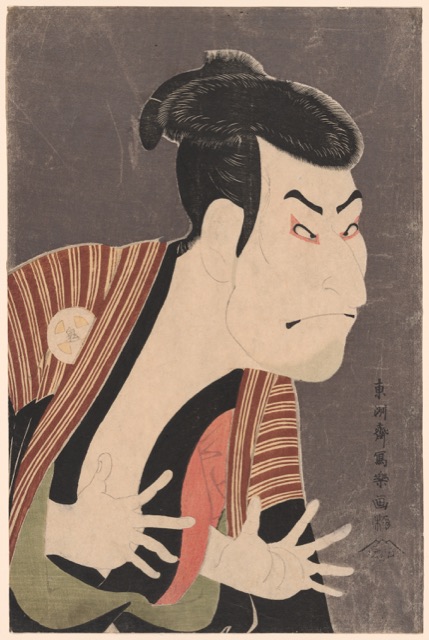
Look at the hands. They push out of the robe with the fingers spread wide, tense and oddly small beneath that face. This is the kabuki actor Otani Oniji the Third, on stage in seventeen ninety-four, playing a servant named Edobei at the moment he turns to violence. The artist, Sharaku, shows us the actor as much as the villain: the jutting jaw, the narrowed eyes, the thin line of the mouth.
A closer look
Notice the dark, flat ground behind the figure. It was printed with powdered mica, so that a fresh impression shimmered in lamplight and the actor seemed to lean out of it. The play was performed at the Kawarazaki theatre in Edo in the early summer of seventeen ninety-four. Edobei is a manservant sent to rob another man’s servant, and this is the instant before he strikes. Prints of actors were sold to theatre fans much as photographs of film stars would be later, and they usually flattered. Sharaku did not. He kept the lines of age and the strain of the pose. About one hundred and forty of his designs are known, all published within some ten months. Then they stop. Who he was has never been settled.
The kabuki actor Otani Oniji III plays Edobei, a servant about to commit a robbery, in a play staged in Edo in 1794. Sharaku’s actor portraits appeared over only about ten months, and nothing certain is known of his life. Colour woodblock print, 37.9 × 25 cm.
Stop 4 of 7 · Kitagawa Utamaro · c. 1795
Takashima Ohisa
First Look
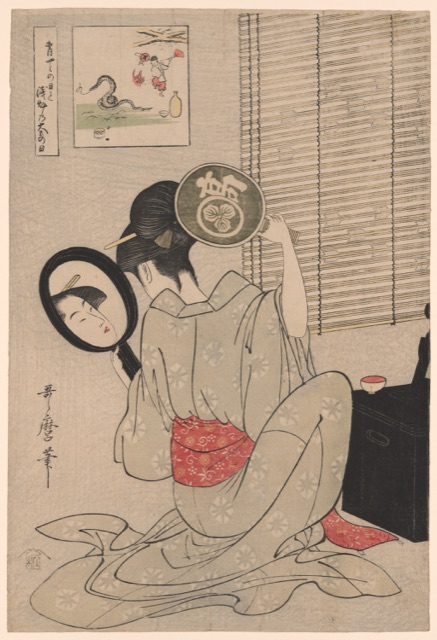
Look into the hand mirror at the lower left. That reflection is the only place we see this woman’s face. She is holding a second mirror behind her head to check the back of her hair, and Kitagawa Utamaro has drawn every strand at the nape of her neck. Her name was Ohisa. She worked at her family’s tea shop in Edo, and around seventeen ninety-five hers was one of the most famous faces in the city.
A closer look
Find the round mirror she is holding up behind her head. On its dark back is a crest of three oak leaves. Buyers of this print would have known it at once as the emblem of the Takashima family, and so known the sitter without reading a word. Ohisa was the daughter of a tea seller near the Ryogoku Bridge, and customers came to the shop as much to see her as to drink tea. Utamaro made her famous across Edo in a run of prints during the seventeen nineties. He was the leading designer of pictures of beautiful women in his time, and he brought the figure close, often showing only head and shoulders. Here he sets himself a harder problem: the same woman from behind and from the front at once. Notice the bamboo blind at the right, drawn slat by slat.
Ohisa, the daughter of a tea seller near the Ryogoku Bridge and one of the most admired young women in Edo, checks the back of her hair with two mirrors. Utamaro lets us see her face only as a reflection. Colour woodblock print, 38 × 25.8 cm.
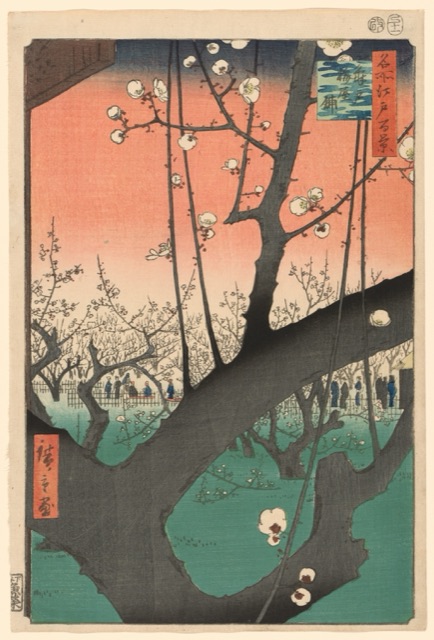
Stop 5 of 7 · Utagawa Hiroshige · 1857
Plum Garden at Kameido (Kameido Umeyashiki), from the series "One Hundred Famous Views of Edo (Meisho Edo hyakkei)"
First Look
Look past the dark branch to the small figures in the distance, strolling behind a low fence. Hiroshige has put us almost inside the tree, so close that its trunk blocks half the view. This was the most famous plum tree in Edo, nicknamed the Sleeping Dragon. The print was published in eighteen fifty-seven. Thirty years later, in Paris, Vincent van Gogh copied it in oil paint, red sky and all.
A closer look
Look at the sky and watch how the colour changes. Deep red at the top fades to white, and then to green at the ground. The printer produced these gradations by wiping pigment across the damp wooden block by hand before each impression, so no two sheets came out quite the same. The print belongs to One Hundred Famous Views of Edo, the last great series by Utagawa Hiroshige, published between eighteen fifty-six and eighteen fifty-eight, the year of his death. Many of its views place something large and close in front of a distant scene, as this branch is set against the garden. When Japanese prints reached Europe in numbers, painters there were struck by exactly that device. Van Gogh owned a copy of this design. In eighteen eighty-seven he traced it, enlarged it and painted it, adding a border of Japanese characters.
A dark branch of the most famous plum tree in Edo, known as the Sleeping Dragon, cuts across a red sky while visitors stroll behind a fence in the distance. Vincent van Gogh copied this print in oil paint in 1887. Colour woodblock print, 36 × 24.4 cm.
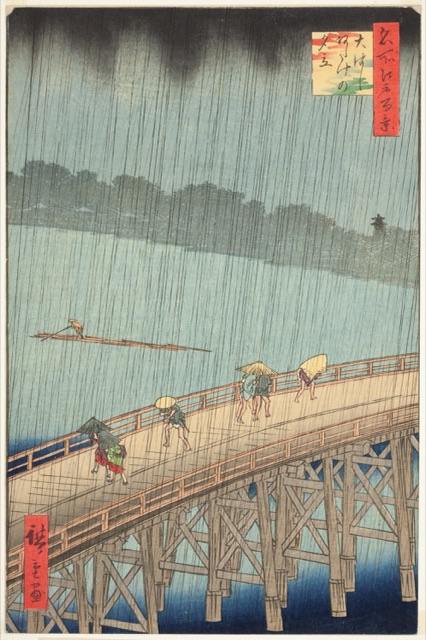
Stop 6 of 7 · Utagawa Hiroshige · 1857
Sudden Shower over Shin Ohashi Bridge and Atake (Ohashi Atake no yudachi), from the series "One Hundred Famous Views of Edo (Meisho Edo hyakkei)"
First Look
Look at the rain. It is printed as hundreds of thin dark lines, each one cut into a wooden block. Under them, six people on the bridge crouch beneath hats, a straw mat and an umbrella. Out on the river a lone boatman poles his raft through the storm. Utagawa Hiroshige published this view of the Sumida River in Edo in eighteen fifty-seven.
A closer look
Look up at the cloud along the top edge. Its dark, rolling outline was not cut into the block. The Art Institute notes that the printer wiped the ink on by hand in a scalloped shape, instead of the usual straight band, so the storm seems to boil downward. Now look across the water. The far bank, a district called Atake, is printed in soft grey with no outlines, as if seen through the rain. Hiroshige tilts the bridge one way and the shore the other, and that zigzag gives the small sheet its sense of space. Like the plum garden nearby, this design reached Paris within a generation. Vincent van Gogh painted a copy of it in eighteen eighty-seven, working out for himself how a picture could be built from flat colour and strong diagonals.
Six figures hurry across a wooden bridge over the Sumida River as a summer storm breaks, and a lone boatman poles a raft through the rain. The dark cloud at the top was wiped onto the block by hand for each impression. Colour woodblock print, 33.4 × 21.8 cm.
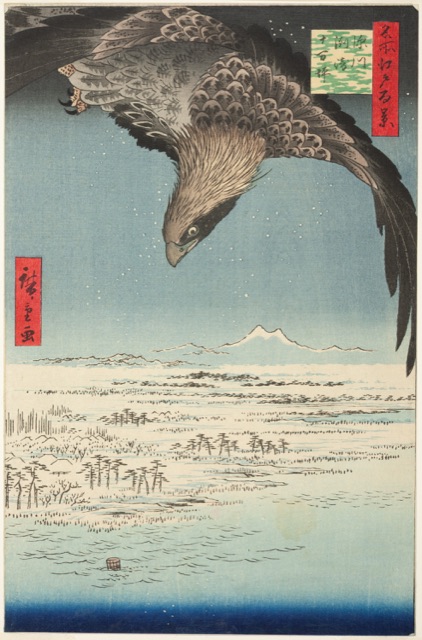
Stop 7 of 7 · Utagawa Hiroshige · 1857
Fukagawa Susaki and Jumantsubo (Fukagawa Susaki Jumantsubo), from the series "One Hundred Famous Views of Edo (Meisho Edo hyakkei)"
First Look
Look at the eagle’s eye, and then follow its gaze down to the frozen shore. The bird fills the top of the sheet, wings spread from edge to edge, and below it lies Edo Bay under snow. In eighteen fifty-seven nobody had seen the land from this height. Hiroshige imagined it. On the horizon, small and white, is the double peak of Mount Tsukuba.
A closer look
Find the small round object floating on the water near the bottom of the sheet. It is a wooden tub, adrift, and it may be what the eagle is watching. Everything else below is still: reeds, snow, the dark water of the bay. The place is Jumantsubo, reclaimed marshland on the eastern edge of Edo, and a bleak spot in winter. The print comes from One Hundred Famous Views of Edo, which Utagawa Hiroshige began in eighteen fifty-six, shortly after a great earthquake had damaged the city. Some historians read the whole series as a record of Edo rebuilt. Most of its views are gentle. This one is not, and it has long been among the best loved. Hiroshige died in eighteen fifty-eight, with the series still appearing.
An eagle hangs over the snow-covered shore of Edo Bay, its wings spanning the top of the sheet. Nobody in 1857 had seen the city from this height: Hiroshige imagined the view. Colour woodblock print, 33.3 × 22 cm.
1765A Young Woman in a Summer Shower
A sudden shower sends a young woman running to save the washing, and she loses a sandal on the way. This sheet was privately commissioned in 1765, the year in which Harunobu’s full-colour printing first appeared in Edo. Colour woodblock print, 28.8 × 21.7 cm.
c. 1787Sudden Shower at Mimeguri Shrine
Caught by a cloudburst, passers-by crowd under the gate of the Mimeguri Shrine, beside the Sumida River. This is the left sheet of a three-sheet design. Kiyonaga’s tall, calm figures set the style for prints of fashionable Edo in the 1780s. Colour woodblock print, 37.9 × 25.1 cm.
1794The actor Otani Oniji III as Edobei
The kabuki actor Otani Oniji III plays Edobei, a servant about to commit a robbery, in a play staged in Edo in 1794. Sharaku’s actor portraits appeared over only about ten months, and nothing certain is known of his life. Colour woodblock print, 37.9 × 25 cm.
c. 1795Takashima Ohisa
Ohisa, the daughter of a tea seller near the Ryogoku Bridge and one of the most admired young women in Edo, checks the back of her hair with two mirrors. Utamaro lets us see her face only as a reflection. Colour woodblock print, 38 × 25.8 cm.
1857Plum Garden at Kameido
A dark branch of the most famous plum tree in Edo, known as the Sleeping Dragon, cuts across a red sky while visitors stroll behind a fence in the distance. Vincent van Gogh copied this print in oil paint in 1887. Colour woodblock print, 36 × 24.4 cm.
1857Sudden Shower over Shin Ohashi Bridge and Atake
Six figures hurry across a wooden bridge over the Sumida River as a summer storm breaks, and a lone boatman poles a raft through the rain. The dark cloud at the top was wiped onto the block by hand for each impression. Colour woodblock print, 33.4 × 21.8 cm.
1857Fukagawa Susaki and Jumantsubo
An eagle hangs over the snow-covered shore of Edo Bay, its wings spanning the top of the sheet. Nobody in 1857 had seen the city from this height: Hiroshige imagined the view. Colour woodblock print, 33.3 × 22 cm.
Other exhibitions
The Sistine Chapel: Ceiling, Altar, and Wall Cycles
Michelangelo’s ceiling and Last Judgment alongside the fifteenth-century north and south wall narratives by Botticelli, Perugino, Ghirlandaio, Rosselli, and Signorelli.
1867–1893 · 7 worksImpressionism: Painters of Modern Life
Seven painters and seven views of modern France, 1867 to 1893: Monet, Renoir, Morisot, Caillebotte, Degas, Cassatt and Pissarro, from the Art Institute of Chicago.
1782–1893 · 6 worksFrom Edo to Paris: Ukiyo-e and the Impressionist Eye
How Japanese woodblock masters Hiroshige and Kiyonaga inspired the cropped framing, asymmetric diagonals, and rain-swept streets of Caillebotte, Degas, and Cassatt.
1653–1665 · 5 worksDutch Golden Age: Light and Likeness
Five paintings from the Dutch Republic, 1653 to about 1670: Rembrandt, Vermeer and Ruisdael, from The Metropolitan Museum of Art.