Takashima Ohisa
Stop 1 · First look
First Look
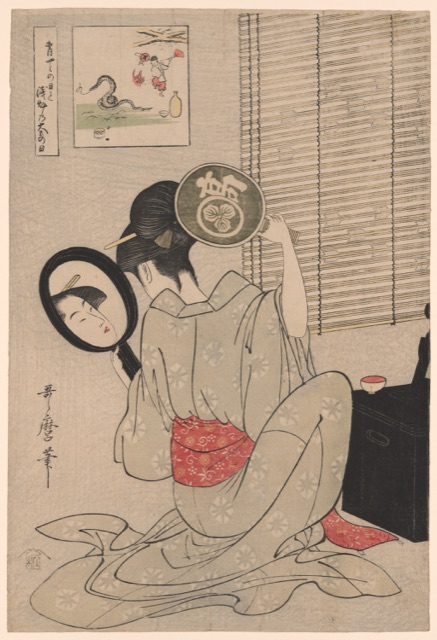
Look into the hand mirror at the lower left. That reflection is the only place we see this woman’s face. She is holding a second mirror behind her head to check the back of her hair, and Kitagawa Utamaro has drawn every strand at the nape of her neck. Her name was Ohisa. She worked at her family’s tea shop in Edo, and around seventeen ninety-five hers was one of the most famous faces in the city.
Stop 2 · Technique
Closer Reading
Find the round mirror she is holding up behind her head. On its dark back is a crest of three oak leaves. Buyers of this print would have known it at once as the emblem of the Takashima family, and so known the sitter without reading a word. Ohisa was the daughter of a tea seller near the Ryogoku Bridge, and customers came to the shop as much to see her as to drink tea. Utamaro made her famous across Edo in a run of prints during the seventeen nineties. He was the leading designer of pictures of beautiful women in his time, and he brought the figure close, often showing only head and shoulders. Here he sets himself a harder problem: the same woman from behind and from the front at once. Notice the bamboo blind at the right, drawn slat by slat.
Stop 3 · Museum record
Catalog Summary
Ohisa, the daughter of a tea seller near the Ryogoku Bridge and one of the most admired young women in Edo, checks the back of her hair with two mirrors. Utamaro lets us see her face only as a reflection. Colour woodblock print, 38 × 25.8 cm.
Recorded physical scale: 25.8 × 38.0 cm (10.2 × 15.0 in · 0.26 × 0.38 m).
Stop 4 · Historical Context
Kitagawa Utamaro (c. 1753–1806)
Edo print designer best known for close-up portraits of women and scenes of their daily lives, later much admired by artists in Paris.
Ukiyo-e (17th to 19th century (the Edo period)): Japanese pictures of the floating world: paintings and, above all, woodblock prints of actors, beauties and landscapes made for townspeople in the Edo period.
First Look
Look into the hand mirror at the lower left. That reflection is the only place we see this woman’s face. She is holding a second mirror behind her head to check the back of her hair, and Kitagawa Utamaro has drawn every strand at the nape of her neck. Her name was Ohisa. She worked at her family’s tea shop in Edo, and around seventeen ninety-five hers was one of the most famous faces in the city.
Closer Reading
Find the round mirror she is holding up behind her head. On its dark back is a crest of three oak leaves. Buyers of this print would have known it at once as the emblem of the Takashima family, and so known the sitter without reading a word. Ohisa was the daughter of a tea seller near the Ryogoku Bridge, and customers came to the shop as much to see her as to drink tea. Utamaro made her famous across Edo in a run of prints during the seventeen nineties. He was the leading designer of pictures of beautiful women in his time, and he brought the figure close, often showing only head and shoulders. Here he sets himself a harder problem: the same woman from behind and from the front at once. Notice the bamboo blind at the right, drawn slat by slat.
Catalog Summary
Ohisa, the daughter of a tea seller near the Ryogoku Bridge and one of the most admired young women in Edo, checks the back of her hair with two mirrors. Utamaro lets us see her face only as a reflection. Colour woodblock print, 38 × 25.8 cm.
About the Artist
Kitagawa Utamaro (c. 1753–1806)
Little is recorded about Kitagawa Utamaro's life, and even his birth year, about 1753, is approximate. He began to study painting early, in the studio of Toriyama Sekien. Through Sekien he met Tsutaya Jūzaburō, a leading publisher in Edo, now Tokyo, who also published Tōshūsai Sharaku.
Utamaro began with illustrations for books of comic verse. The Insect Book of 1788 sets love poems beside finely printed insects and flowers. He then turned to women, and in the 1790s he was at his peak. He introduced portraits that show only the head and upper body, often against a plain ground that shines with powdered mica. He followed the courtesans of the Yoshiwara pleasure district through the hours of the day, and he also drew mothers with children and women cooking or combing their hair.
He is said to have been jailed for three days and handcuffed for fifty in 1804. He died in Edo in 1806. Late in the century his prints were in great demand in Paris, where Mary Cassatt was among the artists who admired them.