Sudden Shower at Mimeguri Shrine
Stop 1 · First look
First Look
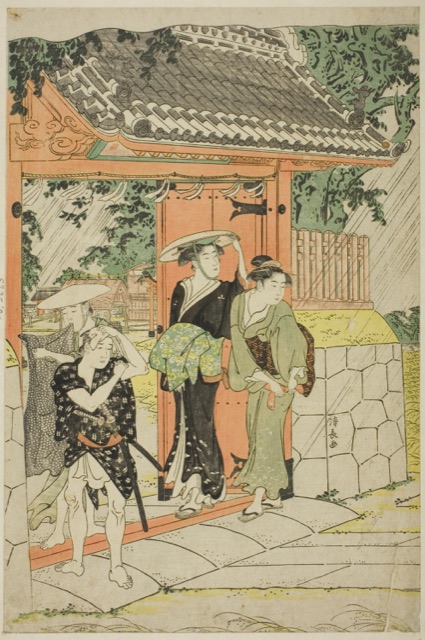
Look under the roof of the red gate, where the dry ground begins. Two women stand there, one still holding the brim of her hat. Two men are just arriving, and the one in front shields his head with both hands, his robe hitched up for running. This is the Mimeguri Shrine, beside the Sumida River in Edo. Torii Kiyonaga designed the scene around seventeen eighty-seven.
Stop 2 · Technique
Closer Reading
Notice how tall these figures are. Kiyonaga drew the people of Edo long-limbed and unhurried, even in a downpour, and for a decade his way of drawing them was the fashion. This sheet is the left third of a larger picture. Two more sheets continued the scene to the right, with more people running for cover and, in the clouds above them, the spirits of the storm. The shrine was a real place on the east bank of the Sumida River, and it had a story attached. A century earlier a well known poet was said to have written a verse there asking for rain, and to have been answered the next day. Buyers of the print would have smiled at the joke: at Mimeguri, of all places, a sudden shower. Look at the stone wall at the right. The artist has signed it.
Stop 3 · Museum record
Catalog Summary
Caught by a cloudburst, passers-by crowd under the gate of the Mimeguri Shrine, beside the Sumida River. This is the left sheet of a three-sheet design. Kiyonaga’s tall, calm figures set the style for prints of fashionable Edo in the 1780s. Colour woodblock print, 37.9 × 25.1 cm.
Recorded physical scale: 25.1 × 37.9 cm (9.9 × 14.9 in · 0.25 × 0.38 m).
Stop 4 · Historical Context
Torii Kiyonaga (1752–1815)
Edo print designer of the 1780s whose tall, calm figures on city outings set the look of Japanese prints for a decade.
Ukiyo-e (17th to 19th century (the Edo period)): Japanese pictures of the floating world: paintings and, above all, woodblock prints of actors, beauties and landscapes made for townspeople in the Edo period.
First Look
Look under the roof of the red gate, where the dry ground begins. Two women stand there, one still holding the brim of her hat. Two men are just arriving, and the one in front shields his head with both hands, his robe hitched up for running. This is the Mimeguri Shrine, beside the Sumida River in Edo. Torii Kiyonaga designed the scene around seventeen eighty-seven.
Closer Reading
Notice how tall these figures are. Kiyonaga drew the people of Edo long-limbed and unhurried, even in a downpour, and for a decade his way of drawing them was the fashion. This sheet is the left third of a larger picture. Two more sheets continued the scene to the right, with more people running for cover and, in the clouds above them, the spirits of the storm. The shrine was a real place on the east bank of the Sumida River, and it had a story attached. A century earlier a well known poet was said to have written a verse there asking for rain, and to have been answered the next day. Buyers of the print would have smiled at the joke: at Mimeguri, of all places, a sudden shower. Look at the stone wall at the right. The artist has signed it.
Catalog Summary
Caught by a cloudburst, passers-by crowd under the gate of the Mimeguri Shrine, beside the Sumida River. This is the left sheet of a three-sheet design. Kiyonaga’s tall, calm figures set the style for prints of fashionable Edo in the 1780s. Colour woodblock print, 37.9 × 25.1 cm.
About the Artist
Torii Kiyonaga (1752–1815)
Torii Kiyonaga was born in 1752 and trained under Torii Kiyomitsu of the Torii school in Edo, now Tokyo. The Torii family specialised in pictures for the Kabuki theatre, and Kiyonaga made actor portraits, stage scenes and cast lists. He is best known, though, for prints of fashionable women.
His early prints follow older designers, including Isoda Koryūsai and Suzuki Harunobu, whose set of eight parlour scenes he answered with a series of his own. In the 1780s he found his own manner: tall, long-limbed figures with a calm, grown-up air, shown on outings and at home. He often spread one scene across two or three large sheets to make a single wide view. A Brocade of Eastern Manners and Twelve Months in the South date from about 1783 to 1784. In those years his style led the field.
Kiyonaga also painted, though only about twenty of his paintings survive. He died in Edo in 1815.