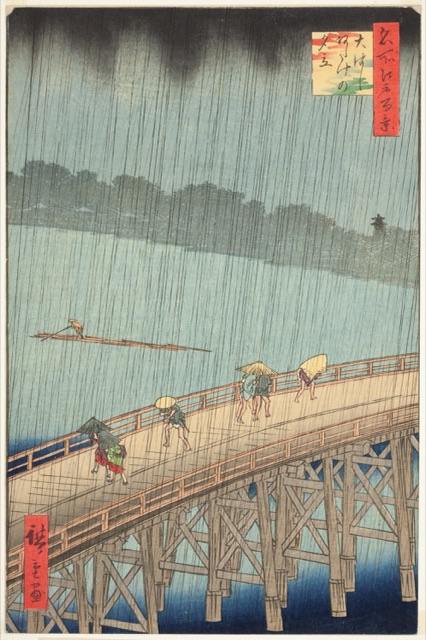
Sudden Shower over Shin Ohashi Bridge and Atake (Ohashi Atake no yudachi), from the series "One Hundred Famous Views of Edo (Meisho Edo hyakkei)"
Stop 1 · First look
First Look
Look at the rain. It is printed as hundreds of thin dark lines, each one cut into a wooden block. Under them, six people on the bridge crouch beneath hats, a straw mat and an umbrella. Out on the river a lone boatman poles his raft through the storm. Utagawa Hiroshige published this view of the Sumida River in Edo in eighteen fifty-seven.
Stop 2 · Technique
Closer Reading
Look up at the cloud along the top edge. Its dark, rolling outline was not cut into the block. The Art Institute notes that the printer wiped the ink on by hand in a scalloped shape, instead of the usual straight band, so the storm seems to boil downward. Now look across the water. The far bank, a district called Atake, is printed in soft grey with no outlines, as if seen through the rain. Hiroshige tilts the bridge one way and the shore the other, and that zigzag gives the small sheet its sense of space. Like the plum garden nearby, this design reached Paris within a generation. Vincent van Gogh painted a copy of it in eighteen eighty-seven, working out for himself how a picture could be built from flat colour and strong diagonals.
Stop 3 · Museum record
Catalog Summary
Six figures hurry across a wooden bridge over the Sumida River as a summer storm breaks, and a lone boatman poles a raft through the rain. The dark cloud at the top was wiped onto the block by hand for each impression. Colour woodblock print, 33.4 × 21.8 cm.
Recorded physical scale: 21.8 × 33.4 cm (8.6 × 13.1 in · 0.22 × 0.33 m).
Stop 4 · Historical Context
Utagawa Hiroshige (1797–1858)
Edo landscape print designer whose views of roads, rain, snow and city life were copied by Vincent van Gogh and admired across Europe.
Ukiyo-e (17th to 19th century (the Edo period)): Japanese pictures of the floating world: paintings and, above all, woodblock prints of actors, beauties and landscapes made for townspeople in the Edo period.
First Look
Look at the rain. It is printed as hundreds of thin dark lines, each one cut into a wooden block. Under them, six people on the bridge crouch beneath hats, a straw mat and an umbrella. Out on the river a lone boatman poles his raft through the storm. Utagawa Hiroshige published this view of the Sumida River in Edo in eighteen fifty-seven.
Closer Reading
Look up at the cloud along the top edge. Its dark, rolling outline was not cut into the block. The Art Institute notes that the printer wiped the ink on by hand in a scalloped shape, instead of the usual straight band, so the storm seems to boil downward. Now look across the water. The far bank, a district called Atake, is printed in soft grey with no outlines, as if seen through the rain. Hiroshige tilts the bridge one way and the shore the other, and that zigzag gives the small sheet its sense of space. Like the plum garden nearby, this design reached Paris within a generation. Vincent van Gogh painted a copy of it in eighteen eighty-seven, working out for himself how a picture could be built from flat colour and strong diagonals.
Catalog Summary
Six figures hurry across a wooden bridge over the Sumida River as a summer storm breaks, and a lone boatman poles a raft through the rain. The dark cloud at the top was wiped onto the block by hand for each impression. Colour woodblock print, 33.4 × 21.8 cm.
About the Artist
Utagawa Hiroshige (1797–1858)
Utagawa Hiroshige was born in Edo, now Tokyo, in 1797. He was orphaned at twelve and soon began to study with Toyohiro of the Utagawa school. His early work includes tall, narrow landscapes and small pictures of birds on flowering branches.
Landscape became his subject. Partly inspired by Katsushika Hokusai's popular Thirty-Six Views of Mount Fuji, he made Fifty-Three Stations of the Tōkaidō (1833 to 1834), which follows the coast road between Edo and Kyoto. His approach is softer than Hokusai's: traders and farmers go about their day in mist, rain or snow. His prints are known for bokashi, colour that fades smoothly from dark to pale.
In 1856 he became a Buddhist monk and began One Hundred Famous Views of Edo, which occupied him until he died in 1858. He designed thousands of prints. In Paris in 1887 Vincent van Gogh painted copies of two views from that series, a plum orchard and a bridge in the rain, with stronger colours than the originals.