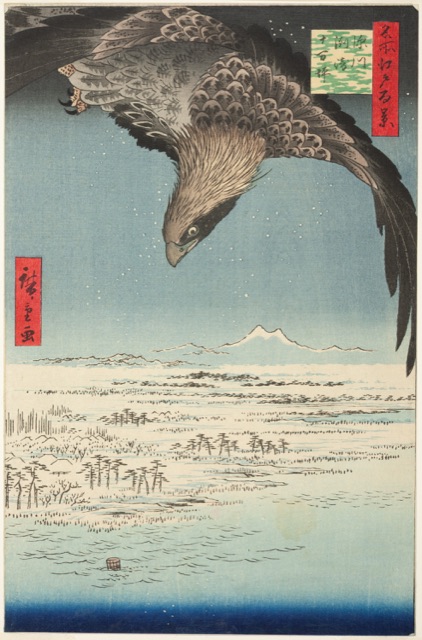
Fukagawa Susaki and Jumantsubo (Fukagawa Susaki Jumantsubo), from the series "One Hundred Famous Views of Edo (Meisho Edo hyakkei)"
Stop 1 · First look
First Look
Look at the eagle’s eye, and then follow its gaze down to the frozen shore. The bird fills the top of the sheet, wings spread from edge to edge, and below it lies Edo Bay under snow. In eighteen fifty-seven nobody had seen the land from this height. Hiroshige imagined it. On the horizon, small and white, is the double peak of Mount Tsukuba.
Stop 2 · Technique
Closer Reading
Find the small round object floating on the water near the bottom of the sheet. It is a wooden tub, adrift, and it may be what the eagle is watching. Everything else below is still: reeds, snow, the dark water of the bay. The place is Jumantsubo, reclaimed marshland on the eastern edge of Edo, and a bleak spot in winter. The print comes from One Hundred Famous Views of Edo, which Utagawa Hiroshige began in eighteen fifty-six, shortly after a great earthquake had damaged the city. Some historians read the whole series as a record of Edo rebuilt. Most of its views are gentle. This one is not, and it has long been among the best loved. Hiroshige died in eighteen fifty-eight, with the series still appearing.
Stop 3 · Museum record
Catalog Summary
An eagle hangs over the snow-covered shore of Edo Bay, its wings spanning the top of the sheet. Nobody in 1857 had seen the city from this height: Hiroshige imagined the view. Colour woodblock print, 33.3 × 22 cm.
Recorded physical scale: 22.0 × 33.3 cm (8.7 × 13.1 in · 0.22 × 0.33 m).
Stop 4 · Historical Context
Utagawa Hiroshige (1797–1858)
Edo landscape print designer whose views of roads, rain, snow and city life were copied by Vincent van Gogh and admired across Europe.
Ukiyo-e (17th to 19th century (the Edo period)): Japanese pictures of the floating world: paintings and, above all, woodblock prints of actors, beauties and landscapes made for townspeople in the Edo period.
First Look
Look at the eagle’s eye, and then follow its gaze down to the frozen shore. The bird fills the top of the sheet, wings spread from edge to edge, and below it lies Edo Bay under snow. In eighteen fifty-seven nobody had seen the land from this height. Hiroshige imagined it. On the horizon, small and white, is the double peak of Mount Tsukuba.
Closer Reading
Find the small round object floating on the water near the bottom of the sheet. It is a wooden tub, adrift, and it may be what the eagle is watching. Everything else below is still: reeds, snow, the dark water of the bay. The place is Jumantsubo, reclaimed marshland on the eastern edge of Edo, and a bleak spot in winter. The print comes from One Hundred Famous Views of Edo, which Utagawa Hiroshige began in eighteen fifty-six, shortly after a great earthquake had damaged the city. Some historians read the whole series as a record of Edo rebuilt. Most of its views are gentle. This one is not, and it has long been among the best loved. Hiroshige died in eighteen fifty-eight, with the series still appearing.
Catalog Summary
An eagle hangs over the snow-covered shore of Edo Bay, its wings spanning the top of the sheet. Nobody in 1857 had seen the city from this height: Hiroshige imagined the view. Colour woodblock print, 33.3 × 22 cm.
About the Artist
Utagawa Hiroshige (1797–1858)
Utagawa Hiroshige was born in Edo, now Tokyo, in 1797. He was orphaned at twelve and soon began to study with Toyohiro of the Utagawa school. His early work includes tall, narrow landscapes and small pictures of birds on flowering branches.
Landscape became his subject. Partly inspired by Katsushika Hokusai's popular Thirty-Six Views of Mount Fuji, he made Fifty-Three Stations of the Tōkaidō (1833 to 1834), which follows the coast road between Edo and Kyoto. His approach is softer than Hokusai's: traders and farmers go about their day in mist, rain or snow. His prints are known for bokashi, colour that fades smoothly from dark to pale.
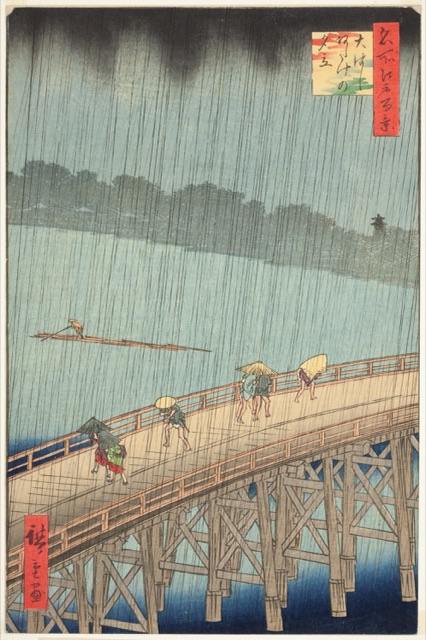
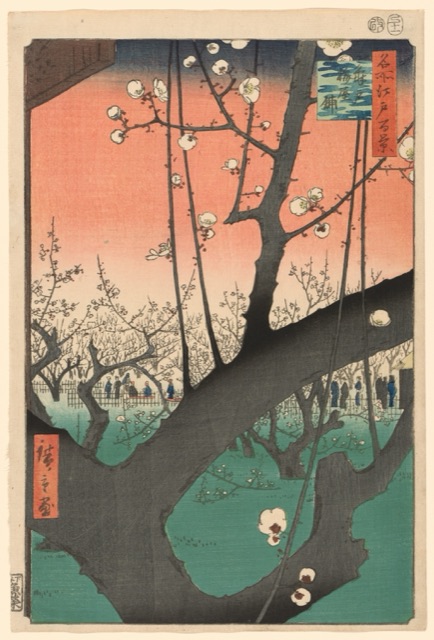
In 1856 he became a Buddhist monk and began One Hundred Famous Views of Edo, which occupied him until he died in 1858. He designed thousands of prints. In Paris in 1887 Vincent van Gogh painted copies of two views from that series, a plum orchard and a bridge in the rain, with stronger colours than the originals.