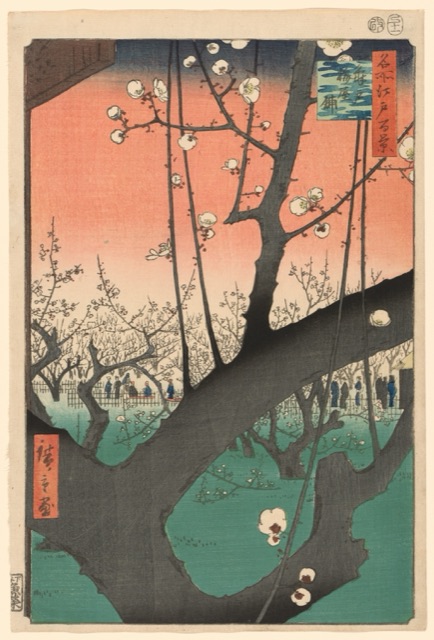
Plum Garden at Kameido (Kameido Umeyashiki), from the series "One Hundred Famous Views of Edo (Meisho Edo hyakkei)"
Stop 1 · First look
First Look
Look past the dark branch to the small figures in the distance, strolling behind a low fence. Hiroshige has put us almost inside the tree, so close that its trunk blocks half the view. This was the most famous plum tree in Edo, nicknamed the Sleeping Dragon. The print was published in eighteen fifty-seven. Thirty years later, in Paris, Vincent van Gogh copied it in oil paint, red sky and all.
Stop 2 · Technique
Closer Reading
Look at the sky and watch how the colour changes. Deep red at the top fades to white, and then to green at the ground. The printer produced these gradations by wiping pigment across the damp wooden block by hand before each impression, so no two sheets came out quite the same. The print belongs to One Hundred Famous Views of Edo, the last great series by Utagawa Hiroshige, published between eighteen fifty-six and eighteen fifty-eight, the year of his death. Many of its views place something large and close in front of a distant scene, as this branch is set against the garden. When Japanese prints reached Europe in numbers, painters there were struck by exactly that device. Van Gogh owned a copy of this design. In eighteen eighty-seven he traced it, enlarged it and painted it, adding a border of Japanese characters.
Stop 3 · Museum record
Catalog Summary
A dark branch of the most famous plum tree in Edo, known as the Sleeping Dragon, cuts across a red sky while visitors stroll behind a fence in the distance. Vincent van Gogh copied this print in oil paint in 1887. Colour woodblock print, 36 × 24.4 cm.
Recorded physical scale: 24.4 × 36.0 cm (9.6 × 14.2 in · 0.24 × 0.36 m).
Stop 4 · Historical Context
Utagawa Hiroshige (1797–1858)
Edo landscape print designer whose views of roads, rain, snow and city life were copied by Vincent van Gogh and admired across Europe.
Ukiyo-e (17th to 19th century (the Edo period)): Japanese pictures of the floating world: paintings and, above all, woodblock prints of actors, beauties and landscapes made for townspeople in the Edo period.
First Look
Look past the dark branch to the small figures in the distance, strolling behind a low fence. Hiroshige has put us almost inside the tree, so close that its trunk blocks half the view. This was the most famous plum tree in Edo, nicknamed the Sleeping Dragon. The print was published in eighteen fifty-seven. Thirty years later, in Paris, Vincent van Gogh copied it in oil paint, red sky and all.
Closer Reading
Look at the sky and watch how the colour changes. Deep red at the top fades to white, and then to green at the ground. The printer produced these gradations by wiping pigment across the damp wooden block by hand before each impression, so no two sheets came out quite the same. The print belongs to One Hundred Famous Views of Edo, the last great series by Utagawa Hiroshige, published between eighteen fifty-six and eighteen fifty-eight, the year of his death. Many of its views place something large and close in front of a distant scene, as this branch is set against the garden. When Japanese prints reached Europe in numbers, painters there were struck by exactly that device. Van Gogh owned a copy of this design. In eighteen eighty-seven he traced it, enlarged it and painted it, adding a border of Japanese characters.
Catalog Summary
A dark branch of the most famous plum tree in Edo, known as the Sleeping Dragon, cuts across a red sky while visitors stroll behind a fence in the distance. Vincent van Gogh copied this print in oil paint in 1887. Colour woodblock print, 36 × 24.4 cm.
About the Artist
Utagawa Hiroshige (1797–1858)
Utagawa Hiroshige was born in Edo, now Tokyo, in 1797. He was orphaned at twelve and soon began to study with Toyohiro of the Utagawa school. His early work includes tall, narrow landscapes and small pictures of birds on flowering branches.
Landscape became his subject. Partly inspired by Katsushika Hokusai's popular Thirty-Six Views of Mount Fuji, he made Fifty-Three Stations of the Tōkaidō (1833 to 1834), which follows the coast road between Edo and Kyoto. His approach is softer than Hokusai's: traders and farmers go about their day in mist, rain or snow. His prints are known for bokashi, colour that fades smoothly from dark to pale.
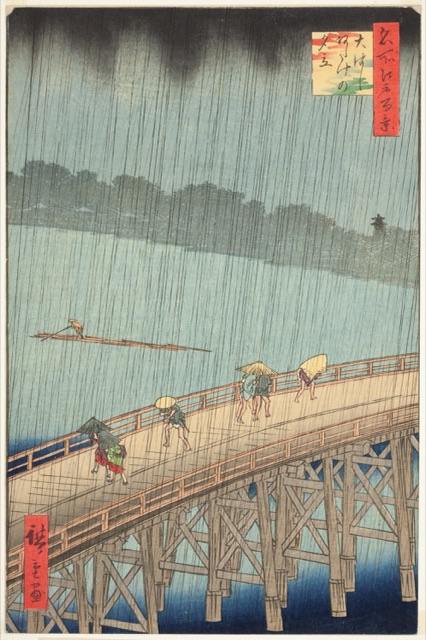
In 1856 he became a Buddhist monk and began One Hundred Famous Views of Edo, which occupied him until he died in 1858. He designed thousands of prints. In Paris in 1887 Vincent van Gogh painted copies of two views from that series, a plum orchard and a bridge in the rain, with stronger colours than the originals.