Paris Street; Rainy Day
Stop 1 · First look
First Look
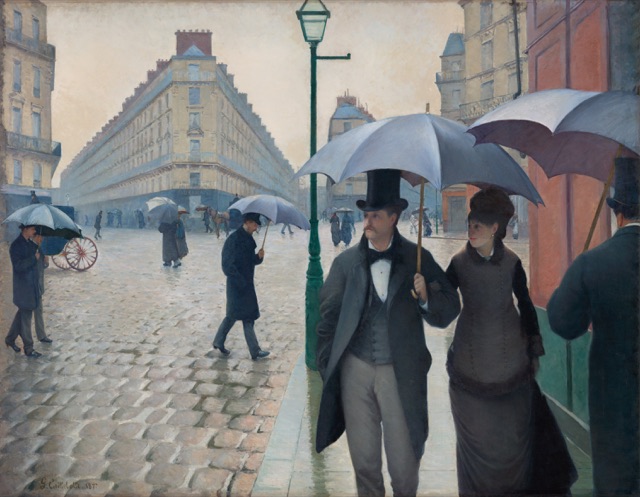
Look down, at the cobblestones. Gustave Caillebotte painted no falling rain in this picture. You know the weather from the umbrellas, and from the light lying on the wet stone. This is Paris in eighteen seventy-seven, at a broad new intersection a short walk from the painter’s home. The canvas is almost three metres wide. Stand where you are, and the couple on the right seem about to walk past you.
Stop 2 · Technique
Closer Reading
Find the green lamp post in the middle of the painting. It divides the canvas almost exactly in half. On the left are open street and distant walkers. On the right are three figures so close that one is cut off by the frame. The Art Institute suggests that this abrupt cropping may owe something to photography, which was then becoming popular. The streets themselves were new. A rebuilding of Paris lasting decades had replaced narrow medieval lanes with long, straight boulevards like these, and the retractable umbrella was a recent invention. Caillebotte showed the painting at the third Impressionist exhibition, in eighteen seventy-seven, which he also helped to pay for. His brushwork is smoother than his friends’, but the subject is theirs: an ordinary moment in the modern city. Look at the couple once more. They are both glancing at something we cannot see.
Stop 3 · Museum record
Catalog Summary
Caillebotte’s largest painting shows a broad new intersection in Paris, a short walk from his home. No raindrops are painted: the weather is told by the umbrellas and by the sheen on the cobblestones. Oil on canvas, 212.2 × 276.2 cm.
Recorded physical scale: 276.2 × 212.2 cm (108.7 × 83.5 in · 2.76 × 2.12 m).
Stop 4 · Historical Context
Gustave Caillebotte (1848–1894)
Paris painter of modern city streets who also organised and funded Impressionist exhibitions and collected his friends' paintings.
Impressionism (1860s to 1880s): A French way of painting modern life and landscape quickly, often outdoors, with broken touches of bright colour that catch passing effects of light.
First Look
Look down, at the cobblestones. Gustave Caillebotte painted no falling rain in this picture. You know the weather from the umbrellas, and from the light lying on the wet stone. This is Paris in eighteen seventy-seven, at a broad new intersection a short walk from the painter’s home. The canvas is almost three metres wide. Stand where you are, and the couple on the right seem about to walk past you.
Closer Reading
Find the green lamp post in the middle of the painting. It divides the canvas almost exactly in half. On the left are open street and distant walkers. On the right are three figures so close that one is cut off by the frame. The Art Institute suggests that this abrupt cropping may owe something to photography, which was then becoming popular. The streets themselves were new. A rebuilding of Paris lasting decades had replaced narrow medieval lanes with long, straight boulevards like these, and the retractable umbrella was a recent invention. Caillebotte showed the painting at the third Impressionist exhibition, in eighteen seventy-seven, which he also helped to pay for. His brushwork is smoother than his friends’, but the subject is theirs: an ordinary moment in the modern city. Look at the couple once more. They are both glancing at something we cannot see.
Catalog Summary
Caillebotte’s largest painting shows a broad new intersection in Paris, a short walk from his home. No raindrops are painted: the weather is told by the umbrellas and by the sheen on the cobblestones. Oil on canvas, 212.2 × 276.2 cm.
About the Artist
Gustave Caillebotte (1848–1894)
Gustave Caillebotte was born in Paris in 1848 into a wealthy family. He took a law degree in 1870, was called up in the Franco-Prussian War, and afterwards studied painting at the École des Beaux-Arts. When the official Salon turned down his Floor Scrapers, he joined the Impressionists, showing with them from 1876.
Caillebotte painted the modern Paris of broad streets, bridges and balconies, in a sharper, more exact manner than his friends. His views are often cut off at the edges like a photograph. Paris Street; Rainy Day, his best-known picture, hung in the 1877 Impressionist exhibition, which he largely ran: he rented the rooms, chose artists and helped hang the pictures.
His money let him buy the work of struggling friends, Claude Monet among them. He left his collection, with pictures by Monet, Renoir, Degas, Cézanne and Pissarro, to the French state, which accepted only part of it. In his last years he gardened and designed racing yachts at Petit-Gennevilliers on the Seine. He died in 1894, aged 45.