The Millinery Shop
Stop 1 · First look
First Look
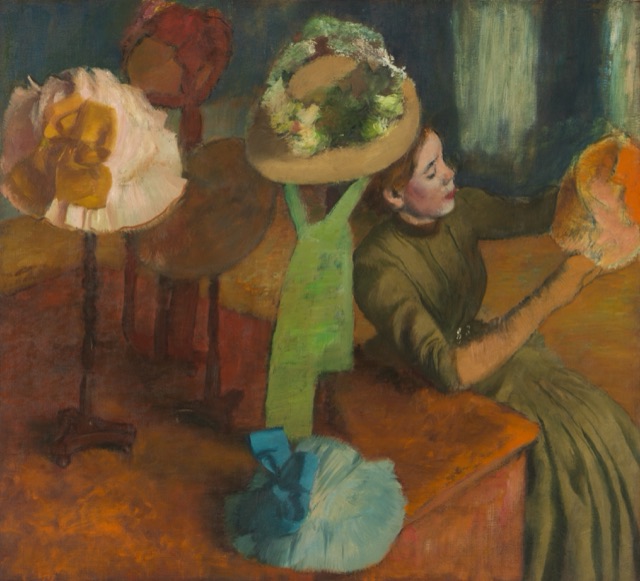
Look at the hat with the green trimmings, just above the woman’s head. It is on a stand behind her, but Edgar Degas has placed it so that it seems to be hers. She is absorbed in another hat, held up in her gloved hands. We see her from above and a little to one side, as if we had just stopped at the counter. Degas worked on this painting between eighteen seventy-nine and eighteen eighty-six.
Stop 2 · Technique
Closer Reading
Count the hats. There are six, on stands at different heights, and together they take up more of the canvas than the woman does. Degas made many drawings and pastels for this one figure, adjusting her pose and her clothes. The Art Institute points to a small uncertainty he left in place. Hat making was a respected trade that could raise a young woman’s standing, and her green dress and long gloves would suit a customer as well as an employee. A lady of the time would be wearing a hat of her own. She is not, so Degas lets one from the display hover over her. Is she buying, or working? The steep view from above and the table sliced by the frame make us feel we have only just walked up. Look at the ribbons. A few quick strokes, left almost unfinished.
Stop 3 · Museum record
Catalog Summary
The largest of Degas’s paintings of milliners looks down on a young woman studying a hat among the shop’s displays. Degas placed a second hat, trimmed in green, so that it seems to sit on her own head. Oil on canvas, 100 × 110.7 cm.
Recorded physical scale: 110.7 × 100.0 cm (43.6 × 39.4 in · 1.11 × 1.00 m).
Stop 4 · Historical Context
Edgar Degas (1834–1917)
French painter, pastel artist and sculptor who showed with the Impressionists but worked indoors, studying dancers, racehorses and bathers.
Impressionism (1860s to 1880s): A French way of painting modern life and landscape quickly, often outdoors, with broken touches of bright colour that catch passing effects of light.
First Look
Look at the hat with the green trimmings, just above the woman’s head. It is on a stand behind her, but Edgar Degas has placed it so that it seems to be hers. She is absorbed in another hat, held up in her gloved hands. We see her from above and a little to one side, as if we had just stopped at the counter. Degas worked on this painting between eighteen seventy-nine and eighteen eighty-six.
Closer Reading
Count the hats. There are six, on stands at different heights, and together they take up more of the canvas than the woman does. Degas made many drawings and pastels for this one figure, adjusting her pose and her clothes. The Art Institute points to a small uncertainty he left in place. Hat making was a respected trade that could raise a young woman’s standing, and her green dress and long gloves would suit a customer as well as an employee. A lady of the time would be wearing a hat of her own. She is not, so Degas lets one from the display hover over her. Is she buying, or working? The steep view from above and the table sliced by the frame make us feel we have only just walked up. Look at the ribbons. A few quick strokes, left almost unfinished.
Catalog Summary
The largest of Degas’s paintings of milliners looks down on a young woman studying a hat among the shop’s displays. Degas placed a second hat, trimmed in green, so that it seems to sit on her own head. Oil on canvas, 100 × 110.7 cm.
About the Artist
Edgar Degas (1834–1917)
Edgar Degas was born in Paris in 1834, the eldest son of a wealthy family. He gave up law to study art, trained under Louis Lamothe, a follower of the painter Ingres, and spent the years 1856 to 1859 in Italy copying Renaissance pictures. Back in Paris he came to know Édouard Manet and turned to scenes of modern life.
Degas showed with the Impressionists from their first exhibition in 1874 and in seven of the eight, yet he called himself a realist and had no interest in painting landscapes outdoors. He worked in the studio, returning for decades to ballet dancers, racehorses, café singers, milliners and women washing. His views are cut off at unexpected angles, a habit linked to photography, which he practised, and to the Japanese prints he collected. He mixed methods freely: pastel over one-off prints called monotypes, and modelled figures such as Little Dancer Aged Fourteen.
He was a close friend of Mary Cassatt and introduced her to printmaking. His sight grew worse with age. He died in Paris in 1917.