The Child's Bath
Stop 1 · First look
First Look
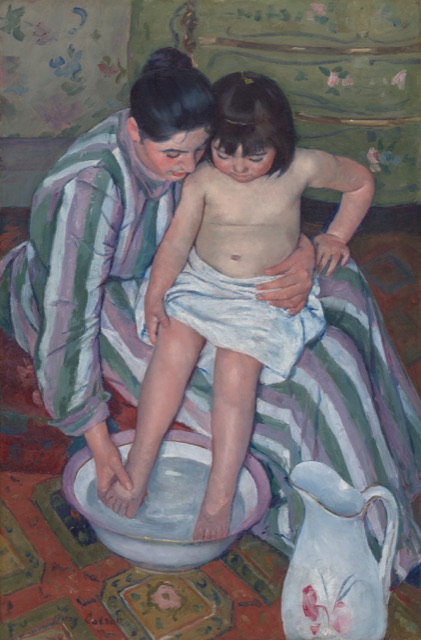
Look at the basin, and at the two hands meeting in the water. The woman’s hand is closed around the child’s foot, and both of them are looking down at the same spot. Mary Cassatt painted this in eighteen ninety-three. We see the pair from above, so the patterned carpet seems to stand upright behind them. Stripes, flowers and carpet press close on every side, and the child’s bare skin is the one plain surface.
Stop 2 · Technique
Closer Reading
Step back and take in the angle. We are looking almost straight down, as if standing over the two figures, and the floor tilts up towards us like a wall. The Art Institute traces this to Cassatt’s close study of Japanese woodblock prints in the eighteen nineties: the high viewpoint, the strong outlines, the cropped shapes, and the pleasure in pattern set against pattern. Cassatt was born in Pennsylvania and settled in Paris, and she was the only American invited to exhibit with the original Impressionist group. Women caring for children became her best known subject, and she painted it without sweetness. Nothing here is posed for us. The Art Institute bought this canvas in nineteen ten, the first of her works to enter its collection. Look at the jug in the corner. Its painted flowers are among the few loose, soft passages in a very firmly built picture.
Stop 3 · Museum record
Catalog Summary
A woman steadies a child on her lap and washes one small foot in a basin. Cassatt, the only American invited to exhibit with the French Impressionists, sets the scene steeply from above and fills it with pattern, lessons she drew from Japanese woodblock prints. Oil on canvas, 101.3 × 67.3 cm.
Recorded physical scale: 67.3 × 101.3 cm (26.5 × 39.9 in · 0.67 × 1.01 m).
Stop 4 · Historical Context
Mary Cassatt (1844–1926)
American painter and printmaker in Paris, the only American to show with the Impressionists, known for close studies of women and children.
Impressionism (1860s to 1880s): A French way of painting modern life and landscape quickly, often outdoors, with broken touches of bright colour that catch passing effects of light.
First Look
Look at the basin, and at the two hands meeting in the water. The woman’s hand is closed around the child’s foot, and both of them are looking down at the same spot. Mary Cassatt painted this in eighteen ninety-three. We see the pair from above, so the patterned carpet seems to stand upright behind them. Stripes, flowers and carpet press close on every side, and the child’s bare skin is the one plain surface.
Closer Reading
Step back and take in the angle. We are looking almost straight down, as if standing over the two figures, and the floor tilts up towards us like a wall. The Art Institute traces this to Cassatt’s close study of Japanese woodblock prints in the eighteen nineties: the high viewpoint, the strong outlines, the cropped shapes, and the pleasure in pattern set against pattern. Cassatt was born in Pennsylvania and settled in Paris, and she was the only American invited to exhibit with the original Impressionist group. Women caring for children became her best known subject, and she painted it without sweetness. Nothing here is posed for us. The Art Institute bought this canvas in nineteen ten, the first of her works to enter its collection. Look at the jug in the corner. Its painted flowers are among the few loose, soft passages in a very firmly built picture.
Catalog Summary
A woman steadies a child on her lap and washes one small foot in a basin. Cassatt, the only American invited to exhibit with the French Impressionists, sets the scene steeply from above and fills it with pattern, lessons she drew from Japanese woodblock prints. Oil on canvas, 101.3 × 67.3 cm.
About the Artist
Mary Cassatt (1844–1926)
Mary Cassatt was born in 1844 in Allegheny City, now part of Pittsburgh, Pennsylvania. She entered the Pennsylvania Academy of the Fine Arts at sixteen, went to Europe five years later to keep studying, and settled in Paris in 1874.
In 1877 Edgar Degas, who had seen her work at the Salon, asked her to show with the Impressionists. She first did so in 1879 and was the only American in the group. Degas became a close friend and introduced her to printmaking. She painted modern life: women reading, taking tea and, above all, caring for children.
In April 1890 she saw a large exhibition of Japanese woodblock prints in Paris and urged Berthe Morisot not to miss it. She admired prints of women's daily lives by artists such as Kitagawa Utamaro. Within a year she made ten colour prints of her own, with flat colour, firm outlines and bold patterns. In 1893 she painted a mural for the World's Columbian Exposition in Chicago. Failing sight forced her to stop work in her last years. She died in France in 1926.