1653–1893 · 4 works · Art Institute of Chicago · The Metropolitan Museum of Art
Quiet Rooms: Vermeer, Rembrandt, Morisot, and Cassatt
Stop 1 of 4 · Johannes Vermeer · ca. 1662
Young Woman with a Water Pitcher
First Look
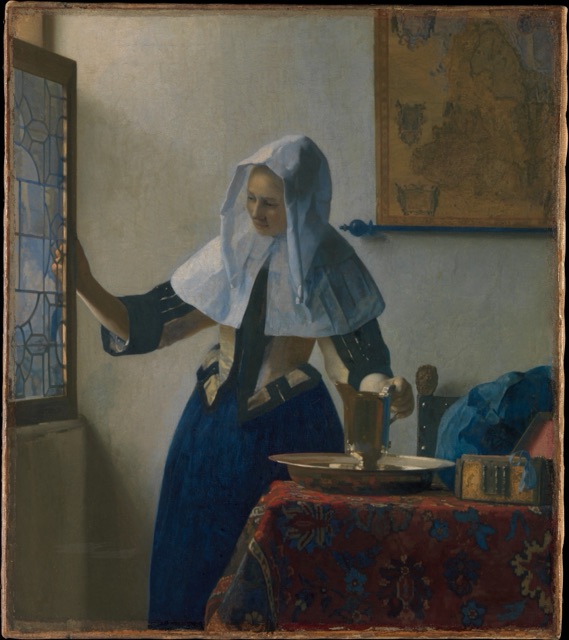
Look at the white linen covering the woman’s head and shoulders. Daylight from the window passes through it at the edges and turns its shadows blue. She stands with one hand on the window frame and the other on a pitcher, caught between two small actions. Johannes Vermeer painted this quiet room in Delft around sixteen sixty-two. Fewer than forty of his paintings are known today.
A closer look
Find the underside of the gilded basin on the table. Reflected in it is the pattern of the red carpet below: a detail smaller than a fingernail, and exact. Vermeer worked slowly, and pictures like this were built from close looking at how light behaves on different things: linen, glass, metal, a plastered wall. The woman’s white head covering was worn at home in the morning, while washing and dressing, and the pitcher and basin belong to the same routine. On the wall hangs a map, and on the table is a jewel box with a blue ribbon and a string of pearls. Nothing is happening, and nothing needs to. The collector Henry Marquand bought the painting in Paris in eighteen eighty-seven and gave it to the Metropolitan Museum two years later. It was the first Vermeer to cross the Atlantic to an American collection.
A young woman begins her day, one hand on the window and the other on a gilded pitcher. Given to The Metropolitan Museum of Art in 1889, this was the first painting by Vermeer to enter an American collection. Oil on canvas, 45.7 × 40.6 cm.
Stop 2 of 4 · Rembrandt (Rembrandt van Rijn) · 1653
Aristotle with a Bust of Homer
First Look
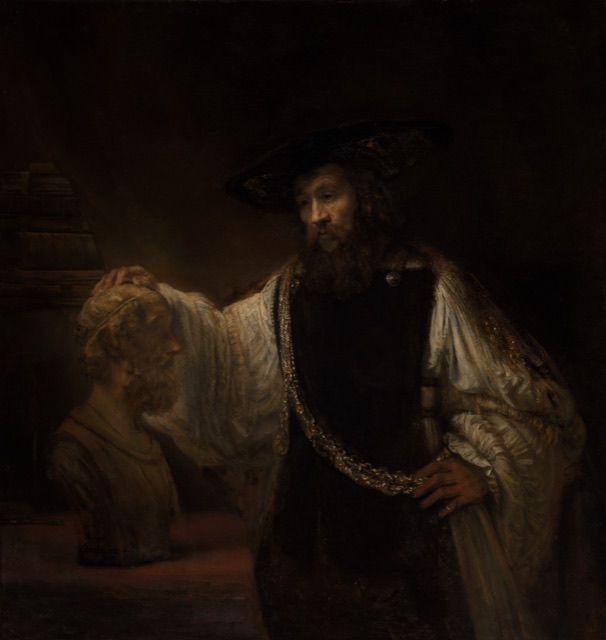
Look at the two hands. One rests on the head of a marble bust, and the other touches a heavy gold chain. The man is the philosopher Aristotle, and the bust is Homer, the poet he revered. Hanging from the chain is a small portrait of Alexander the Great, the conqueror Aristotle once taught. Rembrandt painted this in sixteen fifty-three. His eyes rest on the poet, but his thoughts seem to be somewhere further off.
A closer look
Notice where the light falls: on the sleeves, the bust, and one side of the face, with almost everything else left in brown shadow. The sleeves are built from thick strokes of white and yellow, dragged across the canvas while still wet. The painting was ordered by Don Antonio Ruffo, a nobleman in Messina in Sicily, who never met Rembrandt and seems to have asked only for a philosopher. The choice of Aristotle, dressed in the manner of Rembrandt’s own century rather than ancient Greece, was the painter’s. The picture travelled from Amsterdam to Sicily by ship in sixteen fifty-four, and Ruffo was pleased enough to order more. People have long read the scene as a man weighing two kinds of success, the poet’s lasting words against the honours of a king. Rembrandt left no explanation. When the Metropolitan Museum bought the painting in nineteen sixty-one, it paid the highest price then recorded for any picture.
The Greek philosopher Aristotle rests a hand on a bust of the poet Homer. From his gold chain hangs a medal of his pupil Alexander the Great. Rembrandt painted the picture in Amsterdam for a Sicilian collector, Don Antonio Ruffo. Oil on canvas, 143.5 × 136.5 cm.
Stop 3 of 4 · Berthe Morisot · 1875–80
Woman at Her Toilette
First Look
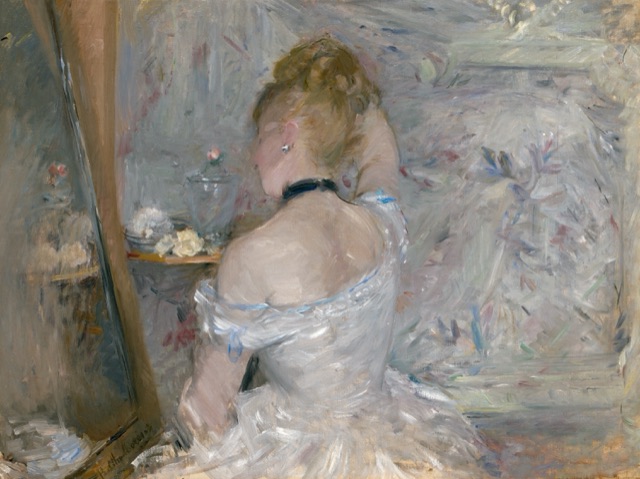
Look at the mirror on the left, and then at its lower edge. Berthe Morisot signed her name there, as if it were written on the glass. The mirror shows no clear reflection, only the same feathery strokes of grey, pink and lavender as the wall behind. A woman is undoing her hair, still wearing a black ribbon at her neck. Morisot showed this painting at the Impressionist exhibition of eighteen eighty.
A closer look
Follow the single dark note in this picture: the ribbon at the woman’s neck. Almost everything around it is pale, and brushed so loosely that wallpaper, bedspread and dress nearly merge. The Art Institute describes her as a fashionable Parisian after a ball, reaching up to take down her hair. Painters of the time often used a woman at a mirror as an emblem of vanity. Here the glass gives back almost nothing. Morisot was a founding member of the Impressionist group and exhibited in seven of its eight shows, more than most of her colleagues. At the exhibition of eighteen eighty her work was highly praised. Look again at the shoulder and the back of the neck. A few strokes of white and blue, and the skin seems to catch the light.
A woman seen from behind lifts a hand to her hair at her dressing table, a black ribbon still at her neck. Morisot paints the room, the dress and the mirror in the same quick, silvery strokes, and signs her name along the mirror’s lower edge. Oil on canvas, 60.3 × 80.4 cm.
Stop 4 of 4 · Mary Cassatt · 1893
The Child's Bath
First Look
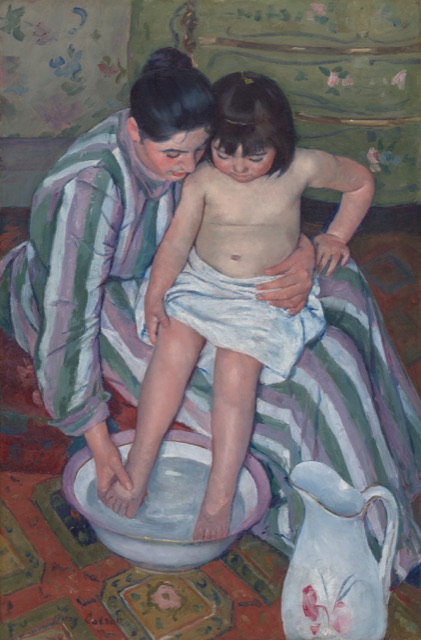
Look at the basin, and at the two hands meeting in the water. The woman’s hand is closed around the child’s foot, and both of them are looking down at the same spot. Mary Cassatt painted this in eighteen ninety-three. We see the pair from above, so the patterned carpet seems to stand upright behind them. Stripes, flowers and carpet press close on every side, and the child’s bare skin is the one plain surface.
A closer look
Step back and take in the angle. We are looking almost straight down, as if standing over the two figures, and the floor tilts up towards us like a wall. The Art Institute traces this to Cassatt’s close study of Japanese woodblock prints in the eighteen nineties: the high viewpoint, the strong outlines, the cropped shapes, and the pleasure in pattern set against pattern. Cassatt was born in Pennsylvania and settled in Paris, and she was the only American invited to exhibit with the original Impressionist group. Women caring for children became her best known subject, and she painted it without sweetness. Nothing here is posed for us. The Art Institute bought this canvas in nineteen ten, the first of her works to enter its collection. Look at the jug in the corner. Its painted flowers are among the few loose, soft passages in a very firmly built picture.
A woman steadies a child on her lap and washes one small foot in a basin. Cassatt, the only American invited to exhibit with the French Impressionists, sets the scene steeply from above and fills it with pattern, lessons she drew from Japanese woodblock prints. Oil on canvas, 101.3 × 67.3 cm.
ca. 1662Young Woman with a Water Pitcher
A young woman begins her day, one hand on the window and the other on a gilded pitcher. Given to The Metropolitan Museum of Art in 1889, this was the first painting by Vermeer to enter an American collection. Oil on canvas, 45.7 × 40.6 cm.
1653Aristotle with a Bust of Homer
The Greek philosopher Aristotle rests a hand on a bust of the poet Homer. From his gold chain hangs a medal of his pupil Alexander the Great. Rembrandt painted the picture in Amsterdam for a Sicilian collector, Don Antonio Ruffo. Oil on canvas, 143.5 × 136.5 cm.
1875–80Woman at Her Toilette
A woman seen from behind lifts a hand to her hair at her dressing table, a black ribbon still at her neck. Morisot paints the room, the dress and the mirror in the same quick, silvery strokes, and signs her name along the mirror’s lower edge. Oil on canvas, 60.3 × 80.4 cm.
1893The Child's Bath
A woman steadies a child on her lap and washes one small foot in a basin. Cassatt, the only American invited to exhibit with the French Impressionists, sets the scene steeply from above and fills it with pattern, lessons she drew from Japanese woodblock prints. Oil on canvas, 101.3 × 67.3 cm.
Other exhibitions
The Sistine Chapel: Ceiling, Altar, and Wall Cycles
Michelangelo’s ceiling and Last Judgment alongside the fifteenth-century north and south wall narratives by Botticelli, Perugino, Ghirlandaio, Rosselli, and Signorelli.
1765–1857 · 7 worksEdo: Pictures of the Floating World
Seven woodblock prints from the city of Edo, 1765 to 1857: Harunobu, Kiyonaga, Sharaku, Utamaro and Hiroshige, from the Art Institute of Chicago.
1867–1893 · 7 worksImpressionism: Painters of Modern Life
Seven painters and seven views of modern France, 1867 to 1893: Monet, Renoir, Morisot, Caillebotte, Degas, Cassatt and Pissarro, from the Art Institute of Chicago.
1782–1893 · 6 worksFrom Edo to Paris: Ukiyo-e and the Impressionist Eye
How Japanese woodblock masters Hiroshige and Kiyonaga inspired the cropped framing, asymmetric diagonals, and rain-swept streets of Caillebotte, Degas, and Cassatt.