1481–1536 · 15 works · Vatican Museums
The Sistine Chapel: Ceiling, Altar, and Wall Cycles
Stop 1 of 15 · Michelangelo · 1508–1512
The Sistine Chapel Ceiling
First Look
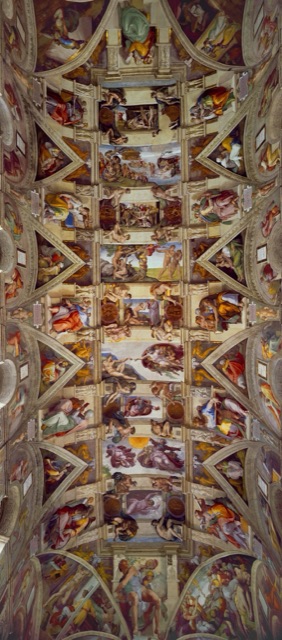
Follow the painted frames along the center: nine scenes move from Creation through humanity’s fall to Noah. Michelangelo surrounds this sequence with seven prophets and five sibyls. Their enormous seated bodies make the smaller narrative scenes feel like windows into another space. Look outward again to the corner scenes and the families above the windows.
A closer look
Look along the center of the ceiling, where nine Genesis scenes sit within a painted framework. Then let your attention move outward to the seated prophets and sibyls. The scale changes as your eye travels. Michelangelo completed this vast decoration in fifteen twelve; today, you can study one part at a time.
Nine central scenes from Genesis sit within a painted architectural framework. Around them are prophets, sibyls, ancestors of Christ, and corner scenes of salvation.
Stop 2 of 15 · Michelangelo · 1511
The Creation of Adam
First Look
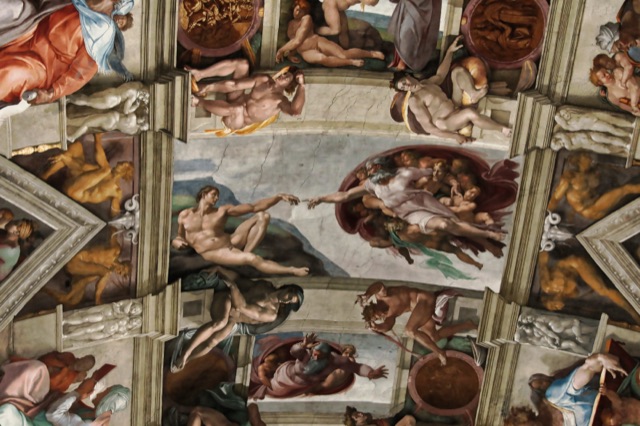
Look first at the space between the fingertips, then follow the two extended arms back to their bodies. Adam rests against the earth; God approaches within a group suspended in the air. Michelangelo makes a tiny interval the focus of monumental forms. This source photograph includes neighboring figures and painted architecture, so the larger setting remains visible.
A closer look
Begin with the two hands. Adam’s arm reaches from a resting body; God’s arm reaches from a group carried through the air. The Vatican Museums interpret their meeting as the giving of life. Look at the interval between the fingertips, and at the way the larger forms direct your eye toward it.
God reaches toward Adam in one of the ceiling’s central Genesis scenes. This photograph also records surrounding painted architecture; the study view preserves that source context.
Stop 3 of 15 · Michelangelo · 1536–1541
The Last Judgment
First Look
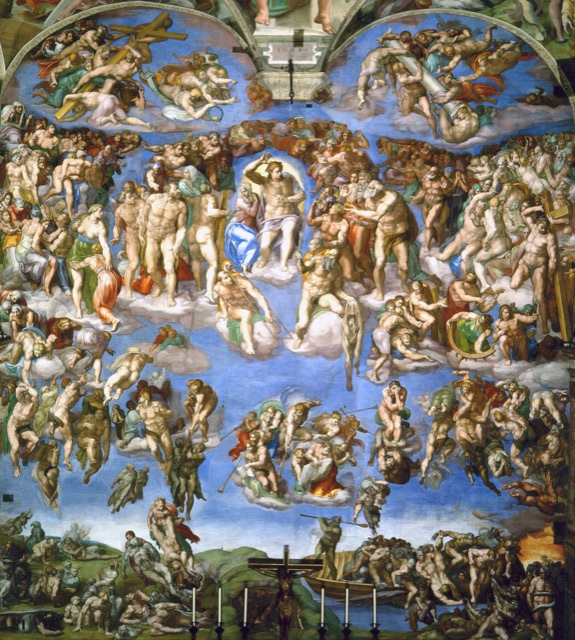
Begin with Christ’s raised arm, then follow the turning bodies around him. Below, trumpet-bearing angels separate the ascending and descending groups. Michelangelo replaces the ceiling’s orderly painted frames with a multitude in motion. The later coverings on some bodies belong to the painting’s subsequent history. This reproduction also contains photographed altar equipment near its lower edge.
A closer look
Find Christ at the center of this gathering. Below him, angels sound long trumpets; the risen ascend on one side while others descend on the other. Michelangelo painted this altar wall between fifteen thirty-six and fifteen forty-one. The Vatican Museums describe a broad, turning movement through the figures. Choose one group, and follow it before looking at the whole.
Christ dominates the altar-wall composition. Around him, saints await judgment while the lower groups rise or descend. Some figures received painted coverings after Michelangelo’s death.
Stop 4 of 15 · Pietro Perugino · 1481–1482
The Baptism of Christ
First Look
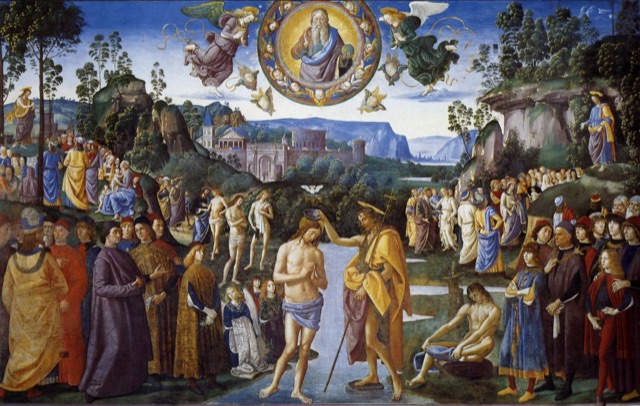
Perugino places Christ’s baptism at the beginning of the surviving Christ cycle. Let your eye move between the central action and the figures gathered beside it. Across the room, the Moses cycle begins another journey. An earlier Nativity on the altar wall once preceded this panel; it was lost when the Last Judgment was painted.
A closer look
Christ’s baptism begins the surviving north-wall cycle. An earlier Nativity on the altar wall was removed for Michelangelo’s Last Judgment.
The first surviving north-wall scene depicts Christ’s baptism. The earlier Nativity on the altar wall was removed for the Last Judgment.
Stop 5 of 15 · Sandro Botticelli · 1481–1482
The Temptations of Christ
First Look
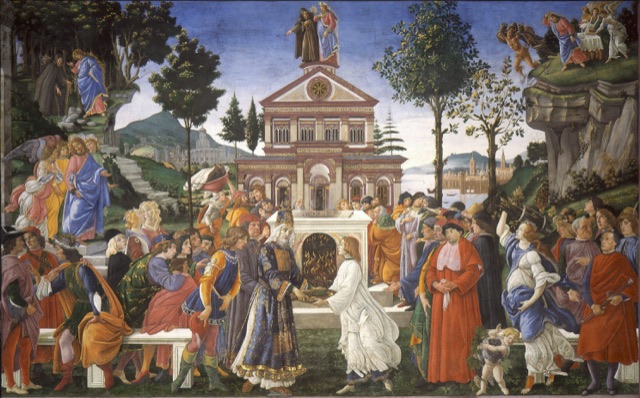
Botticelli gives several moments a shared landscape. Search above and behind the foreground gathering for Christ’s encounters with the tempter. Your eye must travel to assemble the narrative: the foreground is only one part of the painting. Compare this layered storytelling with Botticelli’s scenes of Moses across the room.
A closer look
Several moments of Christ’s temptations share one setting. Look for the smaller episodes as well as the foreground gathering.
The north-wall Christ cycle continues with the temptations, combining related moments within one painted setting.
Stop 6 of 15 · Domenico Ghirlandaio · 1481–1482
The Calling of the Apostles
First Look
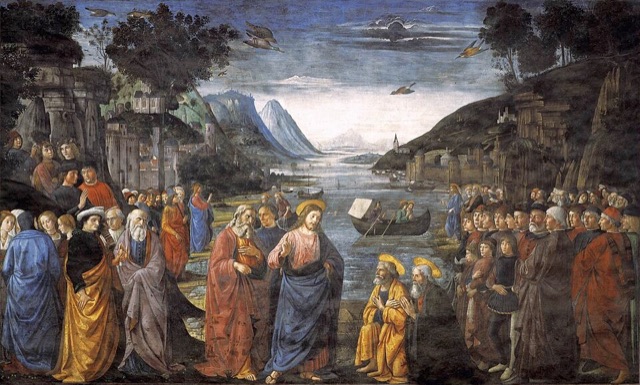
Ghirlandaio brings Peter and Andrew’s calling forward while placing the calling of James and John farther away. Compare the foreground figures with the smaller people along the distant water. The landscape holds different moments together, allowing the viewer to move through the story by looking from one group to another.
A closer look
Peter and Andrew are called in the foreground. Farther away, the painting also shows the calling of James and John.
Peter and Andrew are called in the foreground, with the calling of James and John represented farther away.
Stop 7 of 15 · Cosimo Rosselli · 1481–1482
The Sermon on the Mount
First Look
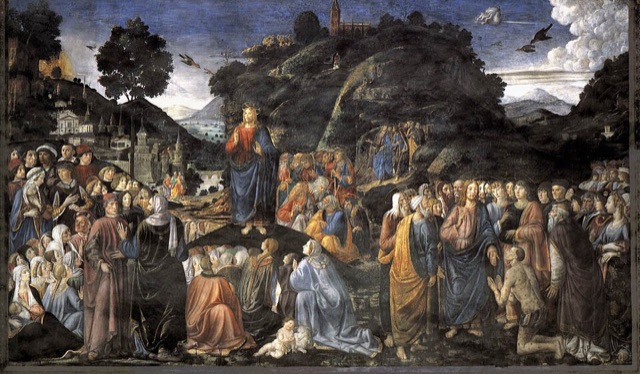
Rosselli combines public teaching with an intimate act of healing. Find the gathered listeners, then look for the curing of the leper within the same setting. A single landscape connects episodes that would be separated in a written account. Pause over the crowd: its variety helps give the central figure a human scale.
A closer look
One painted space brings together two episodes: Christ’s teaching on the mountain and the healing of a leper.
This panel joins the Sermon on the Mount with the healing of a leper.
Stop 8 of 15 · Pietro Perugino · 1481–1482
Christ Giving the Keys to Saint Peter
First Look
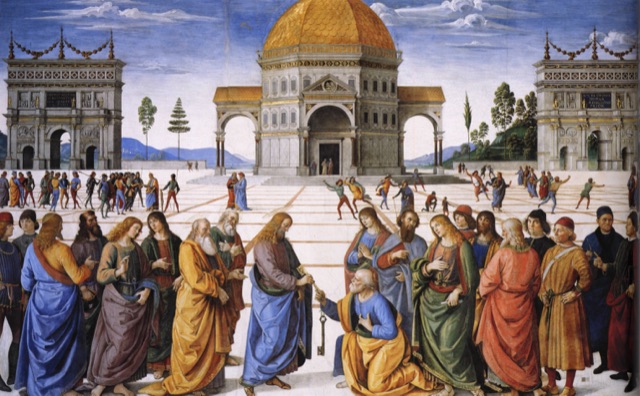
Perugino centers the exchange of keys between Christ and Peter. The Vatican Museums explain it as the handing over of authority. Beyond the foreground, the payment of tribute and an attempted stoning appear as smaller episodes. Follow the pavement toward the architecture, then return to the hands and keys where the main action concentrates.
A closer look
Christ gives Peter the keys in the foreground. Behind them, smaller scenes carry the story into the distance.
Christ gives Peter the keys in the foreground. Related episodes appear within the architectural setting behind them.
Stop 9 of 15 · Cosimo Rosselli · 1481–1482
The Last Supper
First Look
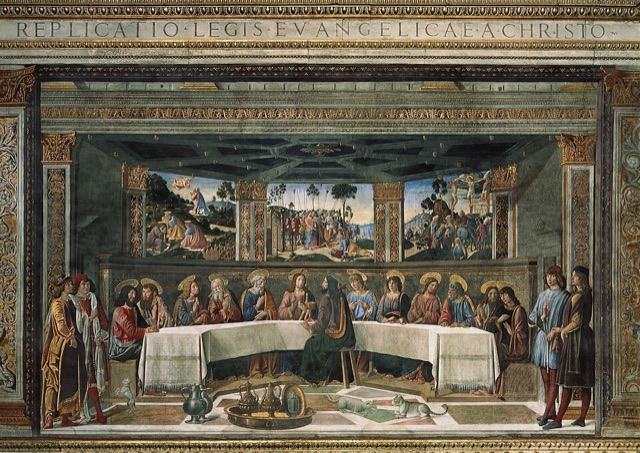
Rosselli makes the supper the foreground of a larger narrative. Behind it appear the Agony in the Garden, the arrest of Jesus and the Crucifixion. Look through the openings beyond the table to discover these later moments. The painting lets one room contain a meal while its background carries the story onward.
A closer look
Look beyond the supper. Episodes of the Passion unfold behind it, carrying the narrative into the painting’s background.
Behind the supper, the painting includes episodes of the Passion in separate background scenes.
Stop 10 of 15 · Pietro Perugino · 1481–1482
Moses’s Journey into Egypt
First Look
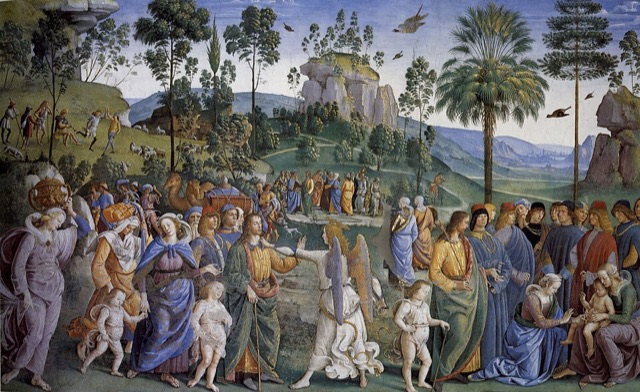
Perugino begins the surviving Moses cycle with departures and returns. The farewell to Jethro, the journey back to Egypt with Moses’s family and the circumcision episode share one landscape. Trace the changing groups rather than expecting a single frozen moment. The missing original beginning of this cycle was on the altar wall.
A closer look
The Moses cycle begins with a journey. Several episodes, including a farewell and the return to Egypt, share this landscape.
The journey to Egypt and other related episodes occupy the first surviving panel of the Moses cycle.
Stop 11 of 15 · Sandro Botticelli · 1481–1482
Scenes from the Life of Moses
First Look
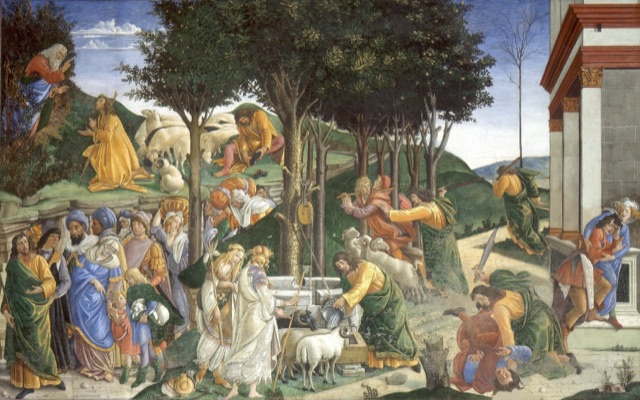
Botticelli repeats Moses across a landscape to tell different encounters. Look for his defense of Jethro’s daughters and his approach to the burning bush. The same protagonist can appear more than once in a Renaissance narrative painting. Compare the scattered episodes with Botticelli’s treatment of Christ’s temptations on the opposite wall.
A closer look
Follow Moses across the landscape. His encounters include defending Jethro’s daughters and approaching the burning bush: different moments within one picture.
Moses appears at different moments in one landscape, including his defense of Jethro’s daughters and the burning bush.
Stop 12 of 15 · Biagio d'Antonio · 1481–1482
The Crossing of the Red Sea
First Look
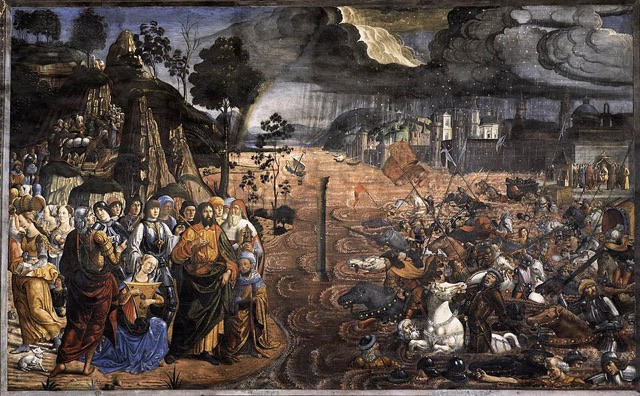
The third surviving Moses panel tells of escape through the Red Sea. Compare the crowd’s movement with the open spaces around it: the landscape becomes part of the drama. Study the scene before returning to its place in the sequence, between Moses’s earlier encounters and the giving of the Law.
A closer look
The Israelites escape through the Red Sea. This is the third surviving scene in the south-wall cycle of Moses.
The escape through the Red Sea occupies the third surviving panel of the Moses cycle. The Vatican Museums give this fresco to Biagio d’Antonio.
Stop 13 of 15 · Cosimo Rosselli · 1481–1482
Moses Receiving the Tablets of the Law
First Look
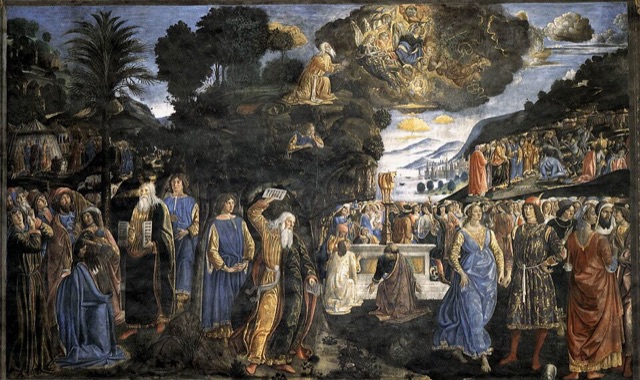
Rosselli brings ascent, disobedience and renewal into one landscape. Moses climbs Sinai to receive the Law; elsewhere, the golden calf draws worshippers, and the prophet returns with new tablets. Search for these separate groups. The painting asks you to connect actions across space as well as across time.
A closer look
Moses climbs Sinai, receives the Law, and returns with renewed tablets. The golden calf appears within the same painted space.
Moses’s ascent, the golden calf and the renewed tablets are told within the same painting.
Stop 14 of 15 · Sandro Botticelli · 1481–1482
The Punishment of Korah, Dathan and Abiram
First Look
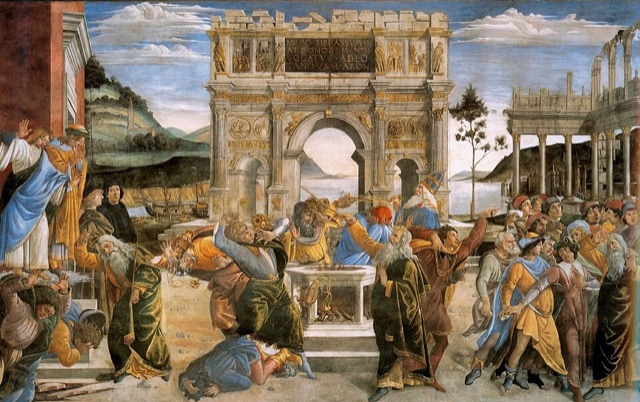
Botticelli turns the challenge to Moses and Aaron’s authority into a series of dramatic groups. Look across the architectural landscape for the different episodes of punishment. Across the chapel, Christ gives Peter the keys: both paintings invite attention to authority, while their gestures and movement give that theme very different visual forms.
A closer look
The rebels challenge Moses and Aaron’s authority. The painting gathers different episodes of their punishment into an architectural landscape.
The rebellion against Moses and Aaron is represented in multiple episodes within an architectural landscape.
Stop 15 of 15 · Luca Signorelli · 1481–1482
The Testament and Death of Moses
First Look
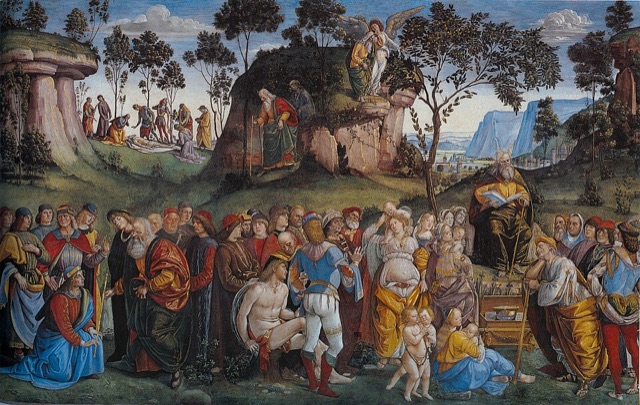
Moses’s final instructions and death close the surviving south-wall sequence. The Promised Land is in sight, yet his own journey is ending. Look between the groups rather than at just one figure. The cycle originally continued on the entrance wall with the dispute over his body.
A closer look
The final surviving south-wall panel tells of Moses’s last instructions and death, with the Promised Land in sight.
The Moses sequence ends with his final instructions and death before entry into the Promised Land.
1508–1512The Sistine Chapel Ceiling
Nine central scenes from Genesis sit within a painted architectural framework. Around them are prophets, sibyls, ancestors of Christ, and corner scenes of salvation.
1511The Creation of Adam
God reaches toward Adam in one of the ceiling’s central Genesis scenes. This photograph also records surrounding painted architecture; the study view preserves that source context.
1536–1541The Last Judgment
Christ dominates the altar-wall composition. Around him, saints await judgment while the lower groups rise or descend. Some figures received painted coverings after Michelangelo’s death.
1481–1482The Baptism of Christ
The first surviving north-wall scene depicts Christ’s baptism. The earlier Nativity on the altar wall was removed for the Last Judgment.
1481–1482The Temptations of Christ
The north-wall Christ cycle continues with the temptations, combining related moments within one painted setting.
1481–1482The Calling of the Apostles
Peter and Andrew are called in the foreground, with the calling of James and John represented farther away.
1481–1482The Sermon on the Mount
This panel joins the Sermon on the Mount with the healing of a leper.
1481–1482Christ Giving the Keys to Saint Peter
Christ gives Peter the keys in the foreground. Related episodes appear within the architectural setting behind them.
1481–1482The Last Supper
Behind the supper, the painting includes episodes of the Passion in separate background scenes.
1481–1482Moses’s Journey into Egypt
The journey to Egypt and other related episodes occupy the first surviving panel of the Moses cycle.
1481–1482Scenes from the Life of Moses
Moses appears at different moments in one landscape, including his defense of Jethro’s daughters and the burning bush.
1481–1482The Crossing of the Red Sea
The escape through the Red Sea occupies the third surviving panel of the Moses cycle. The Vatican Museums give this fresco to Biagio d’Antonio.
1481–1482Moses Receiving the Tablets of the Law
Moses’s ascent, the golden calf and the renewed tablets are told within the same painting.
1481–1482The Punishment of Korah, Dathan and Abiram
The rebellion against Moses and Aaron is represented in multiple episodes within an architectural landscape.
1481–1482The Testament and Death of Moses
The Moses sequence ends with his final instructions and death before entry into the Promised Land.
Other exhibitions
Edo: Pictures of the Floating World
Seven woodblock prints from the city of Edo, 1765 to 1857: Harunobu, Kiyonaga, Sharaku, Utamaro and Hiroshige, from the Art Institute of Chicago.
1867–1893 · 7 worksImpressionism: Painters of Modern Life
Seven painters and seven views of modern France, 1867 to 1893: Monet, Renoir, Morisot, Caillebotte, Degas, Cassatt and Pissarro, from the Art Institute of Chicago.
1782–1893 · 6 worksFrom Edo to Paris: Ukiyo-e and the Impressionist Eye
How Japanese woodblock masters Hiroshige and Kiyonaga inspired the cropped framing, asymmetric diagonals, and rain-swept streets of Caillebotte, Degas, and Cassatt.
1653–1665 · 5 worksDutch Golden Age: Light and Likeness
Five paintings from the Dutch Republic, 1653 to about 1670: Rembrandt, Vermeer and Ruisdael, from The Metropolitan Museum of Art.