The Calling of the Apostles
Stop 1 · First look
First Look
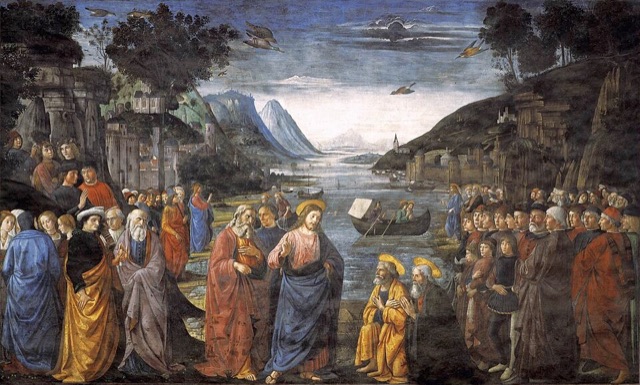
Ghirlandaio brings Peter and Andrew’s calling forward while placing the calling of James and John farther away. Compare the foreground figures with the smaller people along the distant water. The landscape holds different moments together, allowing the viewer to move through the story by looking from one group to another.
Stop 2 · Technique
Closer Reading
Peter and Andrew are called in the foreground. Farther away, the painting also shows the calling of James and John.
Stop 3 · Museum record
Catalog Summary
Peter and Andrew are called in the foreground, with the calling of James and John represented farther away.
Stop 4 · Historical Context
Domenico Ghirlandaio (c. 1449–1494)
Florentine fresco painter who filled sacred stories with portraits of his fellow citizens, and in whose workshop the young Michelangelo trained.
Early Renaissance (15th century): The first age of the Renaissance in Italy, roughly the 15th century, when painters in Florence learned to give figures weight and to set them in a space that looks real.
First Look
Ghirlandaio brings Peter and Andrew’s calling forward while placing the calling of James and John farther away. Compare the foreground figures with the smaller people along the distant water. The landscape holds different moments together, allowing the viewer to move through the story by looking from one group to another.
Closer Reading
Peter and Andrew are called in the foreground. Farther away, the painting also shows the calling of James and John.
Catalog Summary
Peter and Andrew are called in the foreground, with the calling of James and John represented farther away.
About the Artist
Domenico Ghirlandaio (c. 1449–1494)
Domenico Bigordi, called Ghirlandaio, was born in Florence in 1448 or 1449. According to the writer Giorgio Vasari he trained with the painter Alesso Baldovinetti. With his brothers Davide and Benedetto he ran a busy and prosperous workshop. It made altarpieces and, above all, frescoes: pictures painted on fresh plaster walls.
In 1481 to 1482 Pope Sixtus IV called him to Rome with Botticelli, Perugino and Cosimo Rosselli to paint the walls of the Sistine Chapel. His Calling of the First Apostles is still there. He was also one of the four painters of the portraits of popes beside the windows. A Resurrection that he painted on the entrance wall was ruined when the doorway collapsed in 1522.
His chief fresco cycles in Florence are the Sassetti Chapel in Santa Trinita, painted between 1483 and 1486, and those in Santa Maria Novella, painted from 1486 to 1490. He filled these stories with details of daily life and portraits of people he knew, so the walls are also a record of Florence in his day. Michelangelo joined the workshop as a boy of 13. Ghirlandaio died in Florence in 1494.