The Crossing of the Red Sea
Stop 1 · First look
First Look
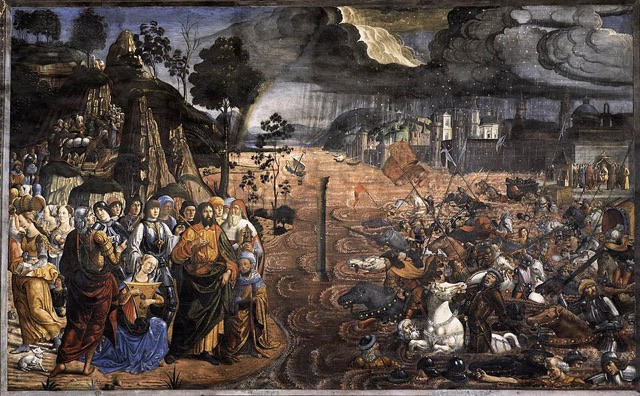
The third surviving Moses panel tells of escape through the Red Sea. Compare the crowd’s movement with the open spaces around it: the landscape becomes part of the drama. Study the scene before returning to its place in the sequence, between Moses’s earlier encounters and the giving of the Law.
Stop 2 · Technique
Closer Reading
The Israelites escape through the Red Sea. This is the third surviving scene in the south-wall cycle of Moses.
Stop 3 · Museum record
Catalog Summary
The escape through the Red Sea occupies the third surviving panel of the Moses cycle. The Vatican Museums give this fresco to Biagio d’Antonio.
Stop 4 · Historical Context
Biagio d'Antonio (c. 1446–1516)
Florentine painter, trained by Cosimo Rosselli, to whom the Vatican Museums give the Crossing of the Red Sea in the Sistine Chapel.
Early Renaissance (15th century): The first age of the Renaissance in Italy, roughly the 15th century, when painters in Florence learned to give figures weight and to set them in a space that looks real.
First Look
The third surviving Moses panel tells of escape through the Red Sea. Compare the crowd’s movement with the open spaces around it: the landscape becomes part of the drama. Study the scene before returning to its place in the sequence, between Moses’s earlier encounters and the giving of the Law.
Closer Reading
The Israelites escape through the Red Sea. This is the third surviving scene in the south-wall cycle of Moses.
Catalog Summary
The escape through the Red Sea occupies the third surviving panel of the Moses cycle. The Vatican Museums give this fresco to Biagio d’Antonio.
About the Artist
Biagio d'Antonio (c. 1446–1516)
Biagio d'Antonio Tucci was born in Florence about 1446, the son of an embroiderer. He trained under Cosimo Rosselli and joined the painters' guild, the Compagnia di San Luca, in 1472. After a short partnership with Jacopo del Sellaio he worked in the workshop of Verrocchio. From about the mid-1470s he also worked in Faenza, for religious orders and local officials, and he kept those patrons for many years.
In 1481 and 1482 he was in Rome, painting the walls of the Sistine Chapel alongside Perugino, Botticelli, Ghirlandaio and Rosselli. The Vatican Museums name him, with Bartolomeo della Gatta and Luca Signorelli, among the closest assistants of those four masters, and they give the Crossing of the Red Sea to him. The picture gallery of Faenza calls that fresco entirely his own work.
In 1504 he sat on the committee of leading Florentine artists that decided where Michelangelo's statue of David should stand. He died in Florence in 1516. In the 19th and 20th centuries his paintings were confused with those of another painter, Giovanni Battista Bertucci.