The Testament and Death of Moses
Stop 1 · First look
First Look
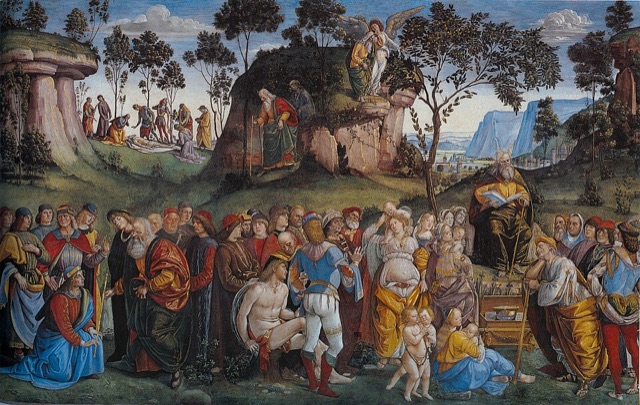
Moses’s final instructions and death close the surviving south-wall sequence. The Promised Land is in sight, yet his own journey is ending. Look between the groups rather than at just one figure. The cycle originally continued on the entrance wall with the dispute over his body.
Stop 2 · Technique
Closer Reading
The final surviving south-wall panel tells of Moses’s last instructions and death, with the Promised Land in sight.
Stop 3 · Museum record
Catalog Summary
The Moses sequence ends with his final instructions and death before entry into the Promised Land.
Stop 4 · Historical Context
Luca Signorelli (c. 1450–1523)
Tuscan painter from Cortona, known for powerful, muscular figures, whose frescoes at Orvieto Cathedral influenced Michelangelo's Last Judgement.
Early Renaissance (15th century): The first age of the Renaissance in Italy, roughly the 15th century, when painters in Florence learned to give figures weight and to set them in a space that looks real.
First Look
Moses’s final instructions and death close the surviving south-wall sequence. The Promised Land is in sight, yet his own journey is ending. Look between the groups rather than at just one figure. The cycle originally continued on the entrance wall with the dispute over his body.
Closer Reading
The final surviving south-wall panel tells of Moses’s last instructions and death, with the Promised Land in sight.
Catalog Summary
The Moses sequence ends with his final instructions and death before entry into the Promised Land.
About the Artist
Luca Signorelli (c. 1450–1523)
Luca Signorelli came from Cortona, a hill town in Tuscany. His birth year is not known: museums give dates between about 1440 and 1450. Giorgio Vasari, a relative who wrote about his life, says he was taught by Piero della Francesca, and he probably also trained in Perugia.
In 1481 to 1482 he worked in Rome on the walls of the Sistine Chapel, in the team led by Perugino, Botticelli, Ghirlandaio and Cosimo Rosselli. The Vatican Museums credit him with the scene of the last days and death of Moses. A second fresco by him, on the entrance wall, was ruined when the doorway collapsed in 1522 and was later repainted.
Signorelli drew the human body with bold outlines and strong muscles, in every kind of pose. His best-known work is the cycle on the end of the world in the San Brizio Chapel of Orvieto Cathedral, painted from 1499 to 1502. It influenced Michelangelo's Last Judgement, and the young Raphael made sketches after a Saint Sebastian by Signorelli. He worked until his death in Cortona in 1523.