The Temptations of Christ
Stop 1 · First look
First Look
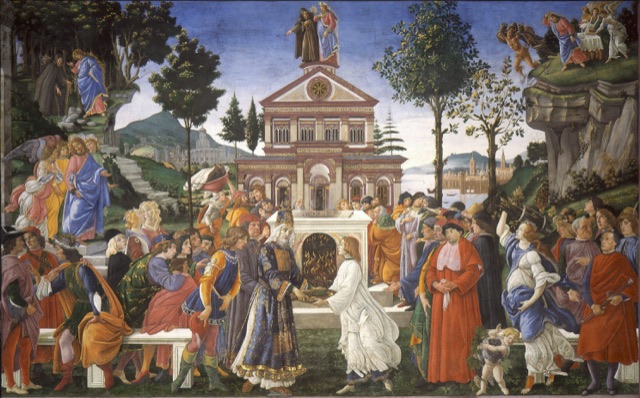
Botticelli gives several moments a shared landscape. Search above and behind the foreground gathering for Christ’s encounters with the tempter. Your eye must travel to assemble the narrative: the foreground is only one part of the painting. Compare this layered storytelling with Botticelli’s scenes of Moses across the room.
Stop 2 · Technique
Closer Reading
Several moments of Christ’s temptations share one setting. Look for the smaller episodes as well as the foreground gathering.
Stop 3 · Museum record
Catalog Summary
The north-wall Christ cycle continues with the temptations, combining related moments within one painted setting.
Stop 4 · Historical Context
Sandro Botticelli (c. 1445–1510)
Florentine painter of the Renaissance, known for graceful line and for large mythological pictures such as Primavera and The Birth of Venus.
Early Renaissance (15th century): The first age of the Renaissance in Italy, roughly the 15th century, when painters in Florence learned to give figures weight and to set them in a space that looks real.
First Look
Botticelli gives several moments a shared landscape. Search above and behind the foreground gathering for Christ’s encounters with the tempter. Your eye must travel to assemble the narrative: the foreground is only one part of the painting. Compare this layered storytelling with Botticelli’s scenes of Moses across the room.
Closer Reading
Several moments of Christ’s temptations share one setting. Look for the smaller episodes as well as the foreground gathering.
Catalog Summary
The north-wall Christ cycle continues with the temptations, combining related moments within one painted setting.
About the Artist
Sandro Botticelli (c. 1445–1510)
Sandro Botticelli was born in Florence around 1445 as Alessandro Filipepi, the son of a tanner. His nickname comes from a word for a small wine cask. He is thought to have trained first with a goldsmith and then with the painter Fra Filippo Lippi, and by 1470 he had his own workshop. For most of his life he worked for the Medici family and their circle.
In 1481 the pope called him to Rome to help paint the walls of the Sistine Chapel, with Perugino, Ghirlandaio and Cosimo Rosselli. He painted the Temptations of Christ and two scenes from the life of Moses, and portraits of early popes. It is the only time he is known to have worked outside Florence.
Between about 1478 and 1490 he painted scenes from ancient myth, among them Primavera and The Birth of Venus, with a flowing, decorative use of line. In the troubled 1490s his pictures became plainer and intensely religious. He died in Florence in 1510, and his name was almost forgotten until the late 1800s.