1653–1665 · 5 works · The Metropolitan Museum of Art
Dutch Golden Age: Light and Likeness
Stop 1 of 5 · Jacob van Ruisdael · ca. 1670
Wheat Fields
First Look
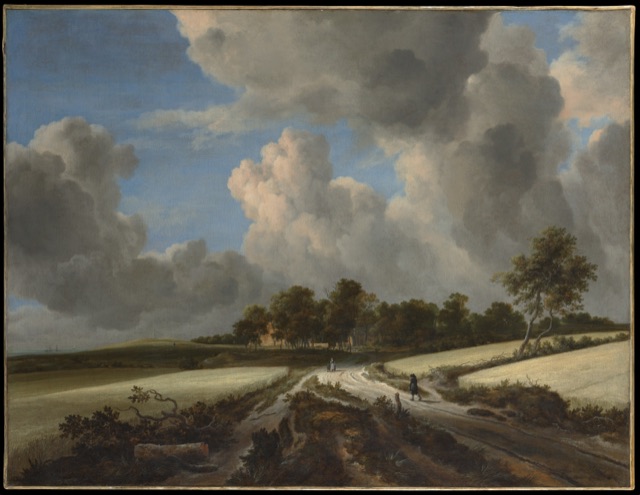
Look along the road, to the three small figures. A man is walking away from us, toward a woman and a child who are coming the other way. They are the only people in a very large view. Jacob van Ruisdael painted this countryside around sixteen seventy. Most of the canvas is sky, and the clouds are what you remember: grey underneath, bright where the sun reaches them.
A closer look
Follow the edges of things toward the centre: the road, the borders of the fields, the low rise of the dunes at the left. They all lead to the same stand of trees, and the clouds above pile up in answer. Nothing in the scene is grand. This is flat farmland near the coast of Holland, with a rutted track and sunlight moving across the wheat. Dutch painters of the sixteen hundreds were among the first in Europe to make ordinary local country the whole subject of a picture, for buyers who were merchants and townspeople rather than princes. Ruisdael was born in Haarlem and worked in Amsterdam, and he gave such views a scale and a seriousness they had not had before. Watch the patch of light on the field at the right. In a moment the cloud will have moved, and it will be gone.
A sandy road runs between ripening fields toward a stand of trees, under a sky that fills most of the canvas. Ruisdael, born in Haarlem and active in Amsterdam, was the leading landscape painter of the Dutch Republic. Oil on canvas, 100 × 130.2 cm.
Stop 2 of 5 · Rembrandt (Rembrandt van Rijn) · 1653
Aristotle with a Bust of Homer
First Look
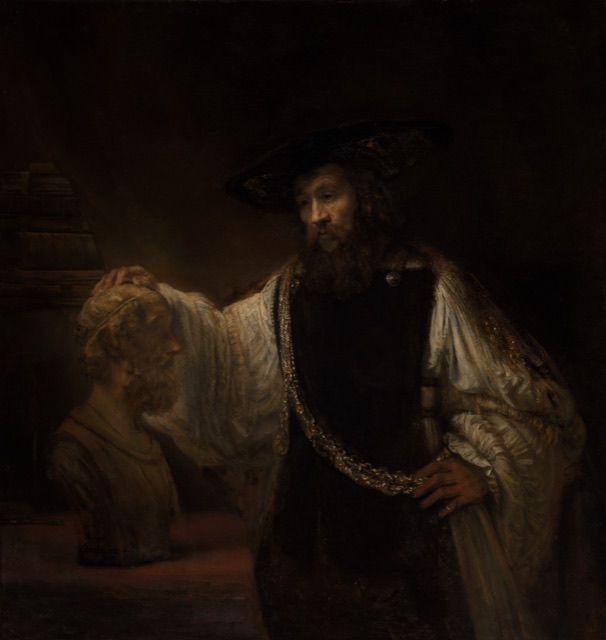
Look at the two hands. One rests on the head of a marble bust, and the other touches a heavy gold chain. The man is the philosopher Aristotle, and the bust is Homer, the poet he revered. Hanging from the chain is a small portrait of Alexander the Great, the conqueror Aristotle once taught. Rembrandt painted this in sixteen fifty-three. His eyes rest on the poet, but his thoughts seem to be somewhere further off.
A closer look
Notice where the light falls: on the sleeves, the bust, and one side of the face, with almost everything else left in brown shadow. The sleeves are built from thick strokes of white and yellow, dragged across the canvas while still wet. The painting was ordered by Don Antonio Ruffo, a nobleman in Messina in Sicily, who never met Rembrandt and seems to have asked only for a philosopher. The choice of Aristotle, dressed in the manner of Rembrandt’s own century rather than ancient Greece, was the painter’s. The picture travelled from Amsterdam to Sicily by ship in sixteen fifty-four, and Ruffo was pleased enough to order more. People have long read the scene as a man weighing two kinds of success, the poet’s lasting words against the honours of a king. Rembrandt left no explanation. When the Metropolitan Museum bought the painting in nineteen sixty-one, it paid the highest price then recorded for any picture.
The Greek philosopher Aristotle rests a hand on a bust of the poet Homer. From his gold chain hangs a medal of his pupil Alexander the Great. Rembrandt painted the picture in Amsterdam for a Sicilian collector, Don Antonio Ruffo. Oil on canvas, 143.5 × 136.5 cm.
Stop 3 of 5 · Rembrandt (Rembrandt van Rijn) · 1660
Self-Portrait
First Look
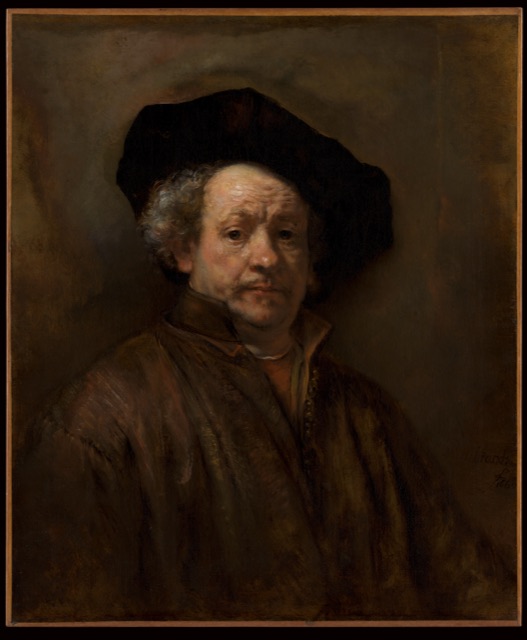
Look at the forehead, just under the dark cap. The furrows are made of thick paint, and the light catches them as it would catch real skin. Rembrandt painted himself here in sixteen sixty, at the age of fifty-four. He had portrayed his own face since he was a young man. This time he gives himself a plain brown coat, a steady gaze, and no flattery at all.
A closer look
Come close to the eyes. They sit in half shadow under the cap, while the cheek and the nose take the full light, so the gaze seems to come from further back than the face. About forty painted self-portraits by Rembrandt survive, made over four decades, along with many more in etching and drawing. No painter before him had studied one face, his own, so often. The years just before this picture were hard. He had been declared insolvent in sixteen fifty-six, and his house and his collection were sold to pay his creditors. He kept working. The paint here is handled with great freedom: scrubbed thin in the coat, and built up in ridges on the brow and the bridge of the nose. He signed and dated the canvas at the lower right.
Rembrandt was fifty-four when he painted this likeness, one of about forty painted self-portraits made across his life. He records the furrowed brow and the heavy cheeks without softening them. Oil on canvas, 80.3 × 67.3 cm.
Stop 4 of 5 · Johannes Vermeer · ca. 1662
Young Woman with a Water Pitcher
First Look
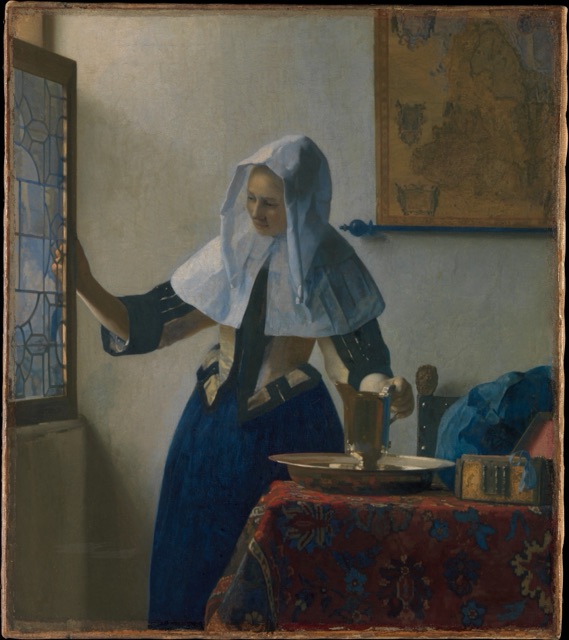
Look at the white linen covering the woman’s head and shoulders. Daylight from the window passes through it at the edges and turns its shadows blue. She stands with one hand on the window frame and the other on a pitcher, caught between two small actions. Johannes Vermeer painted this quiet room in Delft around sixteen sixty-two. Fewer than forty of his paintings are known today.
A closer look
Find the underside of the gilded basin on the table. Reflected in it is the pattern of the red carpet below: a detail smaller than a fingernail, and exact. Vermeer worked slowly, and pictures like this were built from close looking at how light behaves on different things: linen, glass, metal, a plastered wall. The woman’s white head covering was worn at home in the morning, while washing and dressing, and the pitcher and basin belong to the same routine. On the wall hangs a map, and on the table is a jewel box with a blue ribbon and a string of pearls. Nothing is happening, and nothing needs to. The collector Henry Marquand bought the painting in Paris in eighteen eighty-seven and gave it to the Metropolitan Museum two years later. It was the first Vermeer to cross the Atlantic to an American collection.
A young woman begins her day, one hand on the window and the other on a gilded pitcher. Given to The Metropolitan Museum of Art in 1889, this was the first painting by Vermeer to enter an American collection. Oil on canvas, 45.7 × 40.6 cm.
Stop 5 of 5 · Johannes Vermeer · ca. 1665–67
Study of a Young Woman
First Look
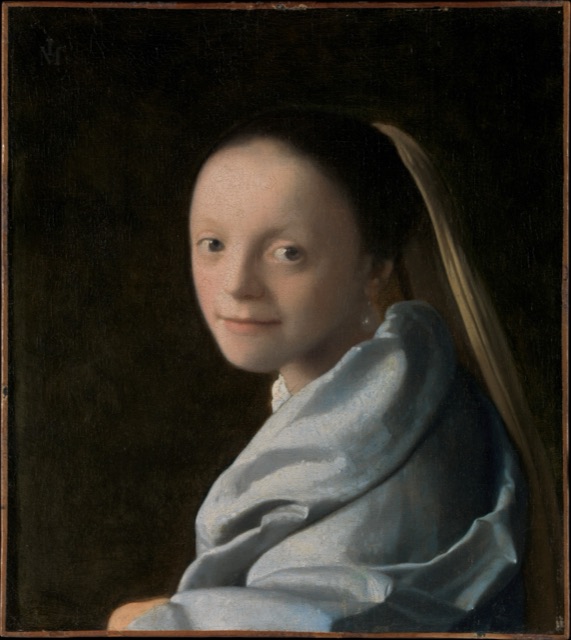
Look at the small highlight on the pearl at her ear, and then at the same soft light on her lower lip. The young woman turns to us out of a plain dark background, with the beginning of a smile. Johannes Vermeer painted her in Delft in the mid sixteen sixties. Nobody knows her name. Pictures like this were studies of a face and a mood, not portraits made to order.
A closer look
Notice how few edges there are. The line of the cheek melts into the shadow, the eyebrows are barely stated, and the wide-set eyes have almost no drawn outline. Vermeer shapes the face with gradations of light alone, and that softness is a large part of its hold on us. The Dutch called such a picture a tronie: a head painted for its expression, its costume or its fall of light, and sold on the open market. This one is close in kind and in date to the painting now known as Girl with a Pearl Earring, in The Hague. Both show a girl against darkness, glancing over her shoulder, with a pearl catching the light. Her features here are particular enough that Vermeer very likely worked from a living model. The canvas came to the Metropolitan Museum in nineteen seventy-nine, the gift of Charles and Jayne Wrightsman.
Not a commissioned portrait but a tronie, the Dutch term for a study of a face and its expression. A young woman turns out of the dark with a pearl at her ear and a blue-grey wrap over her shoulder. Oil on canvas, 44.5 × 40 cm.
ca. 1670Wheat Fields
A sandy road runs between ripening fields toward a stand of trees, under a sky that fills most of the canvas. Ruisdael, born in Haarlem and active in Amsterdam, was the leading landscape painter of the Dutch Republic. Oil on canvas, 100 × 130.2 cm.
1653Aristotle with a Bust of Homer
The Greek philosopher Aristotle rests a hand on a bust of the poet Homer. From his gold chain hangs a medal of his pupil Alexander the Great. Rembrandt painted the picture in Amsterdam for a Sicilian collector, Don Antonio Ruffo. Oil on canvas, 143.5 × 136.5 cm.
1660Self-Portrait
Rembrandt was fifty-four when he painted this likeness, one of about forty painted self-portraits made across his life. He records the furrowed brow and the heavy cheeks without softening them. Oil on canvas, 80.3 × 67.3 cm.
ca. 1662Young Woman with a Water Pitcher
A young woman begins her day, one hand on the window and the other on a gilded pitcher. Given to The Metropolitan Museum of Art in 1889, this was the first painting by Vermeer to enter an American collection. Oil on canvas, 45.7 × 40.6 cm.
ca. 1665–67Study of a Young Woman
Not a commissioned portrait but a tronie, the Dutch term for a study of a face and its expression. A young woman turns out of the dark with a pearl at her ear and a blue-grey wrap over her shoulder. Oil on canvas, 44.5 × 40 cm.
Other exhibitions
The Sistine Chapel: Ceiling, Altar, and Wall Cycles
Michelangelo’s ceiling and Last Judgment alongside the fifteenth-century north and south wall narratives by Botticelli, Perugino, Ghirlandaio, Rosselli, and Signorelli.
1765–1857 · 7 worksEdo: Pictures of the Floating World
Seven woodblock prints from the city of Edo, 1765 to 1857: Harunobu, Kiyonaga, Sharaku, Utamaro and Hiroshige, from the Art Institute of Chicago.
1867–1893 · 7 worksImpressionism: Painters of Modern Life
Seven painters and seven views of modern France, 1867 to 1893: Monet, Renoir, Morisot, Caillebotte, Degas, Cassatt and Pissarro, from the Art Institute of Chicago.
1782–1893 · 6 worksFrom Edo to Paris: Ukiyo-e and the Impressionist Eye
How Japanese woodblock masters Hiroshige and Kiyonaga inspired the cropped framing, asymmetric diagonals, and rain-swept streets of Caillebotte, Degas, and Cassatt.