Study of a Young Woman
Stop 1 · First look
First Look
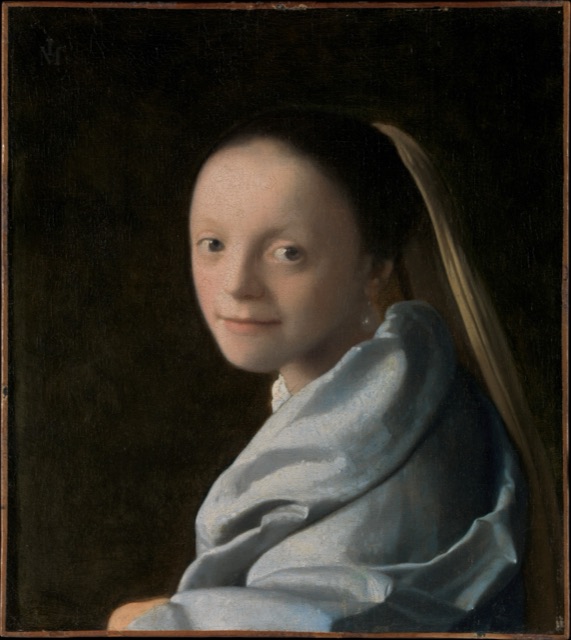
Look at the small highlight on the pearl at her ear, and then at the same soft light on her lower lip. The young woman turns to us out of a plain dark background, with the beginning of a smile. Johannes Vermeer painted her in Delft in the mid sixteen sixties. Nobody knows her name. Pictures like this were studies of a face and a mood, not portraits made to order.
Stop 2 · Technique
Closer Reading
Notice how few edges there are. The line of the cheek melts into the shadow, the eyebrows are barely stated, and the wide-set eyes have almost no drawn outline. Vermeer shapes the face with gradations of light alone, and that softness is a large part of its hold on us. The Dutch called such a picture a tronie: a head painted for its expression, its costume or its fall of light, and sold on the open market. This one is close in kind and in date to the painting now known as Girl with a Pearl Earring, in The Hague. Both show a girl against darkness, glancing over her shoulder, with a pearl catching the light. Her features here are particular enough that Vermeer very likely worked from a living model. The canvas came to the Metropolitan Museum in nineteen seventy-nine, the gift of Charles and Jayne Wrightsman.
Stop 3 · Museum record
Catalog Summary
Not a commissioned portrait but a tronie, the Dutch term for a study of a face and its expression. A young woman turns out of the dark with a pearl at her ear and a blue-grey wrap over her shoulder. Oil on canvas, 44.5 × 40 cm.
Recorded physical scale: 40.0 × 44.5 cm (15.7 × 17.5 in · 0.40 × 0.45 m).
Stop 4 · Historical Context
Johannes Vermeer (1632–1675)
Delft painter of quiet rooms and daylight, who left only about 35 pictures and is now among the best known Dutch artists.
Dutch Golden Age (17th century): The painting of the 17th-century Dutch Republic, bought by a growing middle class: portraits, landscapes, still lifes and scenes of everyday life.
First Look
Look at the small highlight on the pearl at her ear, and then at the same soft light on her lower lip. The young woman turns to us out of a plain dark background, with the beginning of a smile. Johannes Vermeer painted her in Delft in the mid sixteen sixties. Nobody knows her name. Pictures like this were studies of a face and a mood, not portraits made to order.
Closer Reading
Notice how few edges there are. The line of the cheek melts into the shadow, the eyebrows are barely stated, and the wide-set eyes have almost no drawn outline. Vermeer shapes the face with gradations of light alone, and that softness is a large part of its hold on us. The Dutch called such a picture a tronie: a head painted for its expression, its costume or its fall of light, and sold on the open market. This one is close in kind and in date to the painting now known as Girl with a Pearl Earring, in The Hague. Both show a girl against darkness, glancing over her shoulder, with a pearl catching the light. Her features here are particular enough that Vermeer very likely worked from a living model. The canvas came to the Metropolitan Museum in nineteen seventy-nine, the gift of Charles and Jayne Wrightsman.
Catalog Summary
Not a commissioned portrait but a tronie, the Dutch term for a study of a face and its expression. A young woman turns out of the dark with a pearl at her ear and a blue-grey wrap over her shoulder. Oil on canvas, 44.5 × 40 cm.
About the Artist
Johannes Vermeer (1632–1675)
Johannes Vermeer was baptised in Delft on 31 October 1632 and lived and worked there. In 1653 he married and became a master in the town's painters' guild. He also dealt in other artists' pictures and had a large family. It is not certain who taught him.
His early paintings show stories from the Bible and from myth. He then turned to rooms in ordinary houses, where one or two people read a letter, pour milk or play music. Daylight from a window falls softly across walls, cloth and skin. He may have taken his interest in how light behaves from Carel Fabritius, a former pupil of Rembrandt who worked in Delft from 1650 to 1654. Vermeer seems to have painted slowly: only about 35 pictures by him are known, among them The Milkmaid.
Collectors travelled from abroad to see his studio, yet by 1672 he was in money trouble. He died in 1675 unable to pay his debts, leaving his wife and many children poor. He was then largely forgotten until the middle of the 1800s.