Self-Portrait
Stop 1 · First look
First Look
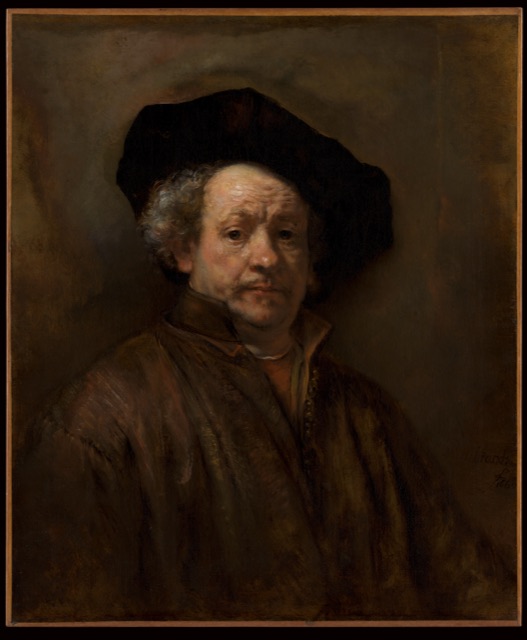
Look at the forehead, just under the dark cap. The furrows are made of thick paint, and the light catches them as it would catch real skin. Rembrandt painted himself here in sixteen sixty, at the age of fifty-four. He had portrayed his own face since he was a young man. This time he gives himself a plain brown coat, a steady gaze, and no flattery at all.
Stop 2 · Technique
Closer Reading
Come close to the eyes. They sit in half shadow under the cap, while the cheek and the nose take the full light, so the gaze seems to come from further back than the face. About forty painted self-portraits by Rembrandt survive, made over four decades, along with many more in etching and drawing. No painter before him had studied one face, his own, so often. The years just before this picture were hard. He had been declared insolvent in sixteen fifty-six, and his house and his collection were sold to pay his creditors. He kept working. The paint here is handled with great freedom: scrubbed thin in the coat, and built up in ridges on the brow and the bridge of the nose. He signed and dated the canvas at the lower right.
Stop 3 · Museum record
Catalog Summary
Rembrandt was fifty-four when he painted this likeness, one of about forty painted self-portraits made across his life. He records the furrowed brow and the heavy cheeks without softening them. Oil on canvas, 80.3 × 67.3 cm.
Recorded physical scale: 67.3 × 80.3 cm (26.5 × 31.6 in · 0.67 × 0.80 m).
Stop 4 · Historical Context
Rembrandt van Rijn (1606–1669)
Dutch painter and printmaker who used strong light and deep shadow to show people thinking and feeling, from Bible scenes to dozens of self-portraits.
Dutch Golden Age (17th century): The painting of the 17th-century Dutch Republic, bought by a growing middle class: portraits, landscapes, still lifes and scenes of everyday life.
First Look
Look at the forehead, just under the dark cap. The furrows are made of thick paint, and the light catches them as it would catch real skin. Rembrandt painted himself here in sixteen sixty, at the age of fifty-four. He had portrayed his own face since he was a young man. This time he gives himself a plain brown coat, a steady gaze, and no flattery at all.
Closer Reading
Come close to the eyes. They sit in half shadow under the cap, while the cheek and the nose take the full light, so the gaze seems to come from further back than the face. About forty painted self-portraits by Rembrandt survive, made over four decades, along with many more in etching and drawing. No painter before him had studied one face, his own, so often. The years just before this picture were hard. He had been declared insolvent in sixteen fifty-six, and his house and his collection were sold to pay his creditors. He kept working. The paint here is handled with great freedom: scrubbed thin in the coat, and built up in ridges on the brow and the bridge of the nose. He signed and dated the canvas at the lower right.
Catalog Summary
Rembrandt was fifty-four when he painted this likeness, one of about forty painted self-portraits made across his life. He records the furrowed brow and the heavy cheeks without softening them. Oil on canvas, 80.3 × 67.3 cm.
About the Artist
Rembrandt van Rijn (1606–1669)
Rembrandt van Rijn was born in Leiden in 1606, the son of a miller. He left the university after a few months to train as a painter, in Leiden and then briefly with Pieter Lastman in Amsterdam. Around 1631 he moved to Amsterdam and became the most famous artist in the city.
He lit his scenes like a stage: a face or a hand catches the light while the rest sinks into shadow. In The Night Watch, his largest painting, he turned a group portrait into a moment of action. He made many etchings, a kind of print, and about 80 self-portraits by him survive. His early pictures are smooth and exact. The late ones are built from broad strokes, some laid on with a palette knife.
His wife Saskia died in 1642. He spent heavily on art and curiosities and went bankrupt in 1656. He kept painting until he died in 1669. His pupils included Carel Fabritius, who later worked in Vermeer's Delft. In 1890 Vincent van Gogh painted his own version of Rembrandt's print The Raising of Lazarus.