Aristotle with a Bust of Homer
Stop 1 · First look
First Look
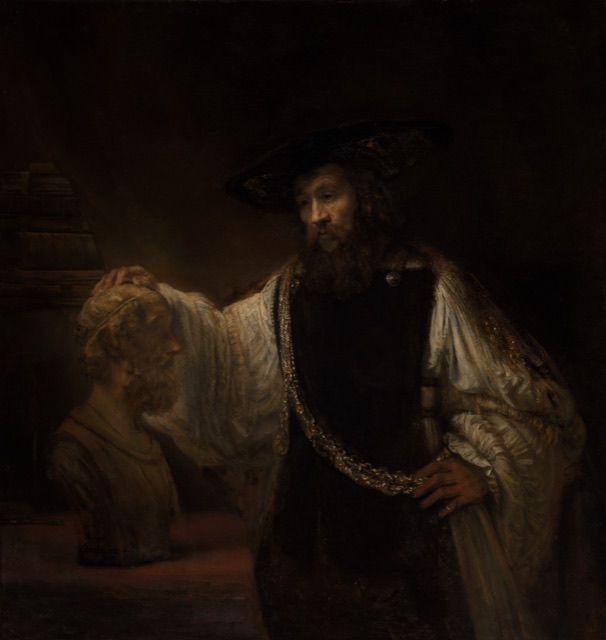
Look at the two hands. One rests on the head of a marble bust, and the other touches a heavy gold chain. The man is the philosopher Aristotle, and the bust is Homer, the poet he revered. Hanging from the chain is a small portrait of Alexander the Great, the conqueror Aristotle once taught. Rembrandt painted this in sixteen fifty-three. His eyes rest on the poet, but his thoughts seem to be somewhere further off.
Stop 2 · Technique
Closer Reading
Notice where the light falls: on the sleeves, the bust, and one side of the face, with almost everything else left in brown shadow. The sleeves are built from thick strokes of white and yellow, dragged across the canvas while still wet. The painting was ordered by Don Antonio Ruffo, a nobleman in Messina in Sicily, who never met Rembrandt and seems to have asked only for a philosopher. The choice of Aristotle, dressed in the manner of Rembrandt’s own century rather than ancient Greece, was the painter’s. The picture travelled from Amsterdam to Sicily by ship in sixteen fifty-four, and Ruffo was pleased enough to order more. People have long read the scene as a man weighing two kinds of success, the poet’s lasting words against the honours of a king. Rembrandt left no explanation. When the Metropolitan Museum bought the painting in nineteen sixty-one, it paid the highest price then recorded for any picture.
Stop 3 · Museum record
Catalog Summary
The Greek philosopher Aristotle rests a hand on a bust of the poet Homer. From his gold chain hangs a medal of his pupil Alexander the Great. Rembrandt painted the picture in Amsterdam for a Sicilian collector, Don Antonio Ruffo. Oil on canvas, 143.5 × 136.5 cm.
Recorded physical scale: 136.5 × 143.5 cm (53.7 × 56.5 in · 1.36 × 1.44 m).
Stop 4 · Historical Context
Rembrandt van Rijn (1606–1669)
Dutch painter and printmaker who used strong light and deep shadow to show people thinking and feeling, from Bible scenes to dozens of self-portraits.
Dutch Golden Age (17th century): The painting of the 17th-century Dutch Republic, bought by a growing middle class: portraits, landscapes, still lifes and scenes of everyday life.
First Look
Look at the two hands. One rests on the head of a marble bust, and the other touches a heavy gold chain. The man is the philosopher Aristotle, and the bust is Homer, the poet he revered. Hanging from the chain is a small portrait of Alexander the Great, the conqueror Aristotle once taught. Rembrandt painted this in sixteen fifty-three. His eyes rest on the poet, but his thoughts seem to be somewhere further off.
Closer Reading
Notice where the light falls: on the sleeves, the bust, and one side of the face, with almost everything else left in brown shadow. The sleeves are built from thick strokes of white and yellow, dragged across the canvas while still wet. The painting was ordered by Don Antonio Ruffo, a nobleman in Messina in Sicily, who never met Rembrandt and seems to have asked only for a philosopher. The choice of Aristotle, dressed in the manner of Rembrandt’s own century rather than ancient Greece, was the painter’s. The picture travelled from Amsterdam to Sicily by ship in sixteen fifty-four, and Ruffo was pleased enough to order more. People have long read the scene as a man weighing two kinds of success, the poet’s lasting words against the honours of a king. Rembrandt left no explanation. When the Metropolitan Museum bought the painting in nineteen sixty-one, it paid the highest price then recorded for any picture.
Catalog Summary
The Greek philosopher Aristotle rests a hand on a bust of the poet Homer. From his gold chain hangs a medal of his pupil Alexander the Great. Rembrandt painted the picture in Amsterdam for a Sicilian collector, Don Antonio Ruffo. Oil on canvas, 143.5 × 136.5 cm.
About the Artist
Rembrandt van Rijn (1606–1669)
Rembrandt van Rijn was born in Leiden in 1606, the son of a miller. He left the university after a few months to train as a painter, in Leiden and then briefly with Pieter Lastman in Amsterdam. Around 1631 he moved to Amsterdam and became the most famous artist in the city.
He lit his scenes like a stage: a face or a hand catches the light while the rest sinks into shadow. In The Night Watch, his largest painting, he turned a group portrait into a moment of action. He made many etchings, a kind of print, and about 80 self-portraits by him survive. His early pictures are smooth and exact. The late ones are built from broad strokes, some laid on with a palette knife.
His wife Saskia died in 1642. He spent heavily on art and curiosities and went bankrupt in 1656. He kept painting until he died in 1669. His pupils included Carel Fabritius, who later worked in Vermeer's Delft. In 1890 Vincent van Gogh painted his own version of Rembrandt's print The Raising of Lazarus.