Wheat Fields
Stop 1 · First look
First Look
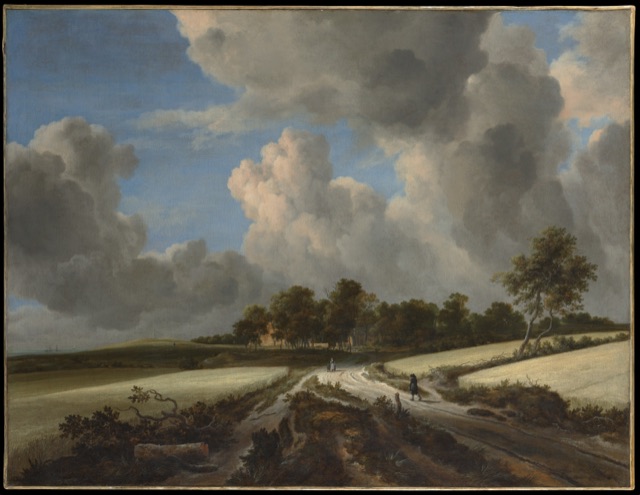
Look along the road, to the three small figures. A man is walking away from us, toward a woman and a child who are coming the other way. They are the only people in a very large view. Jacob van Ruisdael painted this countryside around sixteen seventy. Most of the canvas is sky, and the clouds are what you remember: grey underneath, bright where the sun reaches them.
Stop 2 · Technique
Closer Reading
Follow the edges of things toward the centre: the road, the borders of the fields, the low rise of the dunes at the left. They all lead to the same stand of trees, and the clouds above pile up in answer. Nothing in the scene is grand. This is flat farmland near the coast of Holland, with a rutted track and sunlight moving across the wheat. Dutch painters of the sixteen hundreds were among the first in Europe to make ordinary local country the whole subject of a picture, for buyers who were merchants and townspeople rather than princes. Ruisdael was born in Haarlem and worked in Amsterdam, and he gave such views a scale and a seriousness they had not had before. Watch the patch of light on the field at the right. In a moment the cloud will have moved, and it will be gone.
Stop 3 · Museum record
Catalog Summary
A sandy road runs between ripening fields toward a stand of trees, under a sky that fills most of the canvas. Ruisdael, born in Haarlem and active in Amsterdam, was the leading landscape painter of the Dutch Republic. Oil on canvas, 100 × 130.2 cm.
Recorded physical scale: 130.2 × 100.0 cm (51.3 × 39.4 in · 1.30 × 1.00 m).
Stop 4 · Historical Context
Jacob van Ruisdael (c. 1628–1682)
Leading landscape painter of the Dutch Golden Age, known for huge cloudy skies over woods, dunes, waterfalls and the flat fields around Haarlem.
Dutch Golden Age (17th century): The painting of the 17th-century Dutch Republic, bought by a growing middle class: portraits, landscapes, still lifes and scenes of everyday life.
First Look
Look along the road, to the three small figures. A man is walking away from us, toward a woman and a child who are coming the other way. They are the only people in a very large view. Jacob van Ruisdael painted this countryside around sixteen seventy. Most of the canvas is sky, and the clouds are what you remember: grey underneath, bright where the sun reaches them.
Closer Reading
Follow the edges of things toward the centre: the road, the borders of the fields, the low rise of the dunes at the left. They all lead to the same stand of trees, and the clouds above pile up in answer. Nothing in the scene is grand. This is flat farmland near the coast of Holland, with a rutted track and sunlight moving across the wheat. Dutch painters of the sixteen hundreds were among the first in Europe to make ordinary local country the whole subject of a picture, for buyers who were merchants and townspeople rather than princes. Ruisdael was born in Haarlem and worked in Amsterdam, and he gave such views a scale and a seriousness they had not had before. Watch the patch of light on the field at the right. In a moment the cloud will have moved, and it will be gone.
Catalog Summary
A sandy road runs between ripening fields toward a stand of trees, under a sky that fills most of the canvas. Ruisdael, born in Haarlem and active in Amsterdam, was the leading landscape painter of the Dutch Republic. Oil on canvas, 100 × 130.2 cm.
About the Artist
Jacob van Ruisdael (c. 1628–1682)
Jacob van Ruisdael was born in Haarlem in 1628 or 1629. His father Isaack was a painter, art dealer and frame maker, and his uncle, the painter Salomon van Ruysdael, probably helped to train him. He finished his first work in 1646, still in his teens, and joined the Haarlem painters' guild in 1648.
Around 1650 he travelled to the hilly country near Bentheim, just across the German border. By about 1657 he had settled in Amsterdam. He painted woods, watermills, ruins, beaches and the linen-bleaching fields outside Haarlem, nearly always under a tall sky of moving cloud. From the late 1650s he added rocky waterfalls, a subject taken from Allart van Everdingen, who had been to Scandinavia. His finished views often look grander than the real place.
He is said to have worked as a doctor as well. Meindert Hobbema was his apprentice. Ruisdael died in Amsterdam in 1682 and was buried in Haarlem. Thomas Gainsborough later copied his work, and in 1875 the young Vincent van Gogh hung prints of his landscapes on his wall in Paris.