Young Woman with a Water Pitcher
Stop 1 · First look
First Look
Look at the white linen covering the woman’s head and shoulders. Daylight from the window passes through it at the edges and turns its shadows blue. She stands with one hand on the window frame and the other on a pitcher, caught between two small actions. Johannes Vermeer painted this quiet room in Delft around sixteen sixty-two. Fewer than forty of his paintings are known today.
Stop 2 · Technique
Closer Reading
Find the underside of the gilded basin on the table. Reflected in it is the pattern of the red carpet below: a detail smaller than a fingernail, and exact. Vermeer worked slowly, and pictures like this were built from close looking at how light behaves on different things: linen, glass, metal, a plastered wall. The woman’s white head covering was worn at home in the morning, while washing and dressing, and the pitcher and basin belong to the same routine. On the wall hangs a map, and on the table is a jewel box with a blue ribbon and a string of pearls. Nothing is happening, and nothing needs to. The collector Henry Marquand bought the painting in Paris in eighteen eighty-seven and gave it to the Metropolitan Museum two years later. It was the first Vermeer to cross the Atlantic to an American collection.
Stop 3 · Museum record
Catalog Summary
A young woman begins her day, one hand on the window and the other on a gilded pitcher. Given to The Metropolitan Museum of Art in 1889, this was the first painting by Vermeer to enter an American collection. Oil on canvas, 45.7 × 40.6 cm.
Recorded physical scale: 40.6 × 45.7 cm (16.0 × 18.0 in · 0.41 × 0.46 m).
Stop 4 · Historical Context
Johannes Vermeer (1632–1675)
Delft painter of quiet rooms and daylight, who left only about 35 pictures and is now among the best known Dutch artists.
Dutch Golden Age (17th century): The painting of the 17th-century Dutch Republic, bought by a growing middle class: portraits, landscapes, still lifes and scenes of everyday life.
First Look
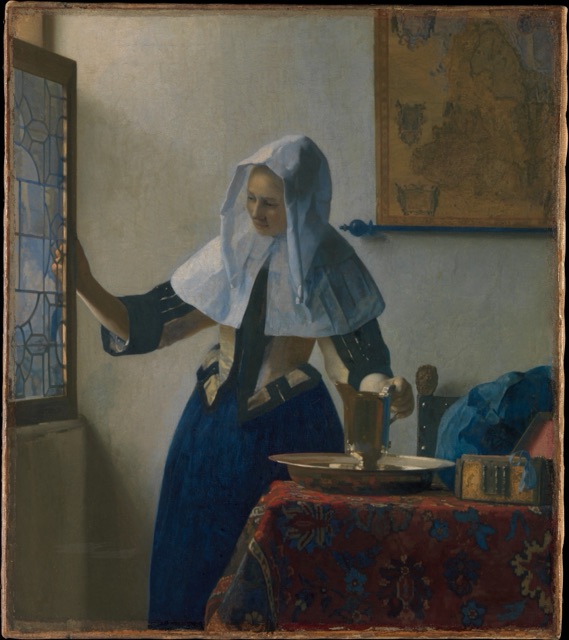
Look at the white linen covering the woman’s head and shoulders. Daylight from the window passes through it at the edges and turns its shadows blue. She stands with one hand on the window frame and the other on a pitcher, caught between two small actions. Johannes Vermeer painted this quiet room in Delft around sixteen sixty-two. Fewer than forty of his paintings are known today.
Closer Reading
Find the underside of the gilded basin on the table. Reflected in it is the pattern of the red carpet below: a detail smaller than a fingernail, and exact. Vermeer worked slowly, and pictures like this were built from close looking at how light behaves on different things: linen, glass, metal, a plastered wall. The woman’s white head covering was worn at home in the morning, while washing and dressing, and the pitcher and basin belong to the same routine. On the wall hangs a map, and on the table is a jewel box with a blue ribbon and a string of pearls. Nothing is happening, and nothing needs to. The collector Henry Marquand bought the painting in Paris in eighteen eighty-seven and gave it to the Metropolitan Museum two years later. It was the first Vermeer to cross the Atlantic to an American collection.
Catalog Summary
A young woman begins her day, one hand on the window and the other on a gilded pitcher. Given to The Metropolitan Museum of Art in 1889, this was the first painting by Vermeer to enter an American collection. Oil on canvas, 45.7 × 40.6 cm.
About the Artist
Johannes Vermeer (1632–1675)
Johannes Vermeer was baptised in Delft on 31 October 1632 and lived and worked there. In 1653 he married and became a master in the town's painters' guild. He also dealt in other artists' pictures and had a large family. It is not certain who taught him.
His early paintings show stories from the Bible and from myth. He then turned to rooms in ordinary houses, where one or two people read a letter, pour milk or play music. Daylight from a window falls softly across walls, cloth and skin. He may have taken his interest in how light behaves from Carel Fabritius, a former pupil of Rembrandt who worked in Delft from 1650 to 1654. Vermeer seems to have painted slowly: only about 35 pictures by him are known, among them The Milkmaid.
Collectors travelled from abroad to see his studio, yet by 1672 he was in money trouble. He died in 1675 unable to pay his debts, leaving his wife and many children poor. He was then largely forgotten until the middle of the 1800s.