1782–1893 · 6 works · Art Institute of Chicago
From Edo to Paris: Ukiyo-e and the Impressionist Eye
Stop 1 of 6 · Torii Kiyonaga · c. 1787
Sudden Shower at Mimeguri Shrine
First Look
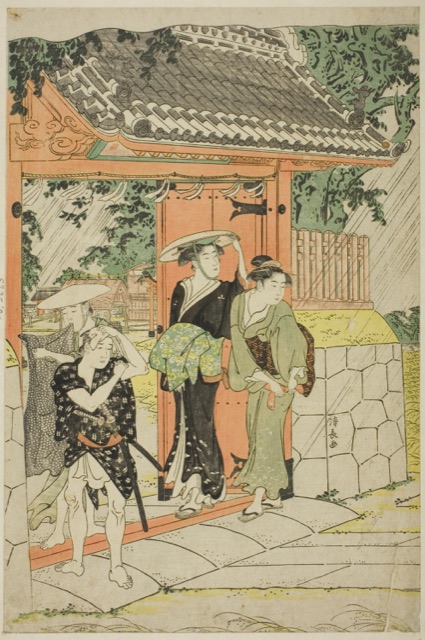
Look under the roof of the red gate, where the dry ground begins. Two women stand there, one still holding the brim of her hat. Two men are just arriving, and the one in front shields his head with both hands, his robe hitched up for running. This is the Mimeguri Shrine, beside the Sumida River in Edo. Torii Kiyonaga designed the scene around seventeen eighty-seven.
A closer look
Notice how tall these figures are. Kiyonaga drew the people of Edo long-limbed and unhurried, even in a downpour, and for a decade his way of drawing them was the fashion. This sheet is the left third of a larger picture. Two more sheets continued the scene to the right, with more people running for cover and, in the clouds above them, the spirits of the storm. The shrine was a real place on the east bank of the Sumida River, and it had a story attached. A century earlier a well known poet was said to have written a verse there asking for rain, and to have been answered the next day. Buyers of the print would have smiled at the joke: at Mimeguri, of all places, a sudden shower. Look at the stone wall at the right. The artist has signed it.
Caught by a cloudburst, passers-by crowd under the gate of the Mimeguri Shrine, beside the Sumida River. This is the left sheet of a three-sheet design. Kiyonaga’s tall, calm figures set the style for prints of fashionable Edo in the 1780s. Colour woodblock print, 37.9 × 25.1 cm.
Stop 2 of 6 · Utagawa Hiroshige · 1857
Sudden Shower over Shin Ohashi Bridge and Atake (Ohashi Atake no yudachi), from the series "One Hundred Famous Views of Edo (Meisho Edo hyakkei)"
First Look
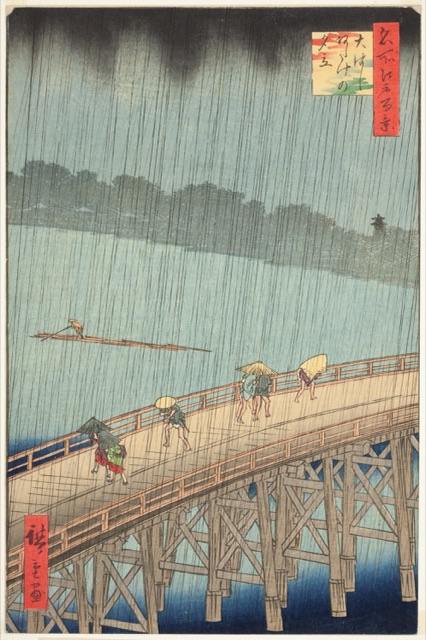
Look at the rain. It is printed as hundreds of thin dark lines, each one cut into a wooden block. Under them, six people on the bridge crouch beneath hats, a straw mat and an umbrella. Out on the river a lone boatman poles his raft through the storm. Utagawa Hiroshige published this view of the Sumida River in Edo in eighteen fifty-seven.
A closer look
Look up at the cloud along the top edge. Its dark, rolling outline was not cut into the block. The Art Institute notes that the printer wiped the ink on by hand in a scalloped shape, instead of the usual straight band, so the storm seems to boil downward. Now look across the water. The far bank, a district called Atake, is printed in soft grey with no outlines, as if seen through the rain. Hiroshige tilts the bridge one way and the shore the other, and that zigzag gives the small sheet its sense of space. Like the plum garden nearby, this design reached Paris within a generation. Vincent van Gogh painted a copy of it in eighteen eighty-seven, working out for himself how a picture could be built from flat colour and strong diagonals.
Six figures hurry across a wooden bridge over the Sumida River as a summer storm breaks, and a lone boatman poles a raft through the rain. The dark cloud at the top was wiped onto the block by hand for each impression. Colour woodblock print, 33.4 × 21.8 cm.
Stop 3 of 6 · Utagawa Hiroshige · 1857
Plum Garden at Kameido (Kameido Umeyashiki), from the series "One Hundred Famous Views of Edo (Meisho Edo hyakkei)"
First Look
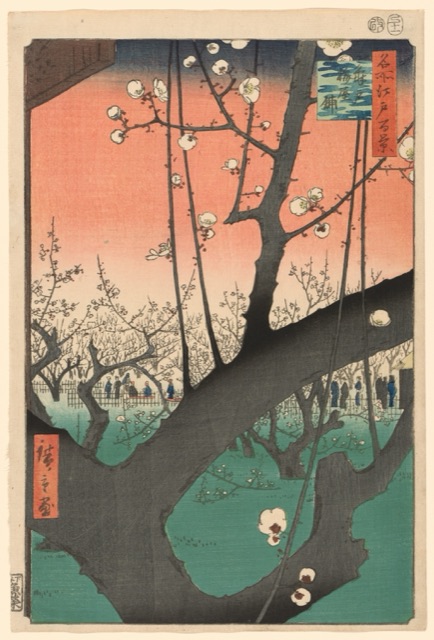
Look past the dark branch to the small figures in the distance, strolling behind a low fence. Hiroshige has put us almost inside the tree, so close that its trunk blocks half the view. This was the most famous plum tree in Edo, nicknamed the Sleeping Dragon. The print was published in eighteen fifty-seven. Thirty years later, in Paris, Vincent van Gogh copied it in oil paint, red sky and all.
A closer look
Look at the sky and watch how the colour changes. Deep red at the top fades to white, and then to green at the ground. The printer produced these gradations by wiping pigment across the damp wooden block by hand before each impression, so no two sheets came out quite the same. The print belongs to One Hundred Famous Views of Edo, the last great series by Utagawa Hiroshige, published between eighteen fifty-six and eighteen fifty-eight, the year of his death. Many of its views place something large and close in front of a distant scene, as this branch is set against the garden. When Japanese prints reached Europe in numbers, painters there were struck by exactly that device. Van Gogh owned a copy of this design. In eighteen eighty-seven he traced it, enlarged it and painted it, adding a border of Japanese characters.
A dark branch of the most famous plum tree in Edo, known as the Sleeping Dragon, cuts across a red sky while visitors stroll behind a fence in the distance. Vincent van Gogh copied this print in oil paint in 1887. Colour woodblock print, 36 × 24.4 cm.
Stop 4 of 6 · Gustave Caillebotte · 1877
Paris Street; Rainy Day
First Look
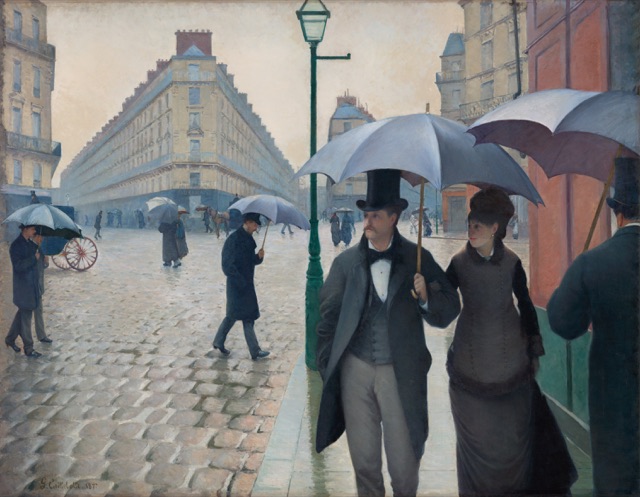
Look down, at the cobblestones. Gustave Caillebotte painted no falling rain in this picture. You know the weather from the umbrellas, and from the light lying on the wet stone. This is Paris in eighteen seventy-seven, at a broad new intersection a short walk from the painter’s home. The canvas is almost three metres wide. Stand where you are, and the couple on the right seem about to walk past you.
A closer look
Find the green lamp post in the middle of the painting. It divides the canvas almost exactly in half. On the left are open street and distant walkers. On the right are three figures so close that one is cut off by the frame. The Art Institute suggests that this abrupt cropping may owe something to photography, which was then becoming popular. The streets themselves were new. A rebuilding of Paris lasting decades had replaced narrow medieval lanes with long, straight boulevards like these, and the retractable umbrella was a recent invention. Caillebotte showed the painting at the third Impressionist exhibition, in eighteen seventy-seven, which he also helped to pay for. His brushwork is smoother than his friends’, but the subject is theirs: an ordinary moment in the modern city. Look at the couple once more. They are both glancing at something we cannot see.
Caillebotte’s largest painting shows a broad new intersection in Paris, a short walk from his home. No raindrops are painted: the weather is told by the umbrellas and by the sheen on the cobblestones. Oil on canvas, 212.2 × 276.2 cm.
Stop 5 of 6 · Hilaire Germain Edgar Degas · 1879-86
The Millinery Shop
First Look
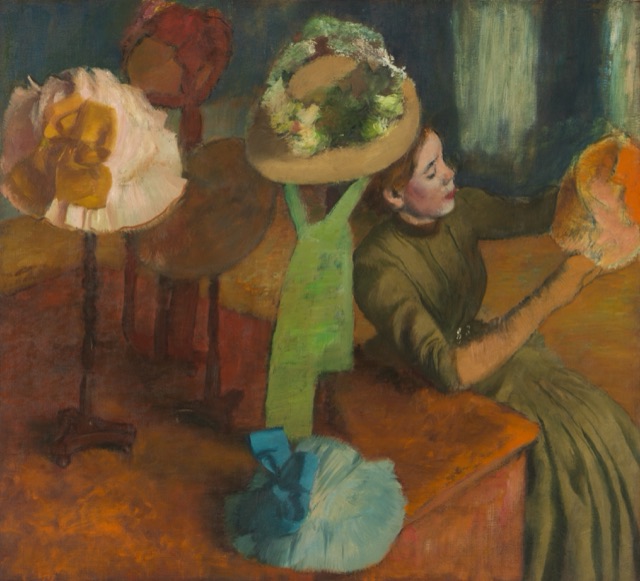
Look at the hat with the green trimmings, just above the woman’s head. It is on a stand behind her, but Edgar Degas has placed it so that it seems to be hers. She is absorbed in another hat, held up in her gloved hands. We see her from above and a little to one side, as if we had just stopped at the counter. Degas worked on this painting between eighteen seventy-nine and eighteen eighty-six.
A closer look
Count the hats. There are six, on stands at different heights, and together they take up more of the canvas than the woman does. Degas made many drawings and pastels for this one figure, adjusting her pose and her clothes. The Art Institute points to a small uncertainty he left in place. Hat making was a respected trade that could raise a young woman’s standing, and her green dress and long gloves would suit a customer as well as an employee. A lady of the time would be wearing a hat of her own. She is not, so Degas lets one from the display hover over her. Is she buying, or working? The steep view from above and the table sliced by the frame make us feel we have only just walked up. Look at the ribbons. A few quick strokes, left almost unfinished.
The largest of Degas’s paintings of milliners looks down on a young woman studying a hat among the shop’s displays. Degas placed a second hat, trimmed in green, so that it seems to sit on her own head. Oil on canvas, 100 × 110.7 cm.
Stop 6 of 6 · Mary Cassatt · 1893
The Child's Bath
First Look
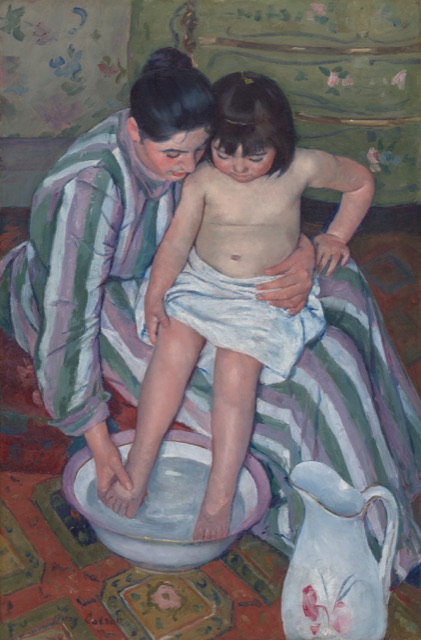
Look at the basin, and at the two hands meeting in the water. The woman’s hand is closed around the child’s foot, and both of them are looking down at the same spot. Mary Cassatt painted this in eighteen ninety-three. We see the pair from above, so the patterned carpet seems to stand upright behind them. Stripes, flowers and carpet press close on every side, and the child’s bare skin is the one plain surface.
A closer look
Step back and take in the angle. We are looking almost straight down, as if standing over the two figures, and the floor tilts up towards us like a wall. The Art Institute traces this to Cassatt’s close study of Japanese woodblock prints in the eighteen nineties: the high viewpoint, the strong outlines, the cropped shapes, and the pleasure in pattern set against pattern. Cassatt was born in Pennsylvania and settled in Paris, and she was the only American invited to exhibit with the original Impressionist group. Women caring for children became her best known subject, and she painted it without sweetness. Nothing here is posed for us. The Art Institute bought this canvas in nineteen ten, the first of her works to enter its collection. Look at the jug in the corner. Its painted flowers are among the few loose, soft passages in a very firmly built picture.
A woman steadies a child on her lap and washes one small foot in a basin. Cassatt, the only American invited to exhibit with the French Impressionists, sets the scene steeply from above and fills it with pattern, lessons she drew from Japanese woodblock prints. Oil on canvas, 101.3 × 67.3 cm.
c. 1787Sudden Shower at Mimeguri Shrine
Caught by a cloudburst, passers-by crowd under the gate of the Mimeguri Shrine, beside the Sumida River. This is the left sheet of a three-sheet design. Kiyonaga’s tall, calm figures set the style for prints of fashionable Edo in the 1780s. Colour woodblock print, 37.9 × 25.1 cm.
1857Sudden Shower over Shin Ohashi Bridge and Atake
Six figures hurry across a wooden bridge over the Sumida River as a summer storm breaks, and a lone boatman poles a raft through the rain. The dark cloud at the top was wiped onto the block by hand for each impression. Colour woodblock print, 33.4 × 21.8 cm.
1857Plum Garden at Kameido
A dark branch of the most famous plum tree in Edo, known as the Sleeping Dragon, cuts across a red sky while visitors stroll behind a fence in the distance. Vincent van Gogh copied this print in oil paint in 1887. Colour woodblock print, 36 × 24.4 cm.
1877Paris Street; Rainy Day
Caillebotte’s largest painting shows a broad new intersection in Paris, a short walk from his home. No raindrops are painted: the weather is told by the umbrellas and by the sheen on the cobblestones. Oil on canvas, 212.2 × 276.2 cm.
1879-86The Millinery Shop
The largest of Degas’s paintings of milliners looks down on a young woman studying a hat among the shop’s displays. Degas placed a second hat, trimmed in green, so that it seems to sit on her own head. Oil on canvas, 100 × 110.7 cm.
1893The Child's Bath
A woman steadies a child on her lap and washes one small foot in a basin. Cassatt, the only American invited to exhibit with the French Impressionists, sets the scene steeply from above and fills it with pattern, lessons she drew from Japanese woodblock prints. Oil on canvas, 101.3 × 67.3 cm.
Other exhibitions
The Sistine Chapel: Ceiling, Altar, and Wall Cycles
Michelangelo’s ceiling and Last Judgment alongside the fifteenth-century north and south wall narratives by Botticelli, Perugino, Ghirlandaio, Rosselli, and Signorelli.
1765–1857 · 7 worksEdo: Pictures of the Floating World
Seven woodblock prints from the city of Edo, 1765 to 1857: Harunobu, Kiyonaga, Sharaku, Utamaro and Hiroshige, from the Art Institute of Chicago.
1867–1893 · 7 worksImpressionism: Painters of Modern Life
Seven painters and seven views of modern France, 1867 to 1893: Monet, Renoir, Morisot, Caillebotte, Degas, Cassatt and Pissarro, from the Art Institute of Chicago.
1653–1665 · 5 worksDutch Golden Age: Light and Likeness
Five paintings from the Dutch Republic, 1653 to about 1670: Rembrandt, Vermeer and Ruisdael, from The Metropolitan Museum of Art.