Moses’s Journey into Egypt
Stop 1 · First look
First Look
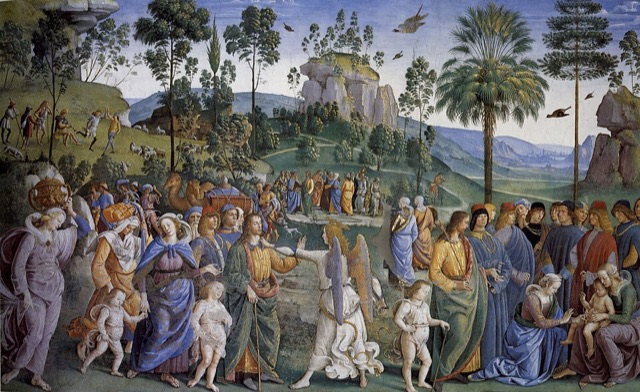
Perugino begins the surviving Moses cycle with departures and returns. The farewell to Jethro, the journey back to Egypt with Moses’s family and the circumcision episode share one landscape. Trace the changing groups rather than expecting a single frozen moment. The missing original beginning of this cycle was on the altar wall.
Stop 2 · Technique
Closer Reading
The Moses cycle begins with a journey. Several episodes, including a farewell and the return to Egypt, share this landscape.
Stop 3 · Museum record
Catalog Summary
The journey to Egypt and other related episodes occupy the first surviving panel of the Moses cycle.
Stop 4 · Historical Context
Pietro Perugino (c. 1450–1523)
Italian painter from Umbria, known for calm, spacious scenes, who was a leading painter of the Sistine Chapel walls and the teacher of Raphael.
Early Renaissance (15th century): The first age of the Renaissance in Italy, roughly the 15th century, when painters in Florence learned to give figures weight and to set them in a space that looks real.
First Look
Perugino begins the surviving Moses cycle with departures and returns. The farewell to Jethro, the journey back to Egypt with Moses’s family and the circumcision episode share one landscape. Trace the changing groups rather than expecting a single frozen moment. The missing original beginning of this cycle was on the altar wall.
Closer Reading
The Moses cycle begins with a journey. Several episodes, including a farewell and the return to Egypt, share this landscape.
Catalog Summary
The journey to Egypt and other related episodes occupy the first surviving panel of the Moses cycle.
About the Artist
Pietro Perugino (c. 1450–1523)
Pietro Vannucci was born around 1450 in Città della Pieve, near Perugia, the city that gave him the name Perugino. He trained in Florence in the workshop of Andrea del Verrocchio, where he met Leonardo da Vinci, Sandro Botticelli and Domenico Ghirlandaio. By 1472 he was registered there as a painter.
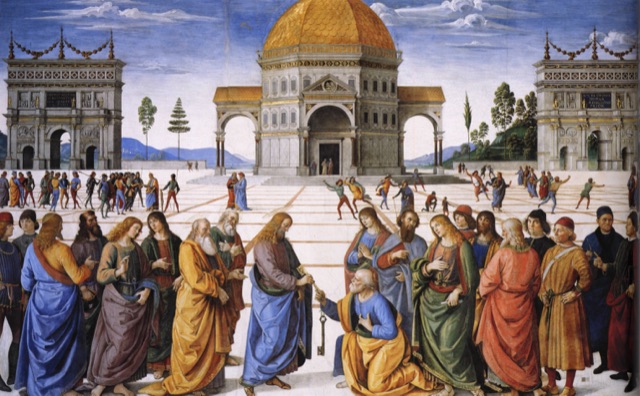
In 1481 to 1482 he worked in Rome on the walls of the Sistine Chapel for Pope Sixtus IV, alongside Botticelli, Ghirlandaio and Cosimo Rosselli. The same four painters made the portraits of popes that stand in pairs beside the windows. His Handing over of the Keys sets its figures before a domed temple flanked by two triumphal arches: a clear, balanced kind of space that his pupil Raphael later took up. Three other works of his, on the altar wall, were destroyed to make room for Michelangelo's Last Judgement.
Perugino ran workshops in both Florence and Perugia and won orders from across Italy and beyond. Raphael worked with him in Perugia in about 1500. His gentle style changed little after the 1490s, and Raphael and Leonardo overtook him. He died of plague at Fontignano, near Perugia, in 1523.