The Last Judgment
Stop 1 · First look
First Look
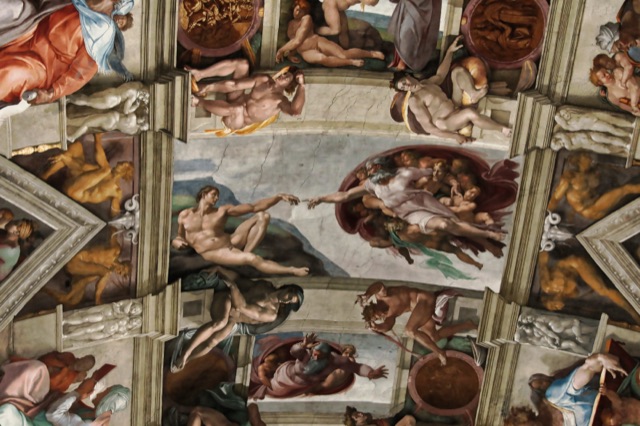
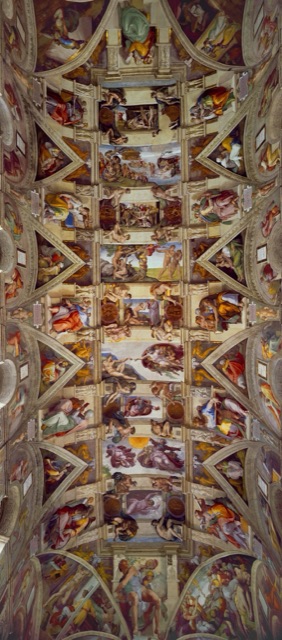
Begin with Christ’s raised arm, then follow the turning bodies around him. Below, trumpet-bearing angels separate the ascending and descending groups. Michelangelo replaces the ceiling’s orderly painted frames with a multitude in motion. The later coverings on some bodies belong to the painting’s subsequent history. This reproduction also contains photographed altar equipment near its lower edge.
Stop 2 · Technique
Closer Reading
Find Christ at the center of this gathering. Below him, angels sound long trumpets; the risen ascend on one side while others descend on the other. Michelangelo painted this altar wall between fifteen thirty-six and fifteen forty-one. The Vatican Museums describe a broad, turning movement through the figures. Choose one group, and follow it before looking at the whole.
Stop 3 · Museum record
Catalog Summary
Christ dominates the altar-wall composition. Around him, saints await judgment while the lower groups rise or descend. Some figures received painted coverings after Michelangelo’s death.
Stop 4 · Historical Context
Michelangelo (1475–1564)
Italian sculptor, painter, architect and poet of the Renaissance, who painted the ceiling and the Last Judgement of the Sistine Chapel.
High Renaissance (early decades of the 16th century): The short later age of the Renaissance in Italy, in the early 16th century, when Leonardo, Michelangelo, Raphael and Titian stood above all other painters.
First Look
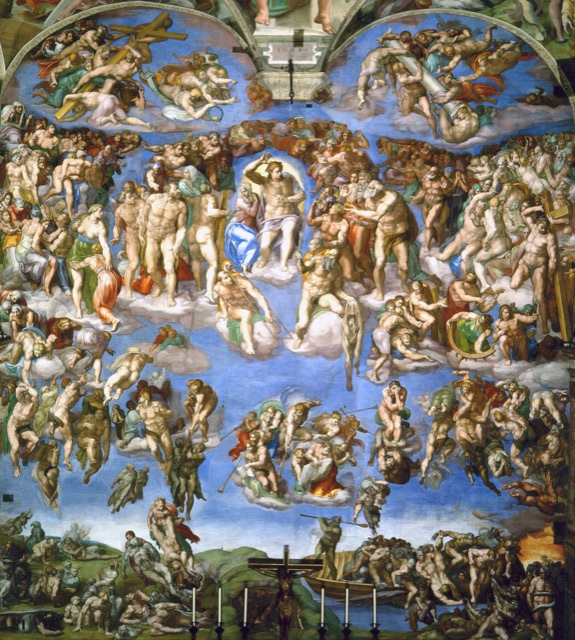
Begin with Christ’s raised arm, then follow the turning bodies around him. Below, trumpet-bearing angels separate the ascending and descending groups. Michelangelo replaces the ceiling’s orderly painted frames with a multitude in motion. The later coverings on some bodies belong to the painting’s subsequent history. This reproduction also contains photographed altar equipment near its lower edge.
Closer Reading
Find Christ at the center of this gathering. Below him, angels sound long trumpets; the risen ascend on one side while others descend on the other. Michelangelo painted this altar wall between fifteen thirty-six and fifteen forty-one. The Vatican Museums describe a broad, turning movement through the figures. Choose one group, and follow it before looking at the whole.
Catalog Summary
Christ dominates the altar-wall composition. Around him, saints await judgment while the lower groups rise or descend. Some figures received painted coverings after Michelangelo’s death.
About the Artist
Michelangelo (1475–1564)
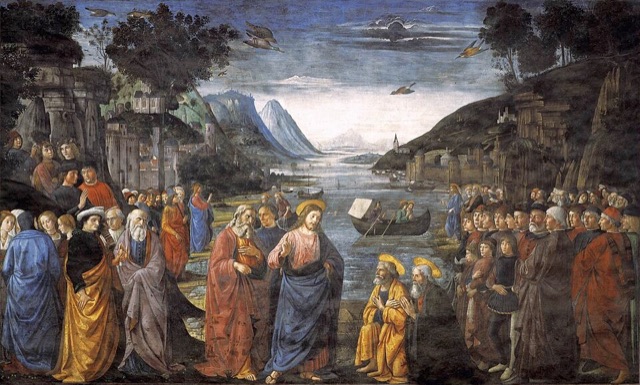
Michelangelo Buonarroti was born in Caprese, a small town that his father governed for Florence. At 13, in Florence, he was apprenticed to the painter Domenico Ghirlandaio. He soon turned to sculpture under the protection of Lorenzo de' Medici. In Rome, from 1496, he carved the Pietà for St Peter's.
In 1508 Pope Julius II hired him to repaint the ceiling of the Sistine Chapel. The first plan was for twelve apostles. Michelangelo called it a poor thing and was allowed to plan the work himself. By October 1512 he had covered the vault with nine scenes from the Book of Genesis, prophets, sibyls and the ancestors of Christ, all in fresco, which is paint laid on fresh wet plaster. Painters across Italy then built a new style, later called Mannerism, on its twisting figures and bright colour.
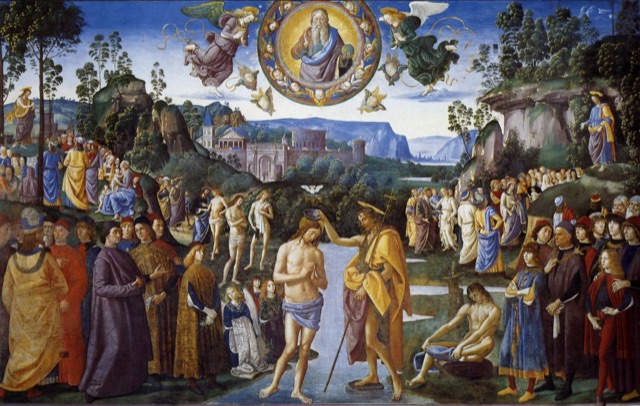
He returned to the chapel in 1536 to paint the Last Judgement on the altar wall, and finished it in 1541. Frescoes by Perugino were destroyed to make room for it, and it was influenced by Luca Signorelli's frescoes at Orvieto. Straight after the Last Judgement he painted his last two frescoes, the Conversion of Saint Paul and the Crucifixion of Saint Peter, on the side walls of the nearby Pauline Chapel. He also designed the dome of St Peter's and built it up to the drum; Giacomo della Porta finished it after his death. Michelangelo worked in Rome for his last thirty years and died there in 1564, aged 88.