The Place du Havre, Paris
Stop 1 · First look
First Look
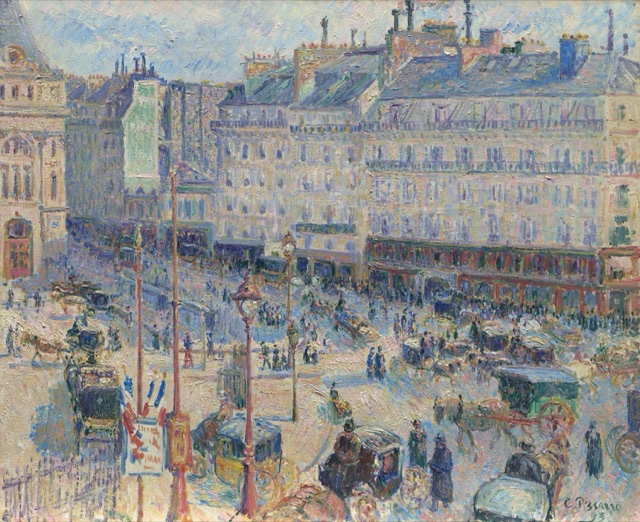
Look down into the square and try to follow one carriage through the traffic. It is hard to do. Camille Pissarro has made every cab, horse and walker from a few small touches of paint, so the whole square seems to be moving at once. He painted this view in eighteen ninety-three from the window of his hotel in Paris. At the far left edge is the Saint-Lazare railway station.
Stop 2 · Technique
Closer Reading
Notice the height we are looking from. Pissarro was in his sixties, and an eye complaint had made working outdoors difficult, so he took to painting from upper windows. For a few weeks early in eighteen ninety-three that window was at the Hôtel Garnier, above the Place du Havre. Some years before, he had tried the method of the younger painter Georges Seurat, building pictures from small separate dots. Here, the Art Institute notes, he has gone back to the looser strokes of his earlier years, laid in many directions. The subject was a return too. By the eighteen nineties most of his colleagues had left the modern city behind. Pissarro, the oldest of the group and the only one to show in all eight of its exhibitions, came back to it, and went on painting city views for the rest of his life.
Stop 3 · Museum record
Catalog Summary
Early in 1893 Pissarro took a room at the Hôtel Garnier in Paris and painted the traffic below his window. The building at the far left edge is the Saint-Lazare railway station. Oil on canvas, 60.1 × 73.5 cm.
Recorded physical scale: 73.5 × 60.1 cm (28.9 × 23.7 in · 0.73 × 0.60 m).
Stop 4 · Historical Context
Camille Pissarro (1830–1903)
Caribbean-born French painter of villages, fields and city streets, the only artist to show in all eight Impressionist exhibitions.
Impressionism (1860s to 1880s): A French way of painting modern life and landscape quickly, often outdoors, with broken touches of bright colour that catch passing effects of light.
First Look
Look down into the square and try to follow one carriage through the traffic. It is hard to do. Camille Pissarro has made every cab, horse and walker from a few small touches of paint, so the whole square seems to be moving at once. He painted this view in eighteen ninety-three from the window of his hotel in Paris. At the far left edge is the Saint-Lazare railway station.
Closer Reading
Notice the height we are looking from. Pissarro was in his sixties, and an eye complaint had made working outdoors difficult, so he took to painting from upper windows. For a few weeks early in eighteen ninety-three that window was at the Hôtel Garnier, above the Place du Havre. Some years before, he had tried the method of the younger painter Georges Seurat, building pictures from small separate dots. Here, the Art Institute notes, he has gone back to the looser strokes of his earlier years, laid in many directions. The subject was a return too. By the eighteen nineties most of his colleagues had left the modern city behind. Pissarro, the oldest of the group and the only one to show in all eight of its exhibitions, came back to it, and went on painting city views for the rest of his life.
Catalog Summary
Early in 1893 Pissarro took a room at the Hôtel Garnier in Paris and painted the traffic below his window. The building at the far left edge is the Saint-Lazare railway station. Oil on canvas, 60.1 × 73.5 cm.
About the Artist
Camille Pissarro (1830–1903)
Camille Pissarro was born in 1830 in Charlotte Amalie on St Thomas, then a Danish island in the Caribbean, where his parents kept a general store. After boarding school in Paris he worked in the family business, then painted in Venezuela with the Danish artist Fritz Melbye. In 1855 he returned to Paris.
Encouraged by Camille Corot, he painted the countryside around Paris, working outdoors. He settled at Pontoise in 1866. During the war of 1870 to 1871 he fled to London, where he worked with Claude Monet. Back at Pontoise he painted side by side with Paul Cézanne. He helped to organise the first Impressionist exhibition in 1874 and was the only artist to show in all eight.
In 1884 he moved to Éragny, came to know Georges Seurat and for a few years painted in small dots of colour. He found the method too limiting and went back to a freer touch. When failing eyesight kept him indoors, he painted busy streets in Paris and Rouen from windows, often in series. He died in Paris in 1903.