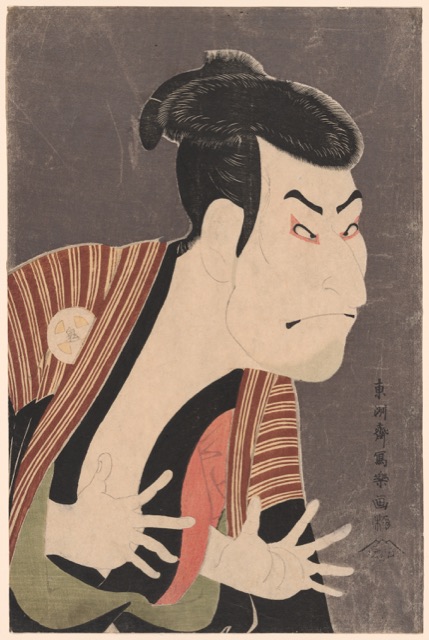
The actor Otani Oniji III as Edobei
Stop 1 · First look
First Look
Look at the hands. They push out of the robe with the fingers spread wide, tense and oddly small beneath that face. This is the kabuki actor Otani Oniji the Third, on stage in seventeen ninety-four, playing a servant named Edobei at the moment he turns to violence. The artist, Sharaku, shows us the actor as much as the villain: the jutting jaw, the narrowed eyes, the thin line of the mouth.
Stop 2 · Technique
Closer Reading
Notice the dark, flat ground behind the figure. It was printed with powdered mica, so that a fresh impression shimmered in lamplight and the actor seemed to lean out of it. The play was performed at the Kawarazaki theatre in Edo in the early summer of seventeen ninety-four. Edobei is a manservant sent to rob another man’s servant, and this is the instant before he strikes. Prints of actors were sold to theatre fans much as photographs of film stars would be later, and they usually flattered. Sharaku did not. He kept the lines of age and the strain of the pose. About one hundred and forty of his designs are known, all published within some ten months. Then they stop. Who he was has never been settled.
Stop 3 · Museum record
Catalog Summary
The kabuki actor Otani Oniji III plays Edobei, a servant about to commit a robbery, in a play staged in Edo in 1794. Sharaku’s actor portraits appeared over only about ten months, and nothing certain is known of his life. Colour woodblock print, 37.9 × 25 cm.
Recorded physical scale: 25.0 × 37.9 cm (9.8 × 14.9 in · 0.25 × 0.38 m).
Stop 4 · Historical Context
Tōshūsai Sharaku
Designer of bold Kabuki actor portraits whose whole known career lasted ten months in 1794 and 1795, and whose identity is still uncertain.
Ukiyo-e (17th to 19th century (the Edo period)): Japanese pictures of the floating world: paintings and, above all, woodblock prints of actors, beauties and landscapes made for townspeople in the Edo period.
First Look
Look at the hands. They push out of the robe with the fingers spread wide, tense and oddly small beneath that face. This is the kabuki actor Otani Oniji the Third, on stage in seventeen ninety-four, playing a servant named Edobei at the moment he turns to violence. The artist, Sharaku, shows us the actor as much as the villain: the jutting jaw, the narrowed eyes, the thin line of the mouth.
Closer Reading
Notice the dark, flat ground behind the figure. It was printed with powdered mica, so that a fresh impression shimmered in lamplight and the actor seemed to lean out of it. The play was performed at the Kawarazaki theatre in Edo in the early summer of seventeen ninety-four. Edobei is a manservant sent to rob another man’s servant, and this is the instant before he strikes. Prints of actors were sold to theatre fans much as photographs of film stars would be later, and they usually flattered. Sharaku did not. He kept the lines of age and the strain of the pose. About one hundred and forty of his designs are known, all published within some ten months. Then they stop. Who he was has never been settled.
Catalog Summary
The kabuki actor Otani Oniji III plays Edobei, a servant about to commit a robbery, in a play staged in Edo in 1794. Sharaku’s actor portraits appeared over only about ten months, and nothing certain is known of his life. Colour woodblock print, 37.9 × 25 cm.
About the Artist
Tōshūsai Sharaku
Nobody knows for certain who Tōshūsai Sharaku was, when he was born or when he died. Only his working months are documented. The name appears on prints published in Edo, now Tokyo, from the middle of 1794 to early 1795. In about ten months he designed some 140 to 150 prints of Kabuki actors. Then the prints stopped.
The first 28 are the best known. They are close-up portraits of actors in roles from plays then running at Edo's three main theatres. The background is dark and glitters, because powdered mica, a shiny mineral, was printed onto it. Sharaku did not flatter. He pushed faces, hands and scowls close to caricature, often at the most dramatic moment of a play. Later designs show two full-length figures on a sheet.
His publisher was Tsutaya Jūzaburō, who also published Kitagawa Utamaro. Why Sharaku stopped is unknown: his style may simply not have kept its buyers. An old tradition says he was a Nō actor named Saitō Jūrōbei, and some scholars have even suggested Katsushika Hokusai. Neither idea is proven.