A Young Woman in a Summer Shower
Stop 1 · First look
First Look
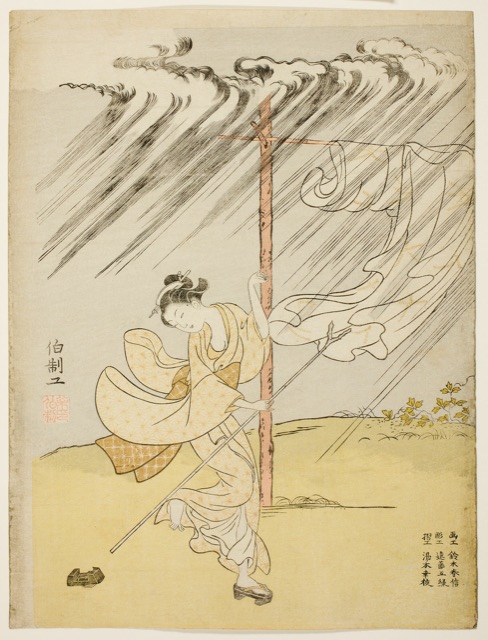
Look at the ground behind the running woman. One of her sandals lies there, lost as she hurries to pull the washing from the line. The rain is drawn as hard slanting lines, and the wind lifts her sleeves and the cloth above her. Suzuki Harunobu designed this print in seventeen sixty-five, the year full-colour printing began in Edo, the city we now call Tokyo.
Stop 2 · Technique
Closer Reading
Look closely at the robe flying from the line. The pale marks scattered over it are numerals, worked into the pattern. In seventeen sixty-five, poetry circles in Edo commissioned picture calendars as gifts, and their designers competed to hide the numbers of the year’s long months inside the image. This sheet is one of them. At the left edge is the name of the patron who devised it. At the lower right, unusually, the designer, the block carver and the printer are each named. Calendars like this called for more colours and finer printing than anything sold in the shops. Within months the same workshops were selling prints made this way to the public, under the name brocade pictures. Suzuki Harunobu became their first master, and until his death five years later his slender figures set the fashion.
Stop 3 · Museum record
Catalog Summary
A sudden shower sends a young woman running to save the washing, and she loses a sandal on the way. This sheet was privately commissioned in 1765, the year in which Harunobu’s full-colour printing first appeared in Edo. Colour woodblock print, 28.8 × 21.7 cm.
Recorded physical scale: 21.7 × 28.8 cm (8.5 × 11.3 in · 0.22 × 0.29 m).
Stop 4 · Historical Context
Suzuki Harunobu (c. 1725–1770)
Edo print designer credited with the first full-colour Japanese woodblock prints in 1765, filled with slender young figures and scenes drawn from poetry.
Ukiyo-e (17th to 19th century (the Edo period)): Japanese pictures of the floating world: paintings and, above all, woodblock prints of actors, beauties and landscapes made for townspeople in the Edo period.
First Look
Look at the ground behind the running woman. One of her sandals lies there, lost as she hurries to pull the washing from the line. The rain is drawn as hard slanting lines, and the wind lifts her sleeves and the cloth above her. Suzuki Harunobu designed this print in seventeen sixty-five, the year full-colour printing began in Edo, the city we now call Tokyo.
Closer Reading
Look closely at the robe flying from the line. The pale marks scattered over it are numerals, worked into the pattern. In seventeen sixty-five, poetry circles in Edo commissioned picture calendars as gifts, and their designers competed to hide the numbers of the year’s long months inside the image. This sheet is one of them. At the left edge is the name of the patron who devised it. At the lower right, unusually, the designer, the block carver and the printer are each named. Calendars like this called for more colours and finer printing than anything sold in the shops. Within months the same workshops were selling prints made this way to the public, under the name brocade pictures. Suzuki Harunobu became their first master, and until his death five years later his slender figures set the fashion.
Catalog Summary
A sudden shower sends a young woman running to save the washing, and she loses a sandal on the way. This sheet was privately commissioned in 1765, the year in which Harunobu’s full-colour printing first appeared in Edo. Colour woodblock print, 28.8 × 21.7 cm.
About the Artist
Suzuki Harunobu (c. 1725–1770)
Suzuki Harunobu worked in Edo, the city now called Tokyo. His birth year is uncertain: museums give 1724 or 1725. His early prints used only a few colours, mainly red and green.
In 1765 it was the fashion in Edo to swap picture calendars at gatherings, and Harunobu designed many. His patrons were wealthy, well-read townsmen from poetry circles. A separate woodblock was carved for each colour, and marks cut into the blocks kept the paper lined up, so any number of colours could be printed on one sheet. The results were called nishiki-e, or brocade pictures, after the rich woven silks of Kyoto. Full colour soon became the normal way to make a Japanese print.
He drew slim, graceful young women and men, children at play, and people of his own day acting out old poems and legends, such as those of the poet Ono no Komachi. His finest prints all date from his last five years. He died in 1770. Torii Kiyonaga later made his own version of Harunobu's series Eight Views of the Parlor.