Woman at the Piano
Stop 1 · First look
First Look
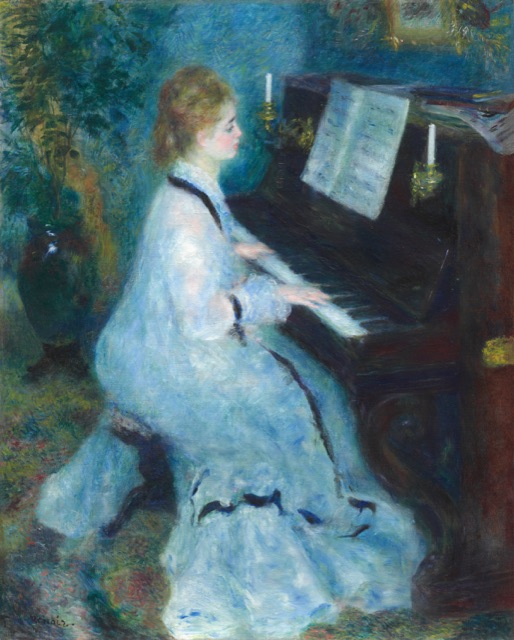
Look at the white dress. It is hardly white at all. Pierre-Auguste Renoir has built it from strokes of pale blue, violet and pink, with a dark ribbon running down the front like a line of ink. He painted this in eighteen seventy-five or seventy-six. A young woman is playing an upright piano, her eyes on the music. Two candles stand ready on the instrument. Neither is lit.
Stop 2 · Technique
Closer Reading
Notice the hands. Renoir has not drawn the fingers one by one. A few soft touches of paint are enough to show that they are moving over the keys. The whole picture works that way. The black piano is not really black: it carries blue and green reflections, and the dark ribbon on the dress answers it. Behind the player a plant in a dark pot and a patterned wall close the room in, so that the pale figure seems to give off its own light. Playing the piano at home was an ordinary part of middle-class life in Paris, and Renoir came back to the subject several times in later years. The Art Institute’s record gives no story for this picture, and it does not need one. It is about a woman absorbed in what she is doing, and about what light does to a white dress.
Stop 3 · Museum record
Catalog Summary
A young woman in a white dress trimmed with a dark ribbon plays an upright piano in a room of deep blues and greens. Renoir paints the dress as a cloud of pale blue, violet and white strokes, the brightest thing in the picture. Oil on canvas, 93 × 74 cm.
Recorded physical scale: 74.0 × 93.0 cm (29.1 × 36.6 in · 0.74 × 0.93 m).
Stop 4 · Historical Context
Pierre-Auguste Renoir (1841–1919)
French Impressionist who painted people at leisure in bright, broken colour, and later turned to firmer outlines and rounded, sculptural figures.
Impressionism (1860s to 1880s): A French way of painting modern life and landscape quickly, often outdoors, with broken touches of bright colour that catch passing effects of light.
First Look
Look at the white dress. It is hardly white at all. Pierre-Auguste Renoir has built it from strokes of pale blue, violet and pink, with a dark ribbon running down the front like a line of ink. He painted this in eighteen seventy-five or seventy-six. A young woman is playing an upright piano, her eyes on the music. Two candles stand ready on the instrument. Neither is lit.
Closer Reading
Notice the hands. Renoir has not drawn the fingers one by one. A few soft touches of paint are enough to show that they are moving over the keys. The whole picture works that way. The black piano is not really black: it carries blue and green reflections, and the dark ribbon on the dress answers it. Behind the player a plant in a dark pot and a patterned wall close the room in, so that the pale figure seems to give off its own light. Playing the piano at home was an ordinary part of middle-class life in Paris, and Renoir came back to the subject several times in later years. The Art Institute’s record gives no story for this picture, and it does not need one. It is about a woman absorbed in what she is doing, and about what light does to a white dress.
Catalog Summary
A young woman in a white dress trimmed with a dark ribbon plays an upright piano in a room of deep blues and greens. Renoir paints the dress as a cloud of pale blue, violet and white strokes, the brightest thing in the picture. Oil on canvas, 93 × 74 cm.
About the Artist
Pierre-Auguste Renoir (1841–1919)
Pierre-Auguste Renoir was born in Limoges and started work as a painter of porcelain. In Paris, in the early 1860s, he joined the studio of Charles Gleyre, where he met Claude Monet, Alfred Sisley and Frédéric Bazille. In 1869 he and Monet sketched together beside the Seine, and Renoir began to use lighter colours and short, broken brushstrokes.
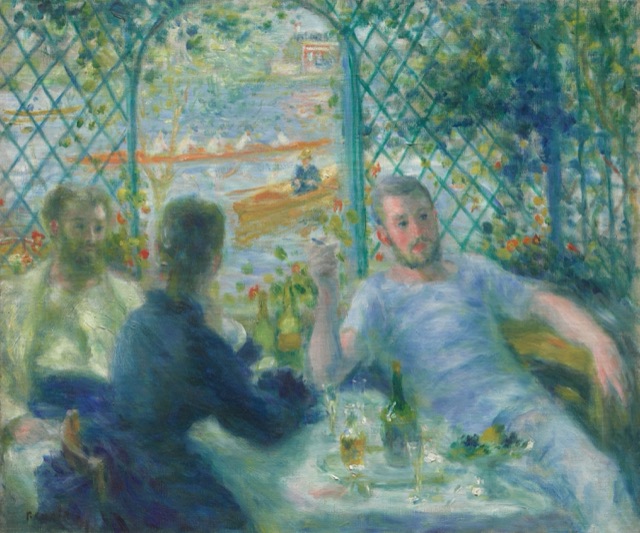
He showed in the first Impressionist exhibition of 1874, with Monet, Pissarro, Cézanne, Degas and Berthe Morisot. He chose happy subjects: friends at riverside restaurants, children, flowers. Luncheon of the Boating Party, with his friends as models, is the best known. A journey to Italy in 1881, where he saw the wall paintings of Pompeii and Renaissance art, led him to firmer outlines.
Fame came in the 1890s. From the 1900s he lived in the south of France and built a house at Cagnes-sur-Mer in 1908. Poor health forced him to paint sitting down, yet he went on painting his family and full-figured women in warm landscapes. He died at Cagnes in 1919. His son Jean became a film director.