1875–1881 · 3 works · Art Institute of Chicago
Renoir: Figures and Interiors
Stop 1 of 3 · Pierre-Auguste Renoir · 1881
Two Sisters (On the Terrace)
First Look
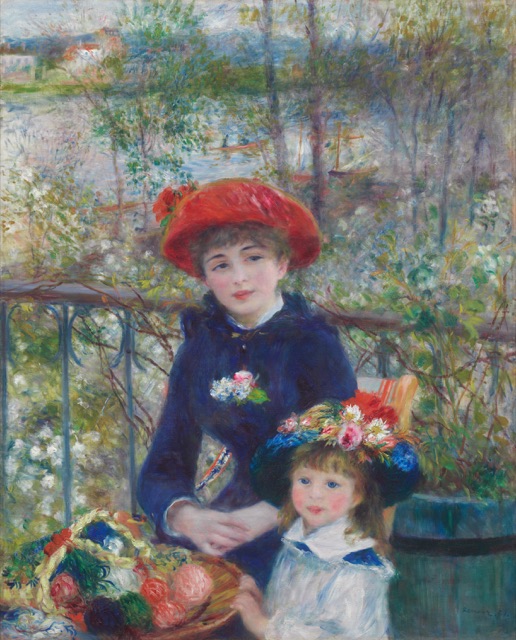
Look at the basket in the lower left corner, full of balls of bright wool. The same colours are scattered through the whole picture. Pierre-Auguste Renoir painted this in eighteen eighty-one on a restaurant terrace beside the Seine, just outside Paris. The two girls were not sisters, whatever the title says. He paid them to pose. Behind them the river and the trees dissolve into spring light.
A closer look
Notice the difference between the faces and everything around them. Renoir painted the two faces with small, careful strokes, so that the skin looks as smooth as porcelain. The river, the boats and the blossoming trees behind are done quite differently, in thin, quick touches that never quite settle into shapes. The contrast is deliberate. The setting is the Restaurant Fournaise at Chatou, where he liked to escape from Paris, and this is among the last pictures he painted there. The older girl wears the dark blue flannel of a woman’s boating costume. The Art Institute suggests that the wool in the basket is like a painter’s palette, a sample of the colours he has used. Renoir sent the painting to the Impressionist exhibition of eighteen eighty-two. Look at the child once more. She rests a hand on the basket, and looks past us.
A young woman in a red hat and a child crowned with flowers sit on the terrace of the Restaurant Fournaise at Chatou, with the Seine behind them. Despite the title, the models were not related. Renoir showed the painting at the Impressionist exhibition of 1882. Oil on canvas, 100.4 × 80.9 cm.
Stop 2 of 3 · Pierre-Auguste Renoir · 1879
Acrobats at the Cirque Fernando (Francisca and Angelina Wartenberg)
First Look
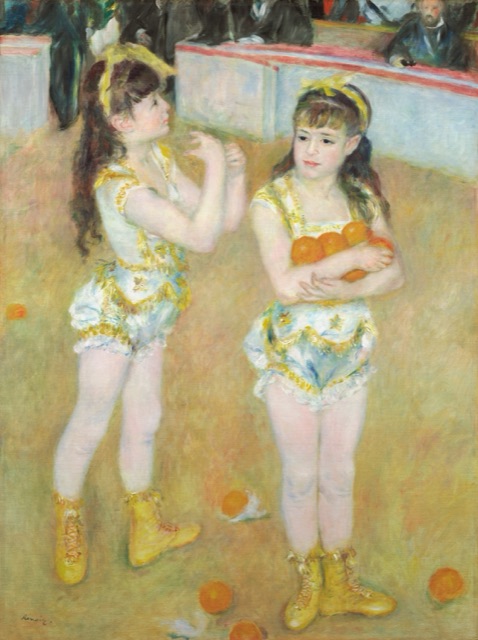
Look at the oranges, in the girl’s arms and on the floor of the ring. The audience has thrown them as a reward. These are Francisca and Angelina Wartenberg, sisters and acrobats at the Cirque Fernando in Paris. Pierre-Auguste Renoir painted them in eighteen seventy-nine, just after their act. One turns to acknowledge the crowd. The other looks out at us, with her arms full.
A closer look
Now look at the very top of the canvas. A row of men in dark suits sits behind the barrier, cut off by the frame. They are all that Renoir shows of the audience. The circus was a favourite evening out in Paris, and not always an innocent one. Renoir pushed that side of it to the edge. A picture, he said, should be something likeable, joyous and pretty, because there are enough ugly things in life already. He did not paint the girls at the circus itself. He feared that its harsh gaslight would turn faces into grimaces, so they came to his studio in costume and posed in daylight. The sisters were seventeen and fourteen, though he made them look younger. The first owner of the painting was Bertha Honoré Palmer of Chicago. The Art Institute records that she liked it so much she kept it with her, even when she travelled abroad.
Francisca and Angelina Wartenberg, sisters who performed as acrobats at the Cirque Fernando in Paris, take their bows in the ring. One holds an armful of the oranges that the audience threw as a tribute. Renoir posed them in his studio so that he could paint them by daylight. Oil on canvas, 131.2 × 99.2 cm.
Stop 3 of 3 · Pierre-Auguste Renoir · 1875–76
Woman at the Piano
First Look
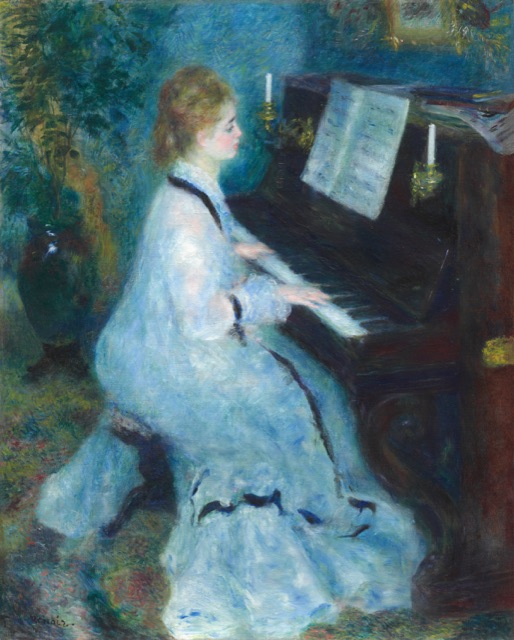
Look at the white dress. It is hardly white at all. Pierre-Auguste Renoir has built it from strokes of pale blue, violet and pink, with a dark ribbon running down the front like a line of ink. He painted this in eighteen seventy-five or seventy-six. A young woman is playing an upright piano, her eyes on the music. Two candles stand ready on the instrument. Neither is lit.
A closer look
Notice the hands. Renoir has not drawn the fingers one by one. A few soft touches of paint are enough to show that they are moving over the keys. The whole picture works that way. The black piano is not really black: it carries blue and green reflections, and the dark ribbon on the dress answers it. Behind the player a plant in a dark pot and a patterned wall close the room in, so that the pale figure seems to give off its own light. Playing the piano at home was an ordinary part of middle-class life in Paris, and Renoir came back to the subject several times in later years. The Art Institute’s record gives no story for this picture, and it does not need one. It is about a woman absorbed in what she is doing, and about what light does to a white dress.
A young woman in a white dress trimmed with a dark ribbon plays an upright piano in a room of deep blues and greens. Renoir paints the dress as a cloud of pale blue, violet and white strokes, the brightest thing in the picture. Oil on canvas, 93 × 74 cm.
1881Two Sisters (On the Terrace)
A young woman in a red hat and a child crowned with flowers sit on the terrace of the Restaurant Fournaise at Chatou, with the Seine behind them. Despite the title, the models were not related. Renoir showed the painting at the Impressionist exhibition of 1882. Oil on canvas, 100.4 × 80.9 cm.
1879Acrobats at the Cirque Fernando
Francisca and Angelina Wartenberg, sisters who performed as acrobats at the Cirque Fernando in Paris, take their bows in the ring. One holds an armful of the oranges that the audience threw as a tribute. Renoir posed them in his studio so that he could paint them by daylight. Oil on canvas, 131.2 × 99.2 cm.
1875–76Woman at the Piano
A young woman in a white dress trimmed with a dark ribbon plays an upright piano in a room of deep blues and greens. Renoir paints the dress as a cloud of pale blue, violet and white strokes, the brightest thing in the picture. Oil on canvas, 93 × 74 cm.
Other exhibitions
The Sistine Chapel: Ceiling, Altar, and Wall Cycles
Michelangelo’s ceiling and Last Judgment alongside the fifteenth-century north and south wall narratives by Botticelli, Perugino, Ghirlandaio, Rosselli, and Signorelli.
1765–1857 · 7 worksEdo: Pictures of the Floating World
Seven woodblock prints from the city of Edo, 1765 to 1857: Harunobu, Kiyonaga, Sharaku, Utamaro and Hiroshige, from the Art Institute of Chicago.
1867–1893 · 7 worksImpressionism: Painters of Modern Life
Seven painters and seven views of modern France, 1867 to 1893: Monet, Renoir, Morisot, Caillebotte, Degas, Cassatt and Pissarro, from the Art Institute of Chicago.
1782–1893 · 6 worksFrom Edo to Paris: Ukiyo-e and the Impressionist Eye
How Japanese woodblock masters Hiroshige and Kiyonaga inspired the cropped framing, asymmetric diagonals, and rain-swept streets of Caillebotte, Degas, and Cassatt.