Acrobats at the Cirque Fernando (Francisca and Angelina Wartenberg)
Stop 1 · First look
First Look
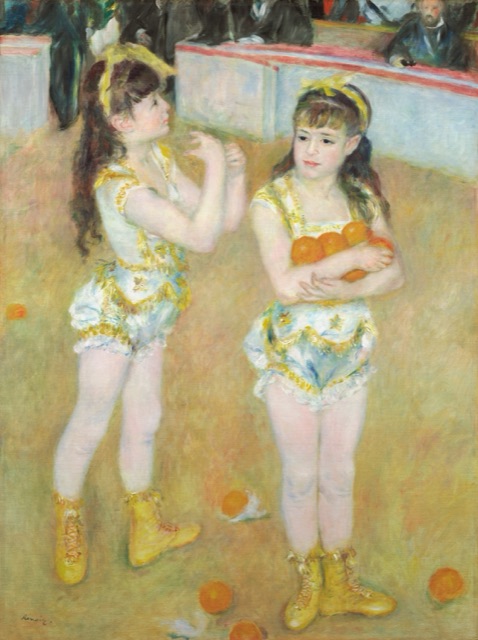
Look at the oranges, in the girl’s arms and on the floor of the ring. The audience has thrown them as a reward. These are Francisca and Angelina Wartenberg, sisters and acrobats at the Cirque Fernando in Paris. Pierre-Auguste Renoir painted them in eighteen seventy-nine, just after their act. One turns to acknowledge the crowd. The other looks out at us, with her arms full.
Stop 2 · Technique
Closer Reading
Now look at the very top of the canvas. A row of men in dark suits sits behind the barrier, cut off by the frame. They are all that Renoir shows of the audience. The circus was a favourite evening out in Paris, and not always an innocent one. Renoir pushed that side of it to the edge. A picture, he said, should be something likeable, joyous and pretty, because there are enough ugly things in life already. He did not paint the girls at the circus itself. He feared that its harsh gaslight would turn faces into grimaces, so they came to his studio in costume and posed in daylight. The sisters were seventeen and fourteen, though he made them look younger. The first owner of the painting was Bertha Honoré Palmer of Chicago. The Art Institute records that she liked it so much she kept it with her, even when she travelled abroad.
Stop 3 · Museum record
Catalog Summary
Francisca and Angelina Wartenberg, sisters who performed as acrobats at the Cirque Fernando in Paris, take their bows in the ring. One holds an armful of the oranges that the audience threw as a tribute. Renoir posed them in his studio so that he could paint them by daylight. Oil on canvas, 131.2 × 99.2 cm.
Recorded physical scale: 99.2 × 131.2 cm (39.1 × 51.7 in · 0.99 × 1.31 m).
Stop 4 · Historical Context
Pierre-Auguste Renoir (1841–1919)
French Impressionist who painted people at leisure in bright, broken colour, and later turned to firmer outlines and rounded, sculptural figures.
Impressionism (1860s to 1880s): A French way of painting modern life and landscape quickly, often outdoors, with broken touches of bright colour that catch passing effects of light.
First Look
Look at the oranges, in the girl’s arms and on the floor of the ring. The audience has thrown them as a reward. These are Francisca and Angelina Wartenberg, sisters and acrobats at the Cirque Fernando in Paris. Pierre-Auguste Renoir painted them in eighteen seventy-nine, just after their act. One turns to acknowledge the crowd. The other looks out at us, with her arms full.
Closer Reading
Now look at the very top of the canvas. A row of men in dark suits sits behind the barrier, cut off by the frame. They are all that Renoir shows of the audience. The circus was a favourite evening out in Paris, and not always an innocent one. Renoir pushed that side of it to the edge. A picture, he said, should be something likeable, joyous and pretty, because there are enough ugly things in life already. He did not paint the girls at the circus itself. He feared that its harsh gaslight would turn faces into grimaces, so they came to his studio in costume and posed in daylight. The sisters were seventeen and fourteen, though he made them look younger. The first owner of the painting was Bertha Honoré Palmer of Chicago. The Art Institute records that she liked it so much she kept it with her, even when she travelled abroad.
Catalog Summary
Francisca and Angelina Wartenberg, sisters who performed as acrobats at the Cirque Fernando in Paris, take their bows in the ring. One holds an armful of the oranges that the audience threw as a tribute. Renoir posed them in his studio so that he could paint them by daylight. Oil on canvas, 131.2 × 99.2 cm.
About the Artist
Pierre-Auguste Renoir (1841–1919)
Pierre-Auguste Renoir was born in Limoges and started work as a painter of porcelain. In Paris, in the early 1860s, he joined the studio of Charles Gleyre, where he met Claude Monet, Alfred Sisley and Frédéric Bazille. In 1869 he and Monet sketched together beside the Seine, and Renoir began to use lighter colours and short, broken brushstrokes.
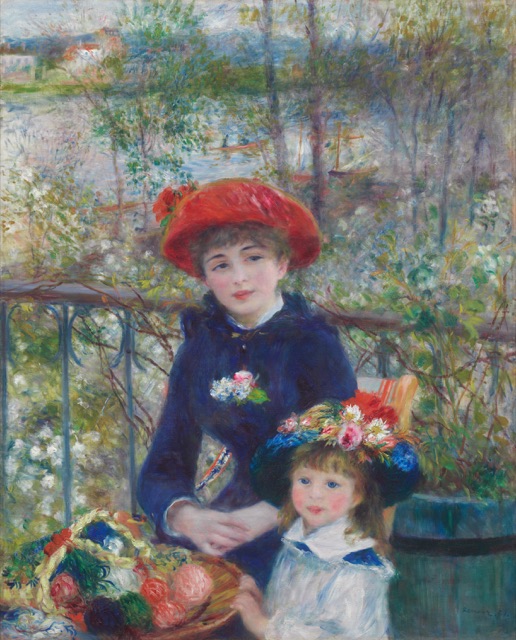
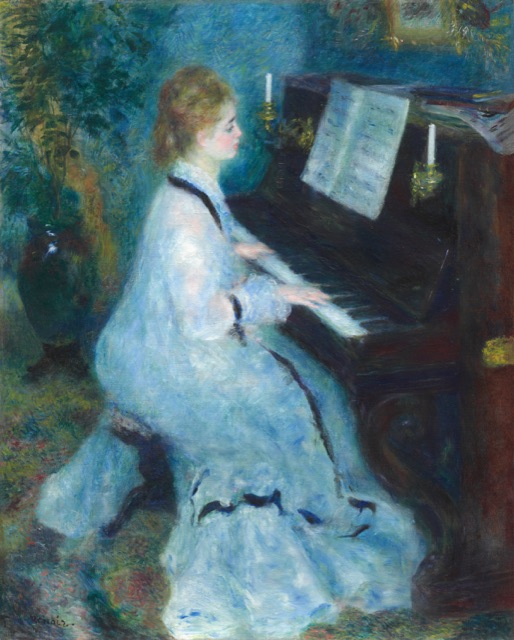
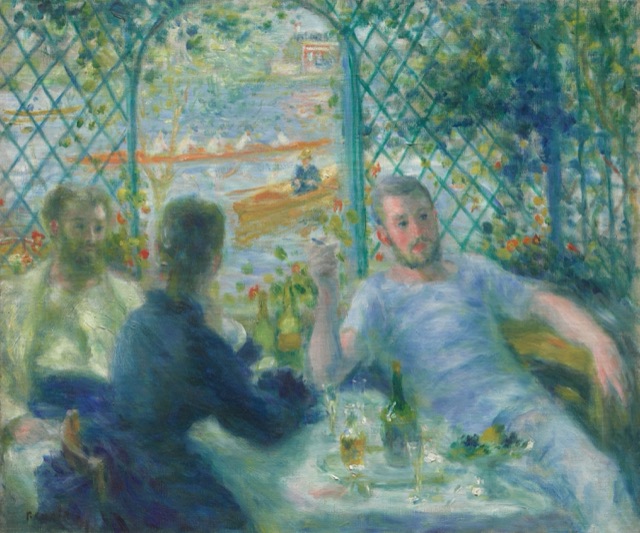
He showed in the first Impressionist exhibition of 1874, with Monet, Pissarro, Cézanne, Degas and Berthe Morisot. He chose happy subjects: friends at riverside restaurants, children, flowers. Luncheon of the Boating Party, with his friends as models, is the best known. A journey to Italy in 1881, where he saw the wall paintings of Pompeii and Renaissance art, led him to firmer outlines.
Fame came in the 1890s. From the 1900s he lived in the south of France and built a house at Cagnes-sur-Mer in 1908. Poor health forced him to paint sitting down, yet he went on painting his family and full-figured women in warm landscapes. He died at Cagnes in 1919. His son Jean became a film director.