Auvers, Panoramic View
Stop 1 · First look
First Look
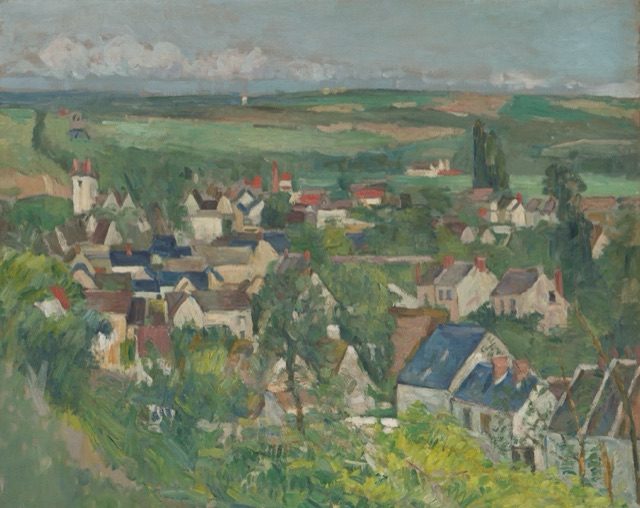
Look at the roofs, blue slate and red tile, each one a single patch of colour. Paul Cezanne painted this view between eighteen seventy-three and eighteen seventy-five, looking down on the village of Auvers, north of Paris. He had come to work near an older painter, Camille Pissarro, who became his mentor. The view runs from the houses below us to a far, pale horizon.
Stop 2 · Technique
Closer Reading
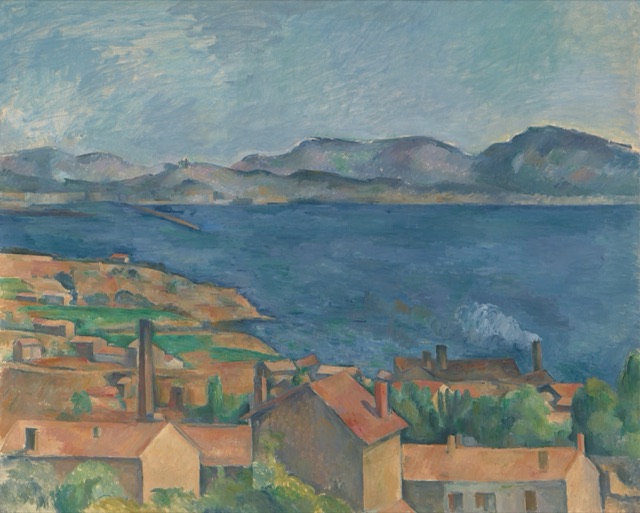
Find the lower left corner, and then the middle of the foreground. The paint there is thin and ragged, and it may look unfinished. The Art Institute points to these passages as a choice. Cezanne was trying to give more than the look of the place. He wanted the feeling of seeing it and of painting it, and he left the work of his brush in view. The high viewpoint is unusual too. We look down on the roofs as if from a hillside path, and the houses fit together like the pieces of a puzzle. This is an early landscape, made while Cezanne was learning from the Impressionists. Compare it with his Bay of Marseille, painted about ten years later. The patches of colour are already here. In the later picture they have become the whole structure.
Stop 3 · Museum record
Catalog Summary
Cezanne looks down over the roofs of Auvers and out to the open country, during his first long stay in the village, where the painter Camille Pissarro was his mentor. The blocky patches of colour and the loosely brushed foreground were radical choices at the time. Oil on canvas, 65.2 × 81.3 cm.
Recorded physical scale: 81.3 × 65.2 cm (32.0 × 25.7 in · 0.81 × 0.65 m).
Stop 4 · Historical Context
Paul Cézanne (1839–1906)
French painter who built pictures from small, ordered strokes of colour, giving Impressionism a new solidity that shaped Picasso and much of modern art.
Impressionism (1860s to 1880s): A French way of painting modern life and landscape quickly, often outdoors, with broken touches of bright colour that catch passing effects of light.
First Look
Look at the roofs, blue slate and red tile, each one a single patch of colour. Paul Cezanne painted this view between eighteen seventy-three and eighteen seventy-five, looking down on the village of Auvers, north of Paris. He had come to work near an older painter, Camille Pissarro, who became his mentor. The view runs from the houses below us to a far, pale horizon.
Closer Reading
Find the lower left corner, and then the middle of the foreground. The paint there is thin and ragged, and it may look unfinished. The Art Institute points to these passages as a choice. Cezanne was trying to give more than the look of the place. He wanted the feeling of seeing it and of painting it, and he left the work of his brush in view. The high viewpoint is unusual too. We look down on the roofs as if from a hillside path, and the houses fit together like the pieces of a puzzle. This is an early landscape, made while Cezanne was learning from the Impressionists. Compare it with his Bay of Marseille, painted about ten years later. The patches of colour are already here. In the later picture they have become the whole structure.
Catalog Summary
Cezanne looks down over the roofs of Auvers and out to the open country, during his first long stay in the village, where the painter Camille Pissarro was his mentor. The blocky patches of colour and the loosely brushed foreground were radical choices at the time. Oil on canvas, 65.2 × 81.3 cm.
About the Artist
Paul Cézanne (1839–1906)
Paul Cézanne was born in Aix-en-Provence, the son of a wealthy banker and a boyhood friend of the writer Émile Zola. He studied law to please his family while taking drawing lessons, then left for Paris in 1862 to paint. In his early pictures the paint is laid on thickly with a palette knife.
In 1872 he moved to Auvers-sur-Oise and painted outdoors beside Camille Pissarro, who guided him. He showed with Monet, Renoir and Pissarro in the first Impressionist exhibition of 1874. But he wanted, he said, to 'make of Impressionism something solid and durable like the art of museums'. He worked slowly, using small, blocky strokes of warm and cool colour to build up form.
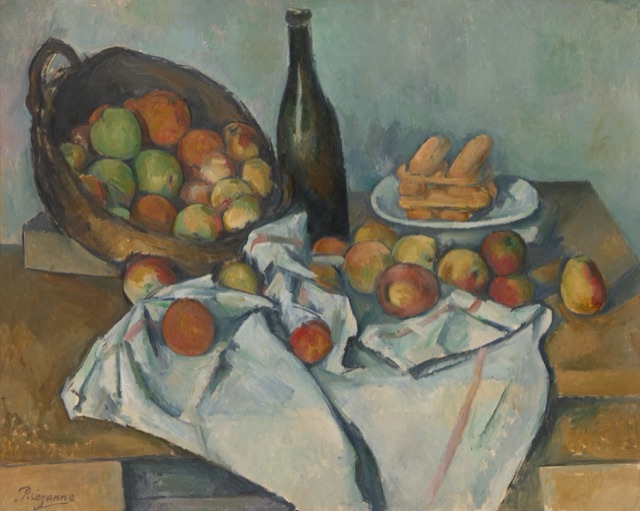
He kept returning to a few subjects: apples on a tilted table, the bay at L'Estaque, the landscape of Provence, bathers. His first exhibition of his own, at Ambroise Vollard's gallery in Paris in 1895, brought him wide notice. Younger painters took him as their guide, and Picasso is said to have called him 'the father of us all'. He died in Aix in 1906.