The Basket of Apples
Stop 1 · First look
First Look
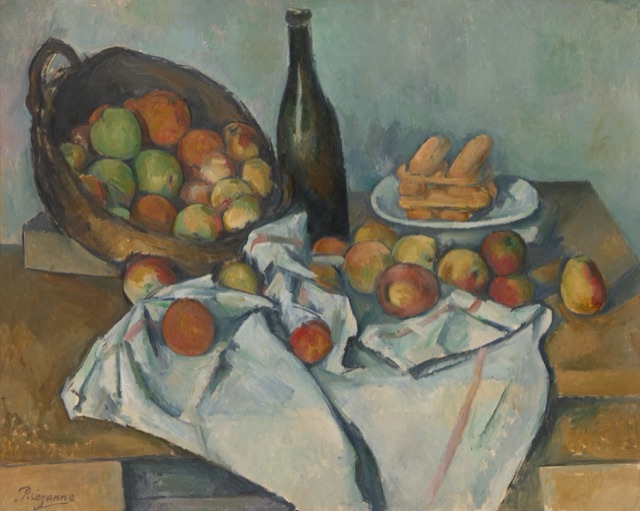
Look at the front edge of the table, to the left of the white cloth and then to the right of it. The two sides do not meet. Paul Cezanne painted this still life around eighteen ninety-three. The bottle leans. The basket tips forward, and the apples seem ready to roll onto the floor. The Art Institute of Chicago calls the effect controlled chaos. None of it is a mistake.
Stop 2 · Technique
Closer Reading
Find the plate of biscuits behind the apples, on the right. They are stacked like logs, in a pile that ought to slide off the plate and does not. Cezanne looked at each object for a long time and painted it from wherever he then stood, so the bottle is seen from one place, the basket from another, and the tabletop from a third. No camera could take this picture. Notice the brushwork as well. The apples and the folds of the cloth are built from thick, firm strokes, while the edges of the table are only sketched in. Cezanne rarely signed his paintings, but this one carries his name at the lower left, which suggests that it mattered to him. It was the first of his works to enter the Art Institute’s collection.
Stop 3 · Museum record
Catalog Summary
A table that will not hold still: the two halves of its front edge do not line up, the bottle leans, and the apples seem about to roll out of the picture. Cezanne painted each thing as he saw it from where he stood, and let the views disagree. Oil on canvas, 65 × 80 cm.
Recorded physical scale: 80.0 × 65.0 cm (31.5 × 25.6 in · 0.80 × 0.65 m).
Stop 4 · Historical Context
Paul Cézanne (1839–1906)
French painter who built pictures from small, ordered strokes of colour, giving Impressionism a new solidity that shaped Picasso and much of modern art.
Post-Impressionism (about 1886 to the early 1900s): A later name for painters, chiefly Cézanne, Gauguin, Seurat and Van Gogh, who started from Impressionism around 1886 and each took it somewhere different.
First Look
Look at the front edge of the table, to the left of the white cloth and then to the right of it. The two sides do not meet. Paul Cezanne painted this still life around eighteen ninety-three. The bottle leans. The basket tips forward, and the apples seem ready to roll onto the floor. The Art Institute of Chicago calls the effect controlled chaos. None of it is a mistake.
Closer Reading
Find the plate of biscuits behind the apples, on the right. They are stacked like logs, in a pile that ought to slide off the plate and does not. Cezanne looked at each object for a long time and painted it from wherever he then stood, so the bottle is seen from one place, the basket from another, and the tabletop from a third. No camera could take this picture. Notice the brushwork as well. The apples and the folds of the cloth are built from thick, firm strokes, while the edges of the table are only sketched in. Cezanne rarely signed his paintings, but this one carries his name at the lower left, which suggests that it mattered to him. It was the first of his works to enter the Art Institute’s collection.
Catalog Summary
A table that will not hold still: the two halves of its front edge do not line up, the bottle leans, and the apples seem about to roll out of the picture. Cezanne painted each thing as he saw it from where he stood, and let the views disagree. Oil on canvas, 65 × 80 cm.
About the Artist
Paul Cézanne (1839–1906)
Paul Cézanne was born in Aix-en-Provence, the son of a wealthy banker and a boyhood friend of the writer Émile Zola. He studied law to please his family while taking drawing lessons, then left for Paris in 1862 to paint. In his early pictures the paint is laid on thickly with a palette knife.
In 1872 he moved to Auvers-sur-Oise and painted outdoors beside Camille Pissarro, who guided him. He showed with Monet, Renoir and Pissarro in the first Impressionist exhibition of 1874. But he wanted, he said, to 'make of Impressionism something solid and durable like the art of museums'. He worked slowly, using small, blocky strokes of warm and cool colour to build up form.
He kept returning to a few subjects: apples on a tilted table, the bay at L'Estaque, the landscape of Provence, bathers. His first exhibition of his own, at Ambroise Vollard's gallery in Paris in 1895, brought him wide notice. Younger painters took him as their guide, and Picasso is said to have called him 'the father of us all'. He died in Aix in 1906.