A Sunday on La Grande Jatte — 1884
Stop 1 · First look
First Look
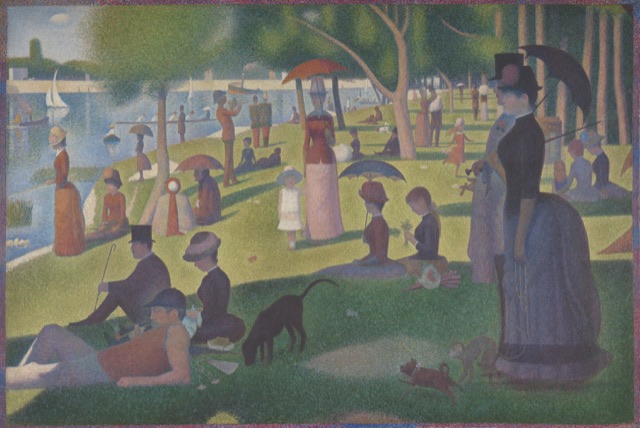
Look at any patch of grass, and step closer. The green breaks up into dots and dashes: yellow, blue, orange, set side by side. Georges Seurat painted this picture between eighteen eighty-four and eighteen eighty-six. It shows Parisians on a Sunday afternoon in a park on an island in the Seine. The canvas is more than three metres wide. Almost nobody in it is moving.
Stop 2 · Technique
Closer Reading
Find the woman on the right with the parasol, and the small monkey on a lead at her feet. Seurat added the monkey late. He came back to the painting two years after he began it, strengthening some of the figures and putting in new ones. Before that he had made many smaller studies, drawn and painted, to settle the landscape and the people. Nothing here was left to chance. His method came from the colour science of his day. Instead of mixing colours on the palette he placed small touches of different colours next to each other, believing that the eye would combine them into a more brilliant whole. The method is called Pointillism. Seurat wanted a painting of modern life to equal a frieze carved in ancient Greece, stately and still. Around the edge he painted a border of dots, added a few years afterwards. The painting has been in Chicago since nineteen twenty-four.
Stop 3 · Museum record
Catalog Summary
Parisians of every age and class spend a Sunday afternoon on an island in the Seine: strolling, fishing, lounging on the grass. Seurat built the whole scene, more than three metres wide, from small touches of colour set side by side. He worked on it for two years and later added the painted border. Oil on canvas, 207.5 × 308.1 cm.
Recorded physical scale: 308.1 × 207.5 cm (121.3 × 81.7 in · 3.08 × 2.08 m).
Stop 4 · Historical Context
Georges Seurat (1859–1891)
French painter who built pictures from small dots of pure colour, the method called pointillism, and so founded Neo-Impressionism.
Neo-Impressionism (1886 to about 1906): A method developed by Georges Seurat for building a picture from small separate dots of pure colour that mix in the viewer's eye.
First Look
Look at any patch of grass, and step closer. The green breaks up into dots and dashes: yellow, blue, orange, set side by side. Georges Seurat painted this picture between eighteen eighty-four and eighteen eighty-six. It shows Parisians on a Sunday afternoon in a park on an island in the Seine. The canvas is more than three metres wide. Almost nobody in it is moving.
Closer Reading
Find the woman on the right with the parasol, and the small monkey on a lead at her feet. Seurat added the monkey late. He came back to the painting two years after he began it, strengthening some of the figures and putting in new ones. Before that he had made many smaller studies, drawn and painted, to settle the landscape and the people. Nothing here was left to chance. His method came from the colour science of his day. Instead of mixing colours on the palette he placed small touches of different colours next to each other, believing that the eye would combine them into a more brilliant whole. The method is called Pointillism. Seurat wanted a painting of modern life to equal a frieze carved in ancient Greece, stately and still. Around the edge he painted a border of dots, added a few years afterwards. The painting has been in Chicago since nineteen twenty-four.
Catalog Summary
Parisians of every age and class spend a Sunday afternoon on an island in the Seine: strolling, fishing, lounging on the grass. Seurat built the whole scene, more than three metres wide, from small touches of colour set side by side. He worked on it for two years and later added the painted border. Oil on canvas, 207.5 × 308.1 cm.
About the Artist
Georges Seurat (1859–1891)
Georges Seurat was born in Paris and trained in the traditional way at the École des Beaux-Arts, under Henri Lehmann. He studied in the Louvre and made soft, grainy drawings in black Conté crayon. His first large canvas, Bathers at Asnières, was turned down by the official Salon in 1884, so he showed it with a new society of independent artists.
Seurat read new research on optics and colour. He believed that small touches of pure colour, set side by side, would blend in the viewer's eye and look more intense and luminous. The method is known as pointillism, and the movement it began is called Neo-Impressionism. Unlike the Impressionists he planned every picture, with many drawings and oil sketches.
A Sunday on La Grande Jatte, about three metres wide, occupied him from 1884 to 1886 and was first shown at the last Impressionist exhibition. Some critics laughed. But Camille Pissarro, who met him in 1885, took up the technique, and Vincent van Gogh responded to it in Paris. Seurat died in Paris in March 1891, aged 31.