1884 · 1 work · Art Institute of Chicago
Seurat: La Grande Jatte
Stop 1 of 1 · Georges Seurat · 1884–86, border added 1888–89
A Sunday on La Grande Jatte — 1884
First Look
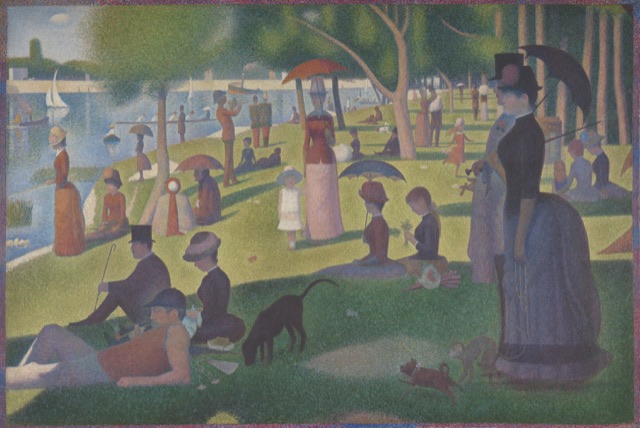
Look at any patch of grass, and step closer. The green breaks up into dots and dashes: yellow, blue, orange, set side by side. Georges Seurat painted this picture between eighteen eighty-four and eighteen eighty-six. It shows Parisians on a Sunday afternoon in a park on an island in the Seine. The canvas is more than three metres wide. Almost nobody in it is moving.
A closer look
Find the woman on the right with the parasol, and the small monkey on a lead at her feet. Seurat added the monkey late. He came back to the painting two years after he began it, strengthening some of the figures and putting in new ones. Before that he had made many smaller studies, drawn and painted, to settle the landscape and the people. Nothing here was left to chance. His method came from the colour science of his day. Instead of mixing colours on the palette he placed small touches of different colours next to each other, believing that the eye would combine them into a more brilliant whole. The method is called Pointillism. Seurat wanted a painting of modern life to equal a frieze carved in ancient Greece, stately and still. Around the edge he painted a border of dots, added a few years afterwards. The painting has been in Chicago since nineteen twenty-four.
Parisians of every age and class spend a Sunday afternoon on an island in the Seine: strolling, fishing, lounging on the grass. Seurat built the whole scene, more than three metres wide, from small touches of colour set side by side. He worked on it for two years and later added the painted border. Oil on canvas, 207.5 × 308.1 cm.
Other exhibitions
The Sistine Chapel: Ceiling, Altar, and Wall Cycles
Michelangelo’s ceiling and Last Judgment alongside the fifteenth-century north and south wall narratives by Botticelli, Perugino, Ghirlandaio, Rosselli, and Signorelli.
1765–1857 · 7 worksEdo: Pictures of the Floating World
Seven woodblock prints from the city of Edo, 1765 to 1857: Harunobu, Kiyonaga, Sharaku, Utamaro and Hiroshige, from the Art Institute of Chicago.
1867–1893 · 7 worksImpressionism: Painters of Modern Life
Seven painters and seven views of modern France, 1867 to 1893: Monet, Renoir, Morisot, Caillebotte, Degas, Cassatt and Pissarro, from the Art Institute of Chicago.
1782–1893 · 6 worksFrom Edo to Paris: Ukiyo-e and the Impressionist Eye
How Japanese woodblock masters Hiroshige and Kiyonaga inspired the cropped framing, asymmetric diagonals, and rain-swept streets of Caillebotte, Degas, and Cassatt.