Water Lilies
Stop 1 · First look
First Look
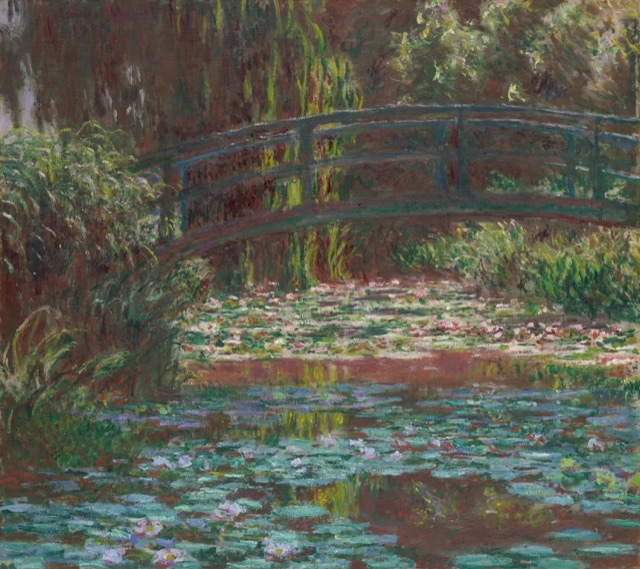
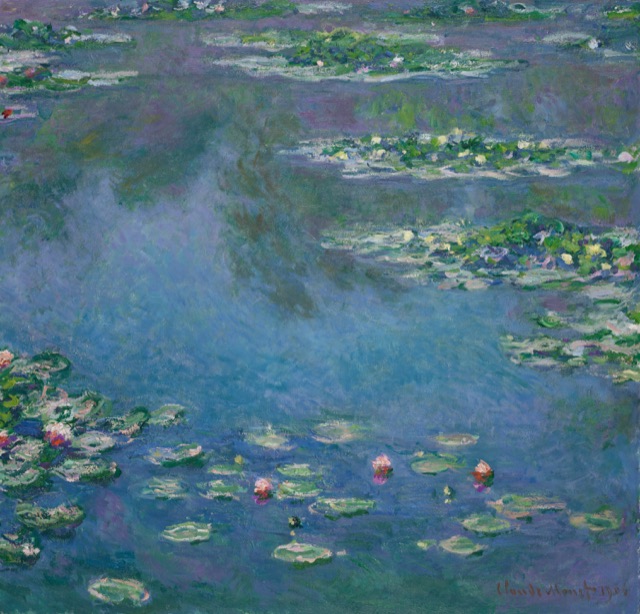
Look for the horizon. There is none. Claude Monet has turned his eyes down to the surface of his pond and left out everything else. He painted this in nineteen oh six, in his garden at Giverny. The lilies float in clusters at the lower left and the upper right. Between them the water shows what is above it: trees, and pale clouds. The sky is in the picture only as a reflection.
Stop 2 · Technique
Closer Reading
Notice the shape of the canvas. It is almost square, and that is part of the idea. A wide canvas suggests a view, with land and sky. A square does not, and Monet had stopped painting views. Here two kinds of space lie on one surface. The lily pads show that the water is flat and stretches away from us. The reflections of trees and clouds show a depth that is really above our heads. Monet painted his water garden about two hundred and fifty times over twenty-five years, and this canvas belongs to a group made between nineteen oh three and nineteen oh eight. He called the subject an obsession. The Art Institute’s examination of this painting found that he changed it a great deal as he worked. The series ended in the enormous water lily murals that he made for the Orangerie museum in Paris.
Stop 3 · Museum record
Catalog Summary
Only the surface of the pond: no bank, no bridge, no sky except its reflection. Monet painted his water garden at Giverny about 250 times, and this nearly square canvas comes from the middle of that long series. Oil on canvas, 89.9 × 94.1 cm.
Recorded physical scale: 94.1 × 89.9 cm (37.0 × 35.4 in · 0.94 × 0.90 m).
Stop 4 · Historical Context
Claude Monet (1840–1926)
French painter who led the Impressionists in painting light outdoors, then spent decades painting one subject many times as the light changed.
Impressionism (1860s to 1880s): A French way of painting modern life and landscape quickly, often outdoors, with broken touches of bright colour that catch passing effects of light.
First Look
Look for the horizon. There is none. Claude Monet has turned his eyes down to the surface of his pond and left out everything else. He painted this in nineteen oh six, in his garden at Giverny. The lilies float in clusters at the lower left and the upper right. Between them the water shows what is above it: trees, and pale clouds. The sky is in the picture only as a reflection.
Closer Reading
Notice the shape of the canvas. It is almost square, and that is part of the idea. A wide canvas suggests a view, with land and sky. A square does not, and Monet had stopped painting views. Here two kinds of space lie on one surface. The lily pads show that the water is flat and stretches away from us. The reflections of trees and clouds show a depth that is really above our heads. Monet painted his water garden about two hundred and fifty times over twenty-five years, and this canvas belongs to a group made between nineteen oh three and nineteen oh eight. He called the subject an obsession. The Art Institute’s examination of this painting found that he changed it a great deal as he worked. The series ended in the enormous water lily murals that he made for the Orangerie museum in Paris.
Catalog Summary
Only the surface of the pond: no bank, no bridge, no sky except its reflection. Monet painted his water garden at Giverny about 250 times, and this nearly square canvas comes from the middle of that long series. Oil on canvas, 89.9 × 94.1 cm.
About the Artist
Claude Monet (1840–1926)
Claude Monet was born in Paris and grew up in Le Havre, in Normandy, where the painter Eugène Boudin showed him how to paint from nature. He came to Paris in 1859 and, three years later, met Pierre-Auguste Renoir in the studio of the painter Charles Gleyre. In 1869 the two painted side by side on the Seine, with quick, broken brushstrokes.
In 1874 Monet, Camille Pissarro and Edgar Degas helped set up a group show apart from the official Salon. One of his pictures there, Impression, Sunrise, gave the group its name, which was first meant as an insult. He worked outdoors, in front of his subject, and often finished a canvas in the studio.
In 1883 he moved to Giverny, north-west of Paris. From 1890 he painted in series, showing one subject, such as stacks of wheat, poplars or Rouen Cathedral, at different hours and seasons. He made a water garden there and painted its water lilies for nearly thirty years, even as his sight failed. He died at Giverny in 1926, aged 86.