1877–1906 · 5 works · Art Institute of Chicago
Monet: Water and Weather
Stop 1 of 5 · Claude Monet · 1906
Water Lilies
First Look
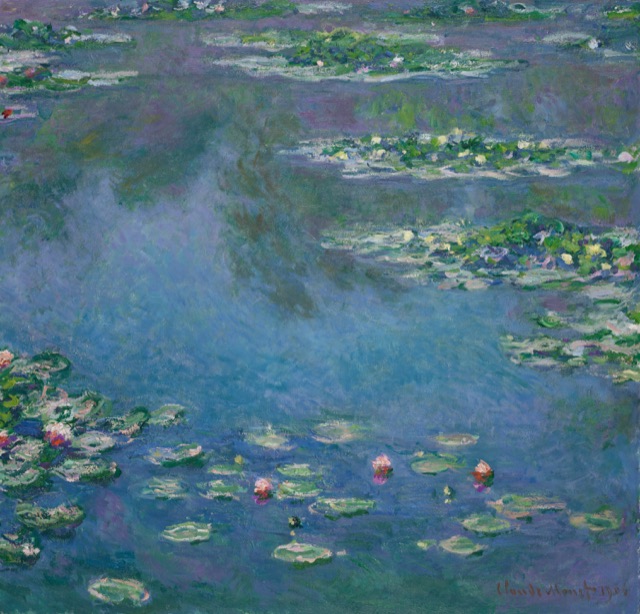
Look for the horizon. There is none. Claude Monet has turned his eyes down to the surface of his pond and left out everything else. He painted this in nineteen oh six, in his garden at Giverny. The lilies float in clusters at the lower left and the upper right. Between them the water shows what is above it: trees, and pale clouds. The sky is in the picture only as a reflection.
A closer look
Notice the shape of the canvas. It is almost square, and that is part of the idea. A wide canvas suggests a view, with land and sky. A square does not, and Monet had stopped painting views. Here two kinds of space lie on one surface. The lily pads show that the water is flat and stretches away from us. The reflections of trees and clouds show a depth that is really above our heads. Monet painted his water garden about two hundred and fifty times over twenty-five years, and this canvas belongs to a group made between nineteen oh three and nineteen oh eight. He called the subject an obsession. The Art Institute’s examination of this painting found that he changed it a great deal as he worked. The series ended in the enormous water lily murals that he made for the Orangerie museum in Paris.
Only the surface of the pond: no bank, no bridge, no sky except its reflection. Monet painted his water garden at Giverny about 250 times, and this nearly square canvas comes from the middle of that long series. Oil on canvas, 89.9 × 94.1 cm.
Stop 2 of 5 · Claude Monet · 1900
Water Lily Pond
First Look
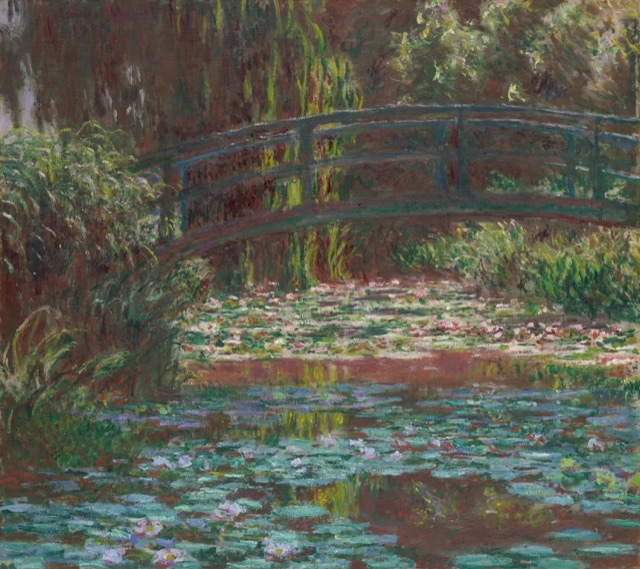
Look at the bridge, and then at the water beneath it. The bridge is the only firm thing in the picture. Claude Monet had it built over a pond that he made behind his house at Giverny, and he painted this view in nineteen hundred. Lily pads float on the surface, and between them the water holds the reflections of the trees. It is hard to say where the plants end and the reflections begin.
A closer look
Notice the red and rust colours in the water, among the greens. They are reflections of the trees and bushes on the far bank, laid between the lily pads in level strokes. In eighteen ninety-three, three years after he bought his property at Giverny, Monet began turning a marshy piece of ground into this pond. He planted it with water lilies and with other plants, some native and some from abroad, and put the wooden bridge across its narrow end. Then he painted it. This canvas belongs to a group of eighteen views of the bridge made in eighteen ninety-nine and nineteen hundred. In all of them the subject is the same: lilies mingling with reflections on the surface of the water. The garden became one of his main subjects for the rest of his life. Compare this picture with his Water Lilies of nineteen oh six, where the bridge and the banks have gone and only the water is left.
The Japanese-style footbridge that Monet built over his pond at Giverny arches across the top of the canvas, with water lilies and reflections filling the water below. It is one of eighteen versions of the view that he painted in 1899 and 1900. Oil on canvas, 89.8 × 101 cm.
Stop 3 of 5 · Claude Monet · 1877
Arrival of the Normandy Train, Gare Saint-Lazare
First Look
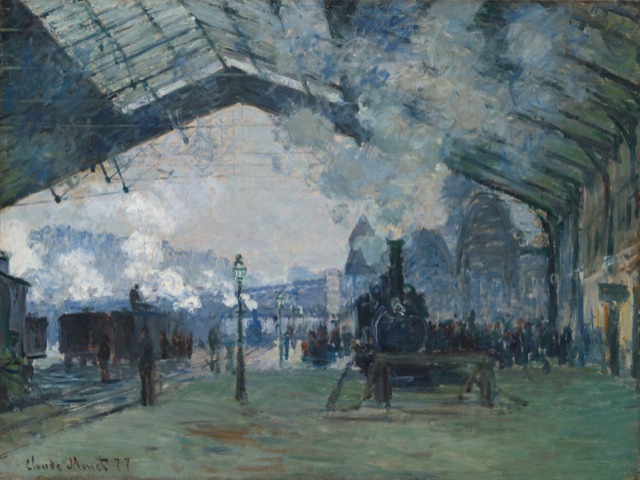
Look up at the roof, where daylight comes through the glass and meets the steam. Claude Monet painted this at the Saint-Lazare station in Paris in eighteen seventy-seven. A train from Normandy has just come in. The engine is the dark shape near the centre, and the people on the platform are only a few quick strokes. What Monet is really painting is the air inside the shed.
A closer look
Notice how the steam changes colour as it rises: white near the engine, then blue and violet under the roof. Monet found in this shed a mixture he liked, of man-made and natural effects. Steam from the locomotives was trapped inside the structure, and sunlight came down through the glazed parts of the roof. He painted the station twelve times, and had eight of the canvases ready for the third Impressionist exhibition. It was the beginning of a habit. Later he would paint one subject again and again, stacks of wheat, a cathedral front, a lily pond, to catch each change of light and weather. The station mattered to him for another reason. Its trains ran to Normandy, where he had learned to paint outdoors. The Art Institute notes that these were also his last pictures of city life. After them he turned almost entirely to landscape.
Under the glass-and-iron shed of the Saint-Lazare station in Paris, a locomotive arrives in a cloud of steam. Monet painted twelve views of the station, and had eight of them ready for the Impressionist exhibition of 1877. Oil on canvas, 60.3 × 80.2 cm.
Stop 4 of 5 · Claude Monet · 1882
Cliff Walk at Pourville
First Look
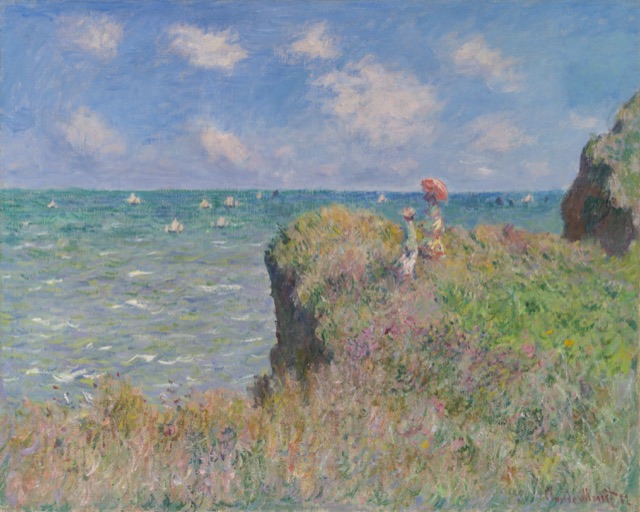
Look at the grass on the clifftop, and then at the sea. Both are made of the same short, curved strokes. Claude Monet painted this in eighteen eighty-two at Pourville, a fishing village on the coast of Normandy. Two young women stand near the edge with a red parasol. They are probably Marthe and Blanche Hoschedé, daughters of the woman who became his second wife. The wind is in everything.
A closer look
Find the dark rock at the far right edge. X-ray images show that Monet first painted it larger, and then cut it back to balance the sea and the sky. He had a problem to solve in this picture: how to put people into a landscape without breaking its surface. His answer was to paint them with the same touch as everything else. The women’s dresses and shawls are made of the strokes that make the grass, only a little changed, and the same strokes again suggest the swell of the water. Monet had come to this coast in February, at a hard time. His first wife, Camille, had died three years before, and his pictures were selling badly. But he grew to love the place. He wrote home about how beautiful the countryside was becoming, and what joy it would be to show the family all its nooks and crannies. In June they joined him.
Two young women stand on a cliff above the sea at Pourville, a fishing village on the Normandy coast where Monet painted in 1882. The same short, curved strokes make the grass, the dresses and the waves, so that everything seems to move in one wind. Oil on canvas, 66.5 × 82.3 cm.
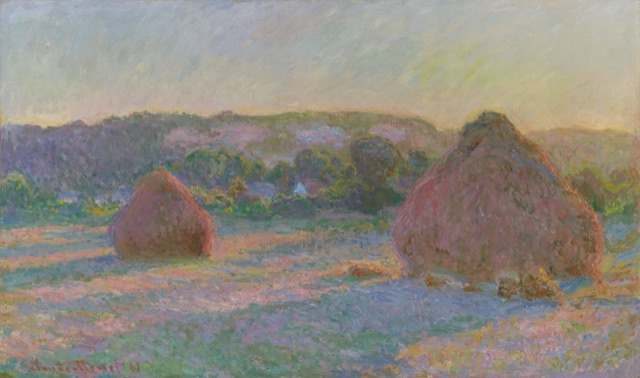
Stop 5 of 5 · Claude Monet · 1890–91
Stacks of Wheat (End of Summer)
First Look
Look at the tops of the two stacks, where they rise above the line of the hills into the sky. Claude Monet painted these stacks of wheat in a field just outside his house at Giverny. Each one stood fifteen to twenty feet high. This is the end of summer, with long violet shadows on the stubble. Monet painted the same stacks again and again, as the light and the season changed.
A closer look
Notice the colour of the shadows. They are not grey or brown but violet and blue, and the lit side of each stack is orange and pink. Through eighteen ninety and eighteen ninety-one Monet worked on these pictures in the field, with several easels set up at once, moving from one canvas to the next as the light changed. Then he finished them in the studio. In May eighteen ninety-one he hung fifteen of them side by side in one small room at his dealer’s gallery in Paris. The exhibition was a triumph, and it changed his career. For Monet the stack was a sign of sustenance and survival: a farm’s stored harvest, built to last through the winter. He went on to paint other series, of poplars, of the front of Rouen Cathedral and of his own garden. The Art Institute of Chicago holds the largest group of his wheat stacks in the world.
Two stacks of wheat stand in a field beside Monet’s house at Giverny, their pointed tops rising above the line of the hills. He painted the stacks through 1890 and 1891 in changing light and seasons, and showed fifteen of the canvases together in Paris. Oil on canvas, 60 × 100.5 cm.
1906Water Lilies
Only the surface of the pond: no bank, no bridge, no sky except its reflection. Monet painted his water garden at Giverny about 250 times, and this nearly square canvas comes from the middle of that long series. Oil on canvas, 89.9 × 94.1 cm.
1900Water Lily Pond
The Japanese-style footbridge that Monet built over his pond at Giverny arches across the top of the canvas, with water lilies and reflections filling the water below. It is one of eighteen versions of the view that he painted in 1899 and 1900. Oil on canvas, 89.8 × 101 cm.
1877Arrival of the Normandy Train, Gare Saint-Lazare
Under the glass-and-iron shed of the Saint-Lazare station in Paris, a locomotive arrives in a cloud of steam. Monet painted twelve views of the station, and had eight of them ready for the Impressionist exhibition of 1877. Oil on canvas, 60.3 × 80.2 cm.
1882Cliff Walk at Pourville
Two young women stand on a cliff above the sea at Pourville, a fishing village on the Normandy coast where Monet painted in 1882. The same short, curved strokes make the grass, the dresses and the waves, so that everything seems to move in one wind. Oil on canvas, 66.5 × 82.3 cm.
1890–91Stacks of Wheat (End of Summer)
Two stacks of wheat stand in a field beside Monet’s house at Giverny, their pointed tops rising above the line of the hills. He painted the stacks through 1890 and 1891 in changing light and seasons, and showed fifteen of the canvases together in Paris. Oil on canvas, 60 × 100.5 cm.
Other exhibitions
The Sistine Chapel: Ceiling, Altar, and Wall Cycles
Michelangelo’s ceiling and Last Judgment alongside the fifteenth-century north and south wall narratives by Botticelli, Perugino, Ghirlandaio, Rosselli, and Signorelli.
1765–1857 · 7 worksEdo: Pictures of the Floating World
Seven woodblock prints from the city of Edo, 1765 to 1857: Harunobu, Kiyonaga, Sharaku, Utamaro and Hiroshige, from the Art Institute of Chicago.
1867–1893 · 7 worksImpressionism: Painters of Modern Life
Seven painters and seven views of modern France, 1867 to 1893: Monet, Renoir, Morisot, Caillebotte, Degas, Cassatt and Pissarro, from the Art Institute of Chicago.
1782–1893 · 6 worksFrom Edo to Paris: Ukiyo-e and the Impressionist Eye
How Japanese woodblock masters Hiroshige and Kiyonaga inspired the cropped framing, asymmetric diagonals, and rain-swept streets of Caillebotte, Degas, and Cassatt.