Water Lily Pond
Stop 1 · First look
First Look
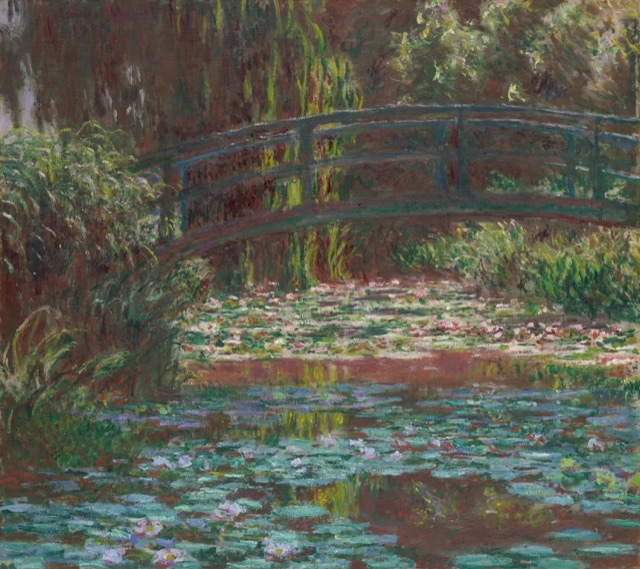
Look at the bridge, and then at the water beneath it. The bridge is the only firm thing in the picture. Claude Monet had it built over a pond that he made behind his house at Giverny, and he painted this view in nineteen hundred. Lily pads float on the surface, and between them the water holds the reflections of the trees. It is hard to say where the plants end and the reflections begin.
Stop 2 · Technique
Closer Reading
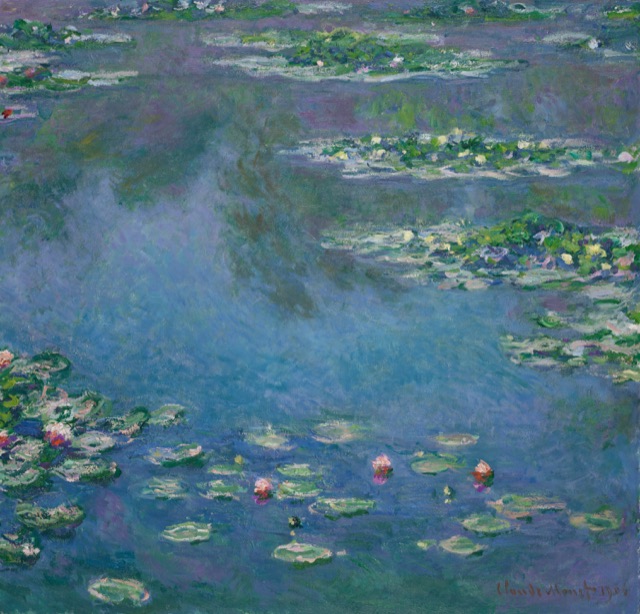
Notice the red and rust colours in the water, among the greens. They are reflections of the trees and bushes on the far bank, laid between the lily pads in level strokes. In eighteen ninety-three, three years after he bought his property at Giverny, Monet began turning a marshy piece of ground into this pond. He planted it with water lilies and with other plants, some native and some from abroad, and put the wooden bridge across its narrow end. Then he painted it. This canvas belongs to a group of eighteen views of the bridge made in eighteen ninety-nine and nineteen hundred. In all of them the subject is the same: lilies mingling with reflections on the surface of the water. The garden became one of his main subjects for the rest of his life. Compare this picture with his Water Lilies of nineteen oh six, where the bridge and the banks have gone and only the water is left.
Stop 3 · Museum record
Catalog Summary
The Japanese-style footbridge that Monet built over his pond at Giverny arches across the top of the canvas, with water lilies and reflections filling the water below. It is one of eighteen versions of the view that he painted in 1899 and 1900. Oil on canvas, 89.8 × 101 cm.
Recorded physical scale: 101.0 × 89.8 cm (39.8 × 35.4 in · 1.01 × 0.90 m).
Stop 4 · Historical Context
Claude Monet (1840–1926)
French painter who led the Impressionists in painting light outdoors, then spent decades painting one subject many times as the light changed.
Impressionism (1860s to 1880s): A French way of painting modern life and landscape quickly, often outdoors, with broken touches of bright colour that catch passing effects of light.
First Look
Look at the bridge, and then at the water beneath it. The bridge is the only firm thing in the picture. Claude Monet had it built over a pond that he made behind his house at Giverny, and he painted this view in nineteen hundred. Lily pads float on the surface, and between them the water holds the reflections of the trees. It is hard to say where the plants end and the reflections begin.
Closer Reading
Notice the red and rust colours in the water, among the greens. They are reflections of the trees and bushes on the far bank, laid between the lily pads in level strokes. In eighteen ninety-three, three years after he bought his property at Giverny, Monet began turning a marshy piece of ground into this pond. He planted it with water lilies and with other plants, some native and some from abroad, and put the wooden bridge across its narrow end. Then he painted it. This canvas belongs to a group of eighteen views of the bridge made in eighteen ninety-nine and nineteen hundred. In all of them the subject is the same: lilies mingling with reflections on the surface of the water. The garden became one of his main subjects for the rest of his life. Compare this picture with his Water Lilies of nineteen oh six, where the bridge and the banks have gone and only the water is left.
Catalog Summary
The Japanese-style footbridge that Monet built over his pond at Giverny arches across the top of the canvas, with water lilies and reflections filling the water below. It is one of eighteen versions of the view that he painted in 1899 and 1900. Oil on canvas, 89.8 × 101 cm.
About the Artist
Claude Monet (1840–1926)
Claude Monet was born in Paris and grew up in Le Havre, in Normandy, where the painter Eugène Boudin showed him how to paint from nature. He came to Paris in 1859 and, three years later, met Pierre-Auguste Renoir in the studio of the painter Charles Gleyre. In 1869 the two painted side by side on the Seine, with quick, broken brushstrokes.
In 1874 Monet, Camille Pissarro and Edgar Degas helped set up a group show apart from the official Salon. One of his pictures there, Impression, Sunrise, gave the group its name, which was first meant as an insult. He worked outdoors, in front of his subject, and often finished a canvas in the studio.
In 1883 he moved to Giverny, north-west of Paris. From 1890 he painted in series, showing one subject, such as stacks of wheat, poplars or Rouen Cathedral, at different hours and seasons. He made a water garden there and painted its water lilies for nearly thirty years, even as his sight failed. He died at Giverny in 1926, aged 86.