Stacks of Wheat (End of Summer)
Stop 1 · First look
First Look
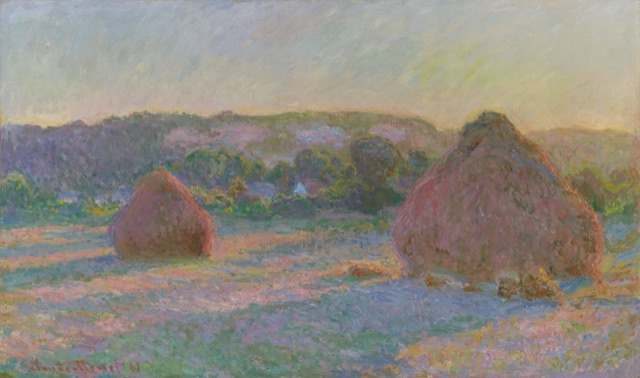
Look at the tops of the two stacks, where they rise above the line of the hills into the sky. Claude Monet painted these stacks of wheat in a field just outside his house at Giverny. Each one stood fifteen to twenty feet high. This is the end of summer, with long violet shadows on the stubble. Monet painted the same stacks again and again, as the light and the season changed.
Stop 2 · Technique
Closer Reading
Notice the colour of the shadows. They are not grey or brown but violet and blue, and the lit side of each stack is orange and pink. Through eighteen ninety and eighteen ninety-one Monet worked on these pictures in the field, with several easels set up at once, moving from one canvas to the next as the light changed. Then he finished them in the studio. In May eighteen ninety-one he hung fifteen of them side by side in one small room at his dealer’s gallery in Paris. The exhibition was a triumph, and it changed his career. For Monet the stack was a sign of sustenance and survival: a farm’s stored harvest, built to last through the winter. He went on to paint other series, of poplars, of the front of Rouen Cathedral and of his own garden. The Art Institute of Chicago holds the largest group of his wheat stacks in the world.
Stop 3 · Museum record
Catalog Summary
Two stacks of wheat stand in a field beside Monet’s house at Giverny, their pointed tops rising above the line of the hills. He painted the stacks through 1890 and 1891 in changing light and seasons, and showed fifteen of the canvases together in Paris. Oil on canvas, 60 × 100.5 cm.
Recorded physical scale: 100.5 × 60.0 cm (39.6 × 23.6 in · 1.00 × 0.60 m).
Stop 4 · Historical Context
Claude Monet (1840–1926)
French painter who led the Impressionists in painting light outdoors, then spent decades painting one subject many times as the light changed.
Impressionism (1860s to 1880s): A French way of painting modern life and landscape quickly, often outdoors, with broken touches of bright colour that catch passing effects of light.
First Look
Look at the tops of the two stacks, where they rise above the line of the hills into the sky. Claude Monet painted these stacks of wheat in a field just outside his house at Giverny. Each one stood fifteen to twenty feet high. This is the end of summer, with long violet shadows on the stubble. Monet painted the same stacks again and again, as the light and the season changed.
Closer Reading
Notice the colour of the shadows. They are not grey or brown but violet and blue, and the lit side of each stack is orange and pink. Through eighteen ninety and eighteen ninety-one Monet worked on these pictures in the field, with several easels set up at once, moving from one canvas to the next as the light changed. Then he finished them in the studio. In May eighteen ninety-one he hung fifteen of them side by side in one small room at his dealer’s gallery in Paris. The exhibition was a triumph, and it changed his career. For Monet the stack was a sign of sustenance and survival: a farm’s stored harvest, built to last through the winter. He went on to paint other series, of poplars, of the front of Rouen Cathedral and of his own garden. The Art Institute of Chicago holds the largest group of his wheat stacks in the world.
Catalog Summary
Two stacks of wheat stand in a field beside Monet’s house at Giverny, their pointed tops rising above the line of the hills. He painted the stacks through 1890 and 1891 in changing light and seasons, and showed fifteen of the canvases together in Paris. Oil on canvas, 60 × 100.5 cm.
About the Artist
Claude Monet (1840–1926)
Claude Monet was born in Paris and grew up in Le Havre, in Normandy, where the painter Eugène Boudin showed him how to paint from nature. He came to Paris in 1859 and, three years later, met Pierre-Auguste Renoir in the studio of the painter Charles Gleyre. In 1869 the two painted side by side on the Seine, with quick, broken brushstrokes.
In 1874 Monet, Camille Pissarro and Edgar Degas helped set up a group show apart from the official Salon. One of his pictures there, Impression, Sunrise, gave the group its name, which was first meant as an insult. He worked outdoors, in front of his subject, and often finished a canvas in the studio.
In 1883 he moved to Giverny, north-west of Paris. From 1890 he painted in series, showing one subject, such as stacks of wheat, poplars or Rouen Cathedral, at different hours and seasons. He made a water garden there and painted its water lilies for nearly thirty years, even as his sight failed. He died at Giverny in 1926, aged 86.