1826–1906 · 5 works · Art Institute of Chicago
Masters of Light and Space
Stop 1 of 5 · Paul Cezanne · c. 1885
The Bay of Marseille, Seen from L'Estaque
First Look
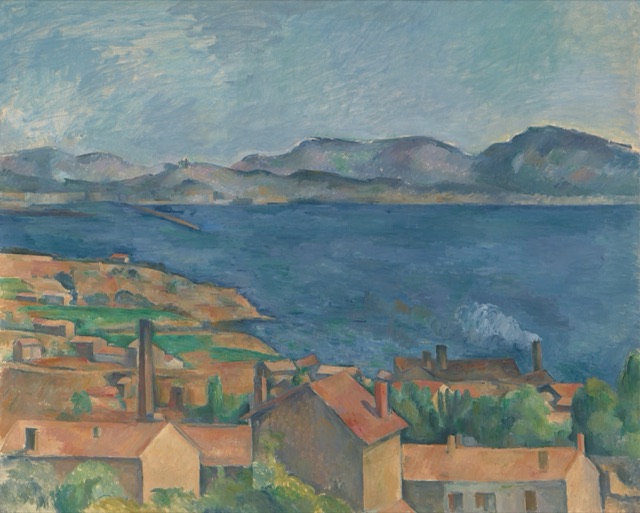
Look at the orange roofs at the bottom, and then let your eyes rise: water, mountains, sky. Four bands, one above another. Paul Cezanne painted this view around eighteen eighty-five from L’Estaque, a village on the bay of Marseille. He told his friend Camille Pissarro that the place was like a playing card, all simple shapes and colours. Notice that the sea looks as solid as the hills.
A closer look
Notice the brushstrokes in the water. They are short and flat, laid side by side like blocks, and the same kind of mark builds the roofs and the hills. Cezanne painted more than a dozen views of this bay during the eighteen eighties. His Impressionist friends would have used such a scene to catch a passing effect of light. Cezanne wanted the structure underneath, something that would last. So he tied the picture together with a grid: the level line of the far shore, the upright chimneys, the slanting roofs. The result seems flat and deep at the same time. The Art Institute notes that the painting looks back to older, carefully built landscapes and forward to Cubism. Now find the small puff of white smoke near the shore, on the right. It is the only thing in the whole view that moves.
From the village of L’Estaque, Cezanne looks across the bay to the hills beyond Marseille. He stacks the view in four bands (roofs, water, mountains, sky) and builds each from block-like strokes of strong colour. Oil on canvas, 80.2 × 100.6 cm.
Stop 2 of 5 · Katsushika Hokusai · 1830/33
Under the Wave off Kanagawa (Kanagawa oki nami ura), also known as The Great Wave, from the series "Thirty-Six Views of Mount Fuji (Fugaku sanjūrokkei)"
First Look
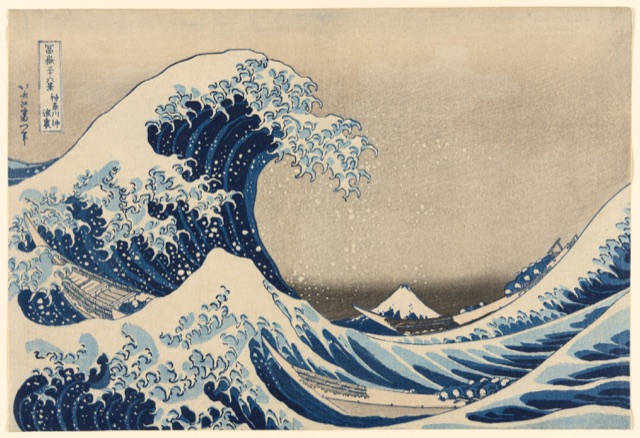
Look under the curl of the great wave, at the small white triangle in the distance. That is Mount Fuji, the highest mountain in Japan. Katsushika Hokusai designed this print in the early eighteen thirties, when he was about seventy. Three boats full of rowers are heading into the wave. Its foam reaches down toward them like fingers. And the print itself is small enough to hold in two hands.
A closer look
Notice the blue. There are several blues here, from pale to almost black. The colour was called Berlin blue, a manufactured pigment that had only lately become cheap enough for Japanese printmakers to use freely. Hokusai used it throughout the series this print belongs to, Thirty-Six Views of Mount Fuji. In every design of that series the mountain appears, near or far, in every season and kind of weather. Here it is tiny, and the wave seems about to fall on it. A print like this was not made by one person. Hokusai drew the design, carvers cut a separate block of wood for each colour, and printers pressed sheet after sheet. The series made landscape a popular subject for prints, and it has stayed one. The Art Institute holds three impressions of the Great Wave, and notes that all three were printed later than the first state of the design.
A wave rears over three boats, its crest breaking into claws of foam, with Mount Fuji small and still in the distance. The print comes from Hokusai’s series Thirty-Six Views of Mount Fuji, begun in 1830 when he was seventy, and owes its deep blue to a newly affordable pigment, Berlin blue. Color woodblock print, 25.4 × 37.6 cm.
Stop 3 of 5 · Georges Seurat · 1884–86, border added 1888–89
A Sunday on La Grande Jatte — 1884
First Look
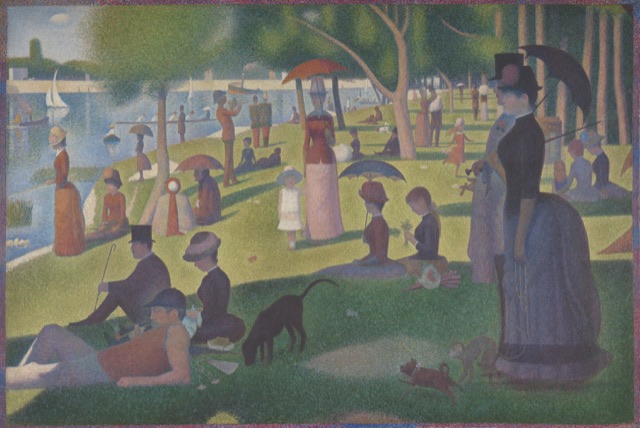
Look at any patch of grass, and step closer. The green breaks up into dots and dashes: yellow, blue, orange, set side by side. Georges Seurat painted this picture between eighteen eighty-four and eighteen eighty-six. It shows Parisians on a Sunday afternoon in a park on an island in the Seine. The canvas is more than three metres wide. Almost nobody in it is moving.
A closer look
Find the woman on the right with the parasol, and the small monkey on a lead at her feet. Seurat added the monkey late. He came back to the painting two years after he began it, strengthening some of the figures and putting in new ones. Before that he had made many smaller studies, drawn and painted, to settle the landscape and the people. Nothing here was left to chance. His method came from the colour science of his day. Instead of mixing colours on the palette he placed small touches of different colours next to each other, believing that the eye would combine them into a more brilliant whole. The method is called Pointillism. Seurat wanted a painting of modern life to equal a frieze carved in ancient Greece, stately and still. Around the edge he painted a border of dots, added a few years afterwards. The painting has been in Chicago since nineteen twenty-four.
Parisians of every age and class spend a Sunday afternoon on an island in the Seine: strolling, fishing, lounging on the grass. Seurat built the whole scene, more than three metres wide, from small touches of colour set side by side. He worked on it for two years and later added the painted border. Oil on canvas, 207.5 × 308.1 cm.
Stop 4 of 5 · Claude Monet · 1906
Water Lilies
First Look
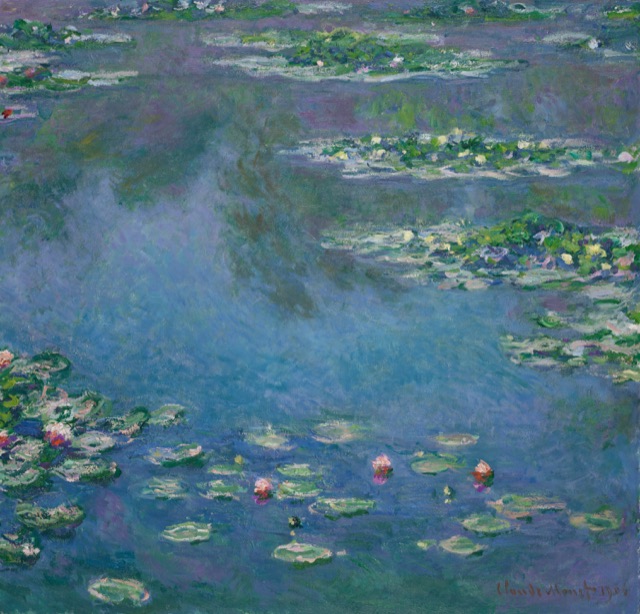
Look for the horizon. There is none. Claude Monet has turned his eyes down to the surface of his pond and left out everything else. He painted this in nineteen oh six, in his garden at Giverny. The lilies float in clusters at the lower left and the upper right. Between them the water shows what is above it: trees, and pale clouds. The sky is in the picture only as a reflection.
A closer look
Notice the shape of the canvas. It is almost square, and that is part of the idea. A wide canvas suggests a view, with land and sky. A square does not, and Monet had stopped painting views. Here two kinds of space lie on one surface. The lily pads show that the water is flat and stretches away from us. The reflections of trees and clouds show a depth that is really above our heads. Monet painted his water garden about two hundred and fifty times over twenty-five years, and this canvas belongs to a group made between nineteen oh three and nineteen oh eight. He called the subject an obsession. The Art Institute’s examination of this painting found that he changed it a great deal as he worked. The series ended in the enormous water lily murals that he made for the Orangerie museum in Paris.
Only the surface of the pond: no bank, no bridge, no sky except its reflection. Monet painted his water garden at Giverny about 250 times, and this nearly square canvas comes from the middle of that long series. Oil on canvas, 89.9 × 94.1 cm.
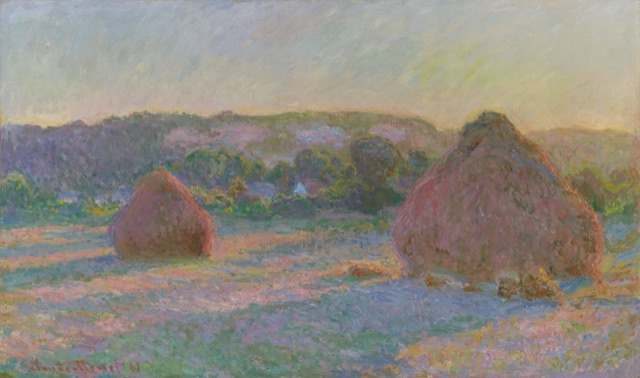
Stop 5 of 5 · Claude Monet · 1890–91
Stacks of Wheat (End of Summer)
First Look
Look at the tops of the two stacks, where they rise above the line of the hills into the sky. Claude Monet painted these stacks of wheat in a field just outside his house at Giverny. Each one stood fifteen to twenty feet high. This is the end of summer, with long violet shadows on the stubble. Monet painted the same stacks again and again, as the light and the season changed.
A closer look
Notice the colour of the shadows. They are not grey or brown but violet and blue, and the lit side of each stack is orange and pink. Through eighteen ninety and eighteen ninety-one Monet worked on these pictures in the field, with several easels set up at once, moving from one canvas to the next as the light changed. Then he finished them in the studio. In May eighteen ninety-one he hung fifteen of them side by side in one small room at his dealer’s gallery in Paris. The exhibition was a triumph, and it changed his career. For Monet the stack was a sign of sustenance and survival: a farm’s stored harvest, built to last through the winter. He went on to paint other series, of poplars, of the front of Rouen Cathedral and of his own garden. The Art Institute of Chicago holds the largest group of his wheat stacks in the world.
Two stacks of wheat stand in a field beside Monet’s house at Giverny, their pointed tops rising above the line of the hills. He painted the stacks through 1890 and 1891 in changing light and seasons, and showed fifteen of the canvases together in Paris. Oil on canvas, 60 × 100.5 cm.
c. 1885The Bay of Marseille, Seen from L'Estaque
From the village of L’Estaque, Cezanne looks across the bay to the hills beyond Marseille. He stacks the view in four bands (roofs, water, mountains, sky) and builds each from block-like strokes of strong colour. Oil on canvas, 80.2 × 100.6 cm.
1830/33Under the Wave off Kanagawa
A wave rears over three boats, its crest breaking into claws of foam, with Mount Fuji small and still in the distance. The print comes from Hokusai’s series Thirty-Six Views of Mount Fuji, begun in 1830 when he was seventy, and owes its deep blue to a newly affordable pigment, Berlin blue. Color woodblock print, 25.4 × 37.6 cm.
1884–86, border added 1888–89A Sunday on La Grande Jatte — 1884
Parisians of every age and class spend a Sunday afternoon on an island in the Seine: strolling, fishing, lounging on the grass. Seurat built the whole scene, more than three metres wide, from small touches of colour set side by side. He worked on it for two years and later added the painted border. Oil on canvas, 207.5 × 308.1 cm.
1906Water Lilies
Only the surface of the pond: no bank, no bridge, no sky except its reflection. Monet painted his water garden at Giverny about 250 times, and this nearly square canvas comes from the middle of that long series. Oil on canvas, 89.9 × 94.1 cm.
1890–91Stacks of Wheat (End of Summer)
Two stacks of wheat stand in a field beside Monet’s house at Giverny, their pointed tops rising above the line of the hills. He painted the stacks through 1890 and 1891 in changing light and seasons, and showed fifteen of the canvases together in Paris. Oil on canvas, 60 × 100.5 cm.
Other exhibitions
The Sistine Chapel: Ceiling, Altar, and Wall Cycles
Michelangelo’s ceiling and Last Judgment alongside the fifteenth-century north and south wall narratives by Botticelli, Perugino, Ghirlandaio, Rosselli, and Signorelli.
1765–1857 · 7 worksEdo: Pictures of the Floating World
Seven woodblock prints from the city of Edo, 1765 to 1857: Harunobu, Kiyonaga, Sharaku, Utamaro and Hiroshige, from the Art Institute of Chicago.
1867–1893 · 7 worksImpressionism: Painters of Modern Life
Seven painters and seven views of modern France, 1867 to 1893: Monet, Renoir, Morisot, Caillebotte, Degas, Cassatt and Pissarro, from the Art Institute of Chicago.
1782–1893 · 6 worksFrom Edo to Paris: Ukiyo-e and the Impressionist Eye
How Japanese woodblock masters Hiroshige and Kiyonaga inspired the cropped framing, asymmetric diagonals, and rain-swept streets of Caillebotte, Degas, and Cassatt.