The Bay of Marseille, Seen from L'Estaque
Stop 1 · First look
First Look
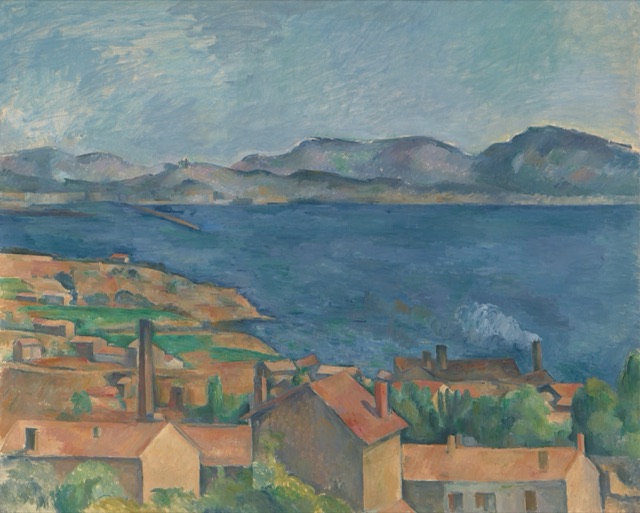
Look at the orange roofs at the bottom, and then let your eyes rise: water, mountains, sky. Four bands, one above another. Paul Cezanne painted this view around eighteen eighty-five from L’Estaque, a village on the bay of Marseille. He told his friend Camille Pissarro that the place was like a playing card, all simple shapes and colours. Notice that the sea looks as solid as the hills.
Stop 2 · Technique
Closer Reading
Notice the brushstrokes in the water. They are short and flat, laid side by side like blocks, and the same kind of mark builds the roofs and the hills. Cezanne painted more than a dozen views of this bay during the eighteen eighties. His Impressionist friends would have used such a scene to catch a passing effect of light. Cezanne wanted the structure underneath, something that would last. So he tied the picture together with a grid: the level line of the far shore, the upright chimneys, the slanting roofs. The result seems flat and deep at the same time. The Art Institute notes that the painting looks back to older, carefully built landscapes and forward to Cubism. Now find the small puff of white smoke near the shore, on the right. It is the only thing in the whole view that moves.
Stop 3 · Museum record
Catalog Summary
From the village of L’Estaque, Cezanne looks across the bay to the hills beyond Marseille. He stacks the view in four bands (roofs, water, mountains, sky) and builds each from block-like strokes of strong colour. Oil on canvas, 80.2 × 100.6 cm.
Recorded physical scale: 100.6 × 80.2 cm (39.6 × 31.6 in · 1.01 × 0.80 m).
Stop 4 · Historical Context
Paul Cézanne (1839–1906)
French painter who built pictures from small, ordered strokes of colour, giving Impressionism a new solidity that shaped Picasso and much of modern art.
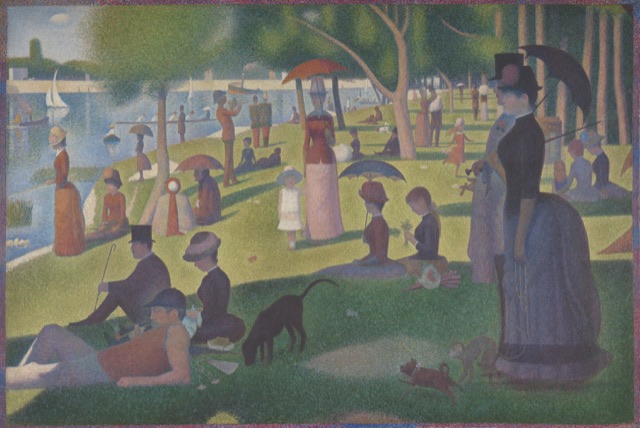
Post-Impressionism (about 1886 to the early 1900s): A later name for painters, chiefly Cézanne, Gauguin, Seurat and Van Gogh, who started from Impressionism around 1886 and each took it somewhere different.
First Look
Look at the orange roofs at the bottom, and then let your eyes rise: water, mountains, sky. Four bands, one above another. Paul Cezanne painted this view around eighteen eighty-five from L’Estaque, a village on the bay of Marseille. He told his friend Camille Pissarro that the place was like a playing card, all simple shapes and colours. Notice that the sea looks as solid as the hills.
Closer Reading
Notice the brushstrokes in the water. They are short and flat, laid side by side like blocks, and the same kind of mark builds the roofs and the hills. Cezanne painted more than a dozen views of this bay during the eighteen eighties. His Impressionist friends would have used such a scene to catch a passing effect of light. Cezanne wanted the structure underneath, something that would last. So he tied the picture together with a grid: the level line of the far shore, the upright chimneys, the slanting roofs. The result seems flat and deep at the same time. The Art Institute notes that the painting looks back to older, carefully built landscapes and forward to Cubism. Now find the small puff of white smoke near the shore, on the right. It is the only thing in the whole view that moves.
Catalog Summary
From the village of L’Estaque, Cezanne looks across the bay to the hills beyond Marseille. He stacks the view in four bands (roofs, water, mountains, sky) and builds each from block-like strokes of strong colour. Oil on canvas, 80.2 × 100.6 cm.
About the Artist
Paul Cézanne (1839–1906)
Paul Cézanne was born in Aix-en-Provence, the son of a wealthy banker and a boyhood friend of the writer Émile Zola. He studied law to please his family while taking drawing lessons, then left for Paris in 1862 to paint. In his early pictures the paint is laid on thickly with a palette knife.
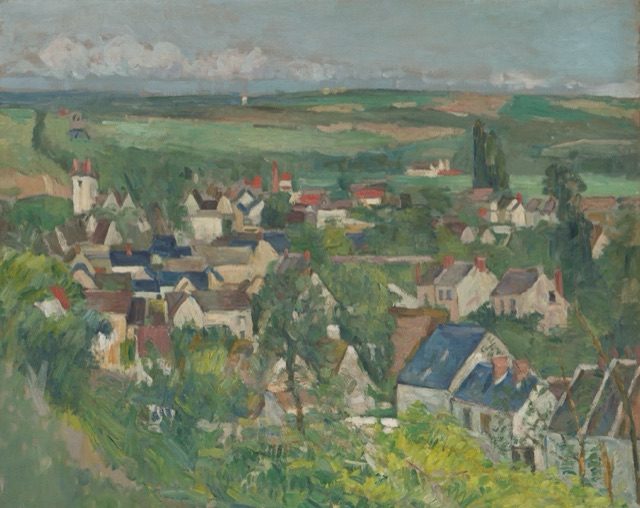
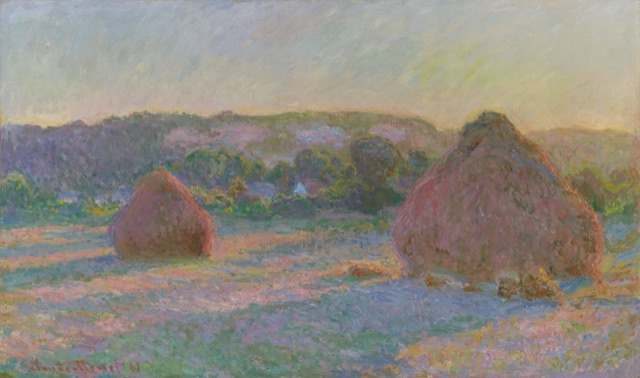
In 1872 he moved to Auvers-sur-Oise and painted outdoors beside Camille Pissarro, who guided him. He showed with Monet, Renoir and Pissarro in the first Impressionist exhibition of 1874. But he wanted, he said, to 'make of Impressionism something solid and durable like the art of museums'. He worked slowly, using small, blocky strokes of warm and cool colour to build up form.
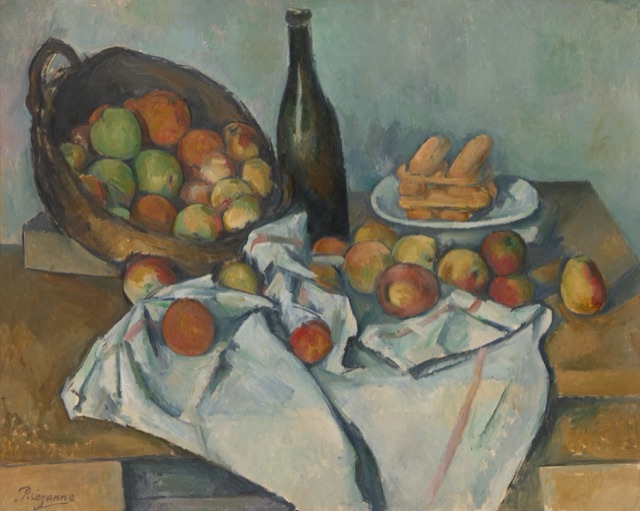
He kept returning to a few subjects: apples on a tilted table, the bay at L'Estaque, the landscape of Provence, bathers. His first exhibition of his own, at Ambroise Vollard's gallery in Paris in 1895, brought him wide notice. Younger painters took him as their guide, and Picasso is said to have called him 'the father of us all'. He died in Aix in 1906.