1873–1887 · 3 works · Art Institute of Chicago
Cézanne: Tables and Landscapes
Stop 1 of 3 · Paul Cezanne · c. 1893
The Basket of Apples
First Look
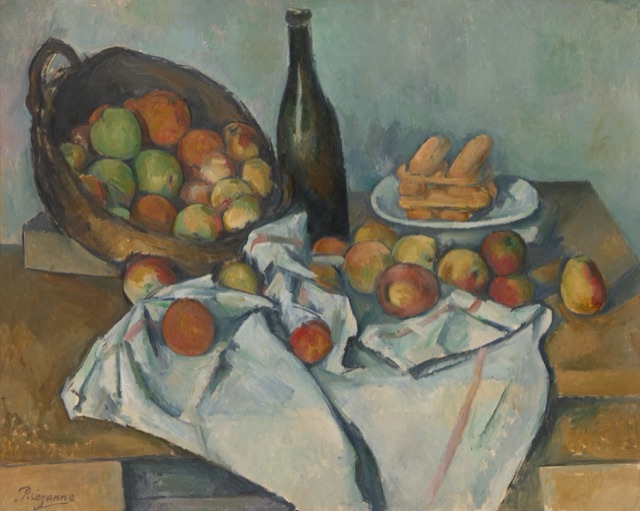
Look at the front edge of the table, to the left of the white cloth and then to the right of it. The two sides do not meet. Paul Cezanne painted this still life around eighteen ninety-three. The bottle leans. The basket tips forward, and the apples seem ready to roll onto the floor. The Art Institute of Chicago calls the effect controlled chaos. None of it is a mistake.
A closer look
Find the plate of biscuits behind the apples, on the right. They are stacked like logs, in a pile that ought to slide off the plate and does not. Cezanne looked at each object for a long time and painted it from wherever he then stood, so the bottle is seen from one place, the basket from another, and the tabletop from a third. No camera could take this picture. Notice the brushwork as well. The apples and the folds of the cloth are built from thick, firm strokes, while the edges of the table are only sketched in. Cezanne rarely signed his paintings, but this one carries his name at the lower left, which suggests that it mattered to him. It was the first of his works to enter the Art Institute’s collection.
A table that will not hold still: the two halves of its front edge do not line up, the bottle leans, and the apples seem about to roll out of the picture. Cezanne painted each thing as he saw it from where he stood, and let the views disagree. Oil on canvas, 65 × 80 cm.
Stop 2 of 3 · Paul Cezanne · c. 1885
The Bay of Marseille, Seen from L'Estaque
First Look
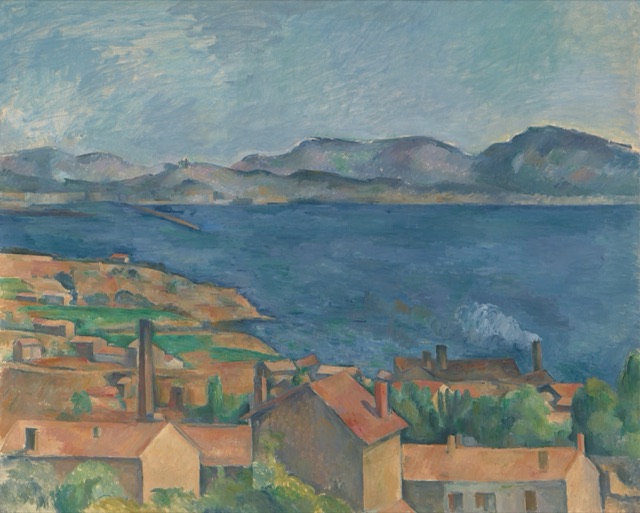
Look at the orange roofs at the bottom, and then let your eyes rise: water, mountains, sky. Four bands, one above another. Paul Cezanne painted this view around eighteen eighty-five from L’Estaque, a village on the bay of Marseille. He told his friend Camille Pissarro that the place was like a playing card, all simple shapes and colours. Notice that the sea looks as solid as the hills.
A closer look
Notice the brushstrokes in the water. They are short and flat, laid side by side like blocks, and the same kind of mark builds the roofs and the hills. Cezanne painted more than a dozen views of this bay during the eighteen eighties. His Impressionist friends would have used such a scene to catch a passing effect of light. Cezanne wanted the structure underneath, something that would last. So he tied the picture together with a grid: the level line of the far shore, the upright chimneys, the slanting roofs. The result seems flat and deep at the same time. The Art Institute notes that the painting looks back to older, carefully built landscapes and forward to Cubism. Now find the small puff of white smoke near the shore, on the right. It is the only thing in the whole view that moves.
From the village of L’Estaque, Cezanne looks across the bay to the hills beyond Marseille. He stacks the view in four bands (roofs, water, mountains, sky) and builds each from block-like strokes of strong colour. Oil on canvas, 80.2 × 100.6 cm.
Stop 3 of 3 · Paul Cezanne · 1873–75
Auvers, Panoramic View
First Look
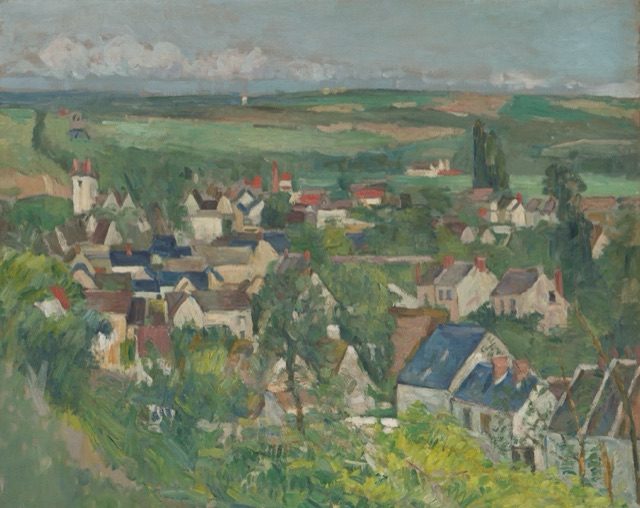
Look at the roofs, blue slate and red tile, each one a single patch of colour. Paul Cezanne painted this view between eighteen seventy-three and eighteen seventy-five, looking down on the village of Auvers, north of Paris. He had come to work near an older painter, Camille Pissarro, who became his mentor. The view runs from the houses below us to a far, pale horizon.
A closer look
Find the lower left corner, and then the middle of the foreground. The paint there is thin and ragged, and it may look unfinished. The Art Institute points to these passages as a choice. Cezanne was trying to give more than the look of the place. He wanted the feeling of seeing it and of painting it, and he left the work of his brush in view. The high viewpoint is unusual too. We look down on the roofs as if from a hillside path, and the houses fit together like the pieces of a puzzle. This is an early landscape, made while Cezanne was learning from the Impressionists. Compare it with his Bay of Marseille, painted about ten years later. The patches of colour are already here. In the later picture they have become the whole structure.
Cezanne looks down over the roofs of Auvers and out to the open country, during his first long stay in the village, where the painter Camille Pissarro was his mentor. The blocky patches of colour and the loosely brushed foreground were radical choices at the time. Oil on canvas, 65.2 × 81.3 cm.
c. 1893The Basket of Apples
A table that will not hold still: the two halves of its front edge do not line up, the bottle leans, and the apples seem about to roll out of the picture. Cezanne painted each thing as he saw it from where he stood, and let the views disagree. Oil on canvas, 65 × 80 cm.
c. 1885The Bay of Marseille, Seen from L'Estaque
From the village of L’Estaque, Cezanne looks across the bay to the hills beyond Marseille. He stacks the view in four bands (roofs, water, mountains, sky) and builds each from block-like strokes of strong colour. Oil on canvas, 80.2 × 100.6 cm.
1873–75Auvers, Panoramic View
Cezanne looks down over the roofs of Auvers and out to the open country, during his first long stay in the village, where the painter Camille Pissarro was his mentor. The blocky patches of colour and the loosely brushed foreground were radical choices at the time. Oil on canvas, 65.2 × 81.3 cm.
Other exhibitions
The Sistine Chapel: Ceiling, Altar, and Wall Cycles
Michelangelo’s ceiling and Last Judgment alongside the fifteenth-century north and south wall narratives by Botticelli, Perugino, Ghirlandaio, Rosselli, and Signorelli.
1765–1857 · 7 worksEdo: Pictures of the Floating World
Seven woodblock prints from the city of Edo, 1765 to 1857: Harunobu, Kiyonaga, Sharaku, Utamaro and Hiroshige, from the Art Institute of Chicago.
1867–1893 · 7 worksImpressionism: Painters of Modern Life
Seven painters and seven views of modern France, 1867 to 1893: Monet, Renoir, Morisot, Caillebotte, Degas, Cassatt and Pissarro, from the Art Institute of Chicago.
1782–1893 · 6 worksFrom Edo to Paris: Ukiyo-e and the Impressionist Eye
How Japanese woodblock masters Hiroshige and Kiyonaga inspired the cropped framing, asymmetric diagonals, and rain-swept streets of Caillebotte, Degas, and Cassatt.