Under the Wave off Kanagawa (Kanagawa oki nami ura), also known as The Great Wave, from the series "Thirty-Six Views of Mount Fuji (Fugaku sanjūrokkei)"
Stop 1 · First look
First Look
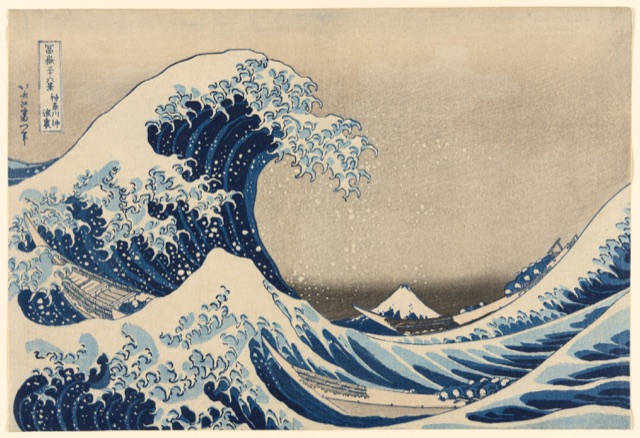
Look under the curl of the great wave, at the small white triangle in the distance. That is Mount Fuji, the highest mountain in Japan. Katsushika Hokusai designed this print in the early eighteen thirties, when he was about seventy. Three boats full of rowers are heading into the wave. Its foam reaches down toward them like fingers. And the print itself is small enough to hold in two hands.
Stop 2 · Technique
Closer Reading
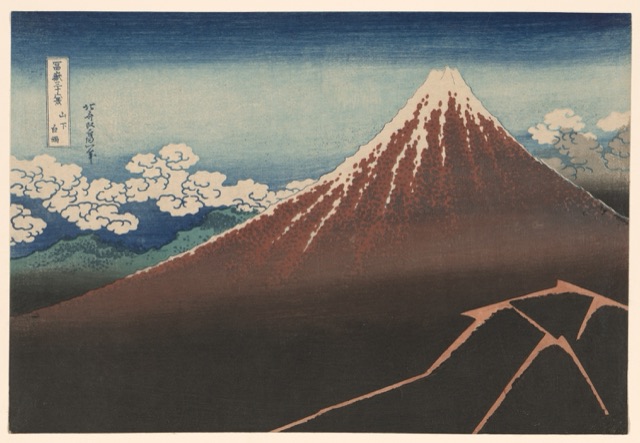
Notice the blue. There are several blues here, from pale to almost black. The colour was called Berlin blue, a manufactured pigment that had only lately become cheap enough for Japanese printmakers to use freely. Hokusai used it throughout the series this print belongs to, Thirty-Six Views of Mount Fuji. In every design of that series the mountain appears, near or far, in every season and kind of weather. Here it is tiny, and the wave seems about to fall on it. A print like this was not made by one person. Hokusai drew the design, carvers cut a separate block of wood for each colour, and printers pressed sheet after sheet. The series made landscape a popular subject for prints, and it has stayed one. The Art Institute holds three impressions of the Great Wave, and notes that all three were printed later than the first state of the design.
Stop 3 · Museum record
Catalog Summary
A wave rears over three boats, its crest breaking into claws of foam, with Mount Fuji small and still in the distance. The print comes from Hokusai’s series Thirty-Six Views of Mount Fuji, begun in 1830 when he was seventy, and owes its deep blue to a newly affordable pigment, Berlin blue. Color woodblock print, 25.4 × 37.6 cm.
Recorded physical scale: 37.6 × 25.4 cm (14.8 × 10.0 in · 0.38 × 0.25 m).
Stop 4 · Historical Context
Katsushika Hokusai (1760–1849)
Japanese artist of Edo whose woodblock prints of Mount Fuji, among them the Great Wave, made landscape a leading subject of Japanese prints.
Ukiyo-e (17th to 19th century (the Edo period)): Japanese pictures of the floating world: paintings and, above all, woodblock prints of actors, beauties and landscapes made for townspeople in the Edo period.
First Look
Look under the curl of the great wave, at the small white triangle in the distance. That is Mount Fuji, the highest mountain in Japan. Katsushika Hokusai designed this print in the early eighteen thirties, when he was about seventy. Three boats full of rowers are heading into the wave. Its foam reaches down toward them like fingers. And the print itself is small enough to hold in two hands.
Closer Reading
Notice the blue. There are several blues here, from pale to almost black. The colour was called Berlin blue, a manufactured pigment that had only lately become cheap enough for Japanese printmakers to use freely. Hokusai used it throughout the series this print belongs to, Thirty-Six Views of Mount Fuji. In every design of that series the mountain appears, near or far, in every season and kind of weather. Here it is tiny, and the wave seems about to fall on it. A print like this was not made by one person. Hokusai drew the design, carvers cut a separate block of wood for each colour, and printers pressed sheet after sheet. The series made landscape a popular subject for prints, and it has stayed one. The Art Institute holds three impressions of the Great Wave, and notes that all three were printed later than the first state of the design.
Catalog Summary
A wave rears over three boats, its crest breaking into claws of foam, with Mount Fuji small and still in the distance. The print comes from Hokusai’s series Thirty-Six Views of Mount Fuji, begun in 1830 when he was seventy, and owes its deep blue to a newly affordable pigment, Berlin blue. Color woodblock print, 25.4 × 37.6 cm.
About the Artist
Katsushika Hokusai (1760–1849)
Katsushika Hokusai was born in Edo, the city now called Tokyo, in the district that is today Sumida. He is said to have drawn from the age of six. At about nineteen he joined the studio of Katsukawa Shunshō and designed prints of kabuki actors. Such prints are called ukiyo-e, which means pictures of the floating world.
He was restless. He left that studio in 1794, studied Japanese, Chinese and Western ways of painting, and declared that he would belong to no school. He used more than thirty artist names and is said to have moved house more than ninety times. From 1814 he published the Hokusai Manga, books of sketches that others used as models.
His best-known work came in his seventies: Thirty-Six Views of Mount Fuji, made around 1830 to 1833, which includes Under the Wave off Kanagawa, known as the Great Wave. The series made landscape a subject of its own in prints and helped inspire Hiroshige. He died in Edo in 1849, close to ninety. His prints later influenced Vincent van Gogh and Edgar Degas.