1825–1829 · 3 works · Art Institute of Chicago
Hokusai: Water, Mountain, Snow
Stop 1 of 3 · Katsushika Hokusai · 1830/33
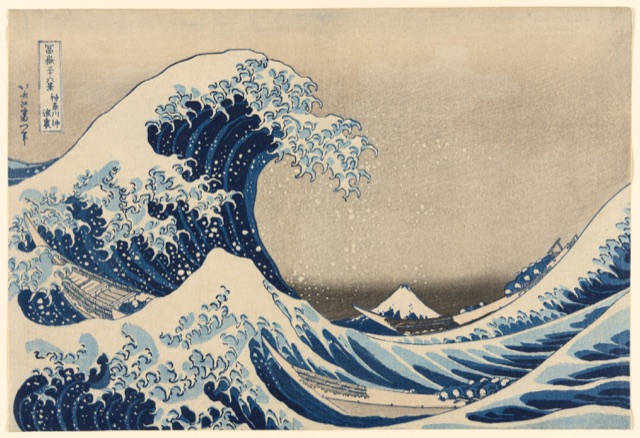
Under the Wave off Kanagawa (Kanagawa oki nami ura), also known as The Great Wave, from the series "Thirty-Six Views of Mount Fuji (Fugaku sanjūrokkei)"
First Look
Look under the curl of the great wave, at the small white triangle in the distance. That is Mount Fuji, the highest mountain in Japan. Katsushika Hokusai designed this print in the early eighteen thirties, when he was about seventy. Three boats full of rowers are heading into the wave. Its foam reaches down toward them like fingers. And the print itself is small enough to hold in two hands.
A closer look
Notice the blue. There are several blues here, from pale to almost black. The colour was called Berlin blue, a manufactured pigment that had only lately become cheap enough for Japanese printmakers to use freely. Hokusai used it throughout the series this print belongs to, Thirty-Six Views of Mount Fuji. In every design of that series the mountain appears, near or far, in every season and kind of weather. Here it is tiny, and the wave seems about to fall on it. A print like this was not made by one person. Hokusai drew the design, carvers cut a separate block of wood for each colour, and printers pressed sheet after sheet. The series made landscape a popular subject for prints, and it has stayed one. The Art Institute holds three impressions of the Great Wave, and notes that all three were printed later than the first state of the design.
A wave rears over three boats, its crest breaking into claws of foam, with Mount Fuji small and still in the distance. The print comes from Hokusai’s series Thirty-Six Views of Mount Fuji, begun in 1830 when he was seventy, and owes its deep blue to a newly affordable pigment, Berlin blue. Color woodblock print, 25.4 × 37.6 cm.
Stop 2 of 3 · Katsushika Hokusai · c. 1830/33
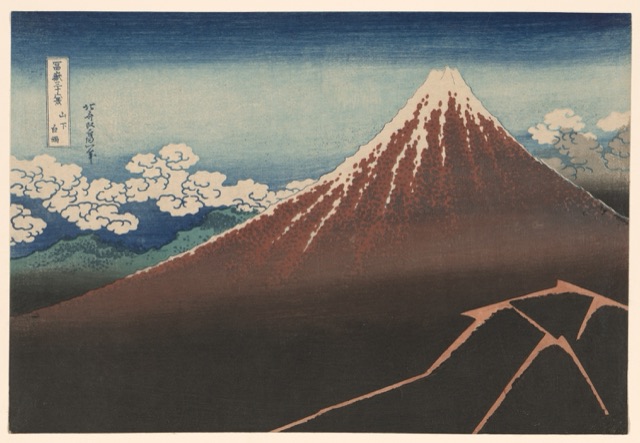
Shower Below the Summit (Sanka hakuu), from the series "Thirty-Six Views of Mount Fuji (Fugaku sanjurokkei)"
First Look
Look at the lower right corner, where a jagged orange line splits the dark. It is lightning. Katsushika Hokusai has put a thunderstorm at the foot of Mount Fuji and left the summit in clear, calm air. He designed this print in the early eighteen thirties. There are no people in it, and no buildings. There is only the mountain, and two kinds of weather at once.
A closer look
Notice how few lines there are. The mountain is two long slopes meeting at a point. The clouds on the left are rounded and soft. The lightning is all sharp angles. The Art Institute describes the result as an image of great simplicity and visual force, made by setting those elegant slopes against that jagged stroke. Fuji is the highest mountain in Japan and was once an active volcano, which last erupted in seventeen oh seven. Long before Hokusai’s time it was worshipped as a sacred mountain, and in his day pilgrims came to it from all over the country. His series was called Thirty-Six Views of Mount Fuji, but ten more designs were added to the first thirty-six, making forty-six. Hokusai was over seventy when he made them. From here, high above the storm, we see what no pilgrim on the mountain could: the summit in clear sky and the storm beneath.
Mount Fuji stands in clear air while a thunderstorm breaks far below, its lightning cut into the dark slope like a crack. The print belongs to Hokusai’s Thirty-Six Views of Mount Fuji, a series that in the end ran to forty-six designs. Color woodblock print, 25.7 × 37.6 cm.
Stop 3 of 3 · Katsushika Hokusai · c. 1834
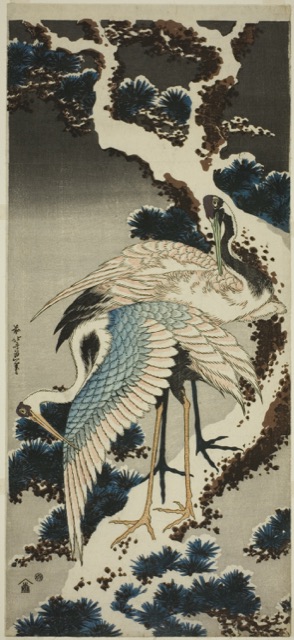
Cranes on snow-covered pine
First Look
Look at the two birds, and how their bodies cross. One crane holds its head high. The other bends down to clean its feathers. Katsushika Hokusai designed this print around eighteen thirty-four. The cranes stand on a pine bough loaded with snow, under a grey winter sky. In Japan the crane and the pine both stand for long life, so the picture is also a kind of good wish.
A closer look
Notice the snow. It is not printed. Wherever you see white, on the bough, on the pine needles and on the birds, you are looking at the paper itself. The printers left those shapes empty and let the grey of the sky and the dark blue of the needles close in around them. Now look at the feathers. Each wing is a fan of long, separate shapes, pink on one bird and blue-grey on the other, and every outline was cut by hand into a block of wood. The sheet is tall and narrow, a size the Art Institute’s record calls vertical nagaban, and it suits the subject: the bough climbs through the picture in a zigzag, and the birds’ long legs and necks repeat it. The museum’s record gives no commentary for this print, and it needs little. Hokusai was in his seventies, and he gave two birds on a branch the weight of a mountain.
Two cranes stand on a pine bough heavy with snow, one holding its head high, the other bending to preen. In Japan the crane and the pine both stand for long life. The tall, narrow sheet is a size called nagaban. Color woodblock print, 52.4 × 23.5 cm.
1830/33Under the Wave off Kanagawa
A wave rears over three boats, its crest breaking into claws of foam, with Mount Fuji small and still in the distance. The print comes from Hokusai’s series Thirty-Six Views of Mount Fuji, begun in 1830 when he was seventy, and owes its deep blue to a newly affordable pigment, Berlin blue. Color woodblock print, 25.4 × 37.6 cm.
c. 1830/33Shower Below the Summit
Mount Fuji stands in clear air while a thunderstorm breaks far below, its lightning cut into the dark slope like a crack. The print belongs to Hokusai’s Thirty-Six Views of Mount Fuji, a series that in the end ran to forty-six designs. Color woodblock print, 25.7 × 37.6 cm.
c. 1834Cranes on snow-covered pine
Two cranes stand on a pine bough heavy with snow, one holding its head high, the other bending to preen. In Japan the crane and the pine both stand for long life. The tall, narrow sheet is a size called nagaban. Color woodblock print, 52.4 × 23.5 cm.
Other exhibitions
The Sistine Chapel: Ceiling, Altar, and Wall Cycles
Michelangelo’s ceiling and Last Judgment alongside the fifteenth-century north and south wall narratives by Botticelli, Perugino, Ghirlandaio, Rosselli, and Signorelli.
1765–1857 · 7 worksEdo: Pictures of the Floating World
Seven woodblock prints from the city of Edo, 1765 to 1857: Harunobu, Kiyonaga, Sharaku, Utamaro and Hiroshige, from the Art Institute of Chicago.
1867–1893 · 7 worksImpressionism: Painters of Modern Life
Seven painters and seven views of modern France, 1867 to 1893: Monet, Renoir, Morisot, Caillebotte, Degas, Cassatt and Pissarro, from the Art Institute of Chicago.
1782–1893 · 6 worksFrom Edo to Paris: Ukiyo-e and the Impressionist Eye
How Japanese woodblock masters Hiroshige and Kiyonaga inspired the cropped framing, asymmetric diagonals, and rain-swept streets of Caillebotte, Degas, and Cassatt.