Cranes on snow-covered pine
Stop 1 · First look
First Look
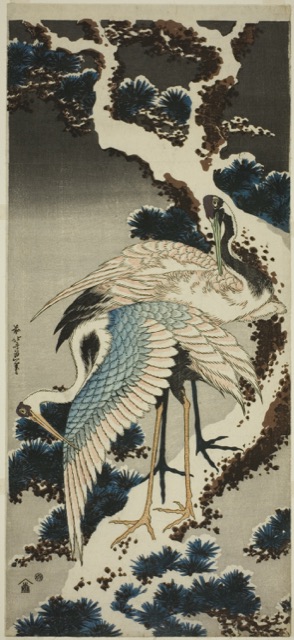
Look at the two birds, and how their bodies cross. One crane holds its head high. The other bends down to clean its feathers. Katsushika Hokusai designed this print around eighteen thirty-four. The cranes stand on a pine bough loaded with snow, under a grey winter sky. In Japan the crane and the pine both stand for long life, so the picture is also a kind of good wish.
Stop 2 · Technique
Closer Reading
Notice the snow. It is not printed. Wherever you see white, on the bough, on the pine needles and on the birds, you are looking at the paper itself. The printers left those shapes empty and let the grey of the sky and the dark blue of the needles close in around them. Now look at the feathers. Each wing is a fan of long, separate shapes, pink on one bird and blue-grey on the other, and every outline was cut by hand into a block of wood. The sheet is tall and narrow, a size the Art Institute’s record calls vertical nagaban, and it suits the subject: the bough climbs through the picture in a zigzag, and the birds’ long legs and necks repeat it. The museum’s record gives no commentary for this print, and it needs little. Hokusai was in his seventies, and he gave two birds on a branch the weight of a mountain.
Stop 3 · Museum record
Catalog Summary
Two cranes stand on a pine bough heavy with snow, one holding its head high, the other bending to preen. In Japan the crane and the pine both stand for long life. The tall, narrow sheet is a size called nagaban. Color woodblock print, 52.4 × 23.5 cm.
Recorded physical scale: 23.5 × 52.4 cm (9.3 × 20.6 in · 0.23 × 0.52 m).
Stop 4 · Historical Context
Katsushika Hokusai (1760–1849)
Japanese artist of Edo whose woodblock prints of Mount Fuji, among them the Great Wave, made landscape a leading subject of Japanese prints.
Ukiyo-e (17th to 19th century (the Edo period)): Japanese pictures of the floating world: paintings and, above all, woodblock prints of actors, beauties and landscapes made for townspeople in the Edo period.
First Look
Look at the two birds, and how their bodies cross. One crane holds its head high. The other bends down to clean its feathers. Katsushika Hokusai designed this print around eighteen thirty-four. The cranes stand on a pine bough loaded with snow, under a grey winter sky. In Japan the crane and the pine both stand for long life, so the picture is also a kind of good wish.
Closer Reading
Notice the snow. It is not printed. Wherever you see white, on the bough, on the pine needles and on the birds, you are looking at the paper itself. The printers left those shapes empty and let the grey of the sky and the dark blue of the needles close in around them. Now look at the feathers. Each wing is a fan of long, separate shapes, pink on one bird and blue-grey on the other, and every outline was cut by hand into a block of wood. The sheet is tall and narrow, a size the Art Institute’s record calls vertical nagaban, and it suits the subject: the bough climbs through the picture in a zigzag, and the birds’ long legs and necks repeat it. The museum’s record gives no commentary for this print, and it needs little. Hokusai was in his seventies, and he gave two birds on a branch the weight of a mountain.
Catalog Summary
Two cranes stand on a pine bough heavy with snow, one holding its head high, the other bending to preen. In Japan the crane and the pine both stand for long life. The tall, narrow sheet is a size called nagaban. Color woodblock print, 52.4 × 23.5 cm.
About the Artist
Katsushika Hokusai (1760–1849)
Katsushika Hokusai was born in Edo, the city now called Tokyo, in the district that is today Sumida. He is said to have drawn from the age of six. At about nineteen he joined the studio of Katsukawa Shunshō and designed prints of kabuki actors. Such prints are called ukiyo-e, which means pictures of the floating world.
He was restless. He left that studio in 1794, studied Japanese, Chinese and Western ways of painting, and declared that he would belong to no school. He used more than thirty artist names and is said to have moved house more than ninety times. From 1814 he published the Hokusai Manga, books of sketches that others used as models.
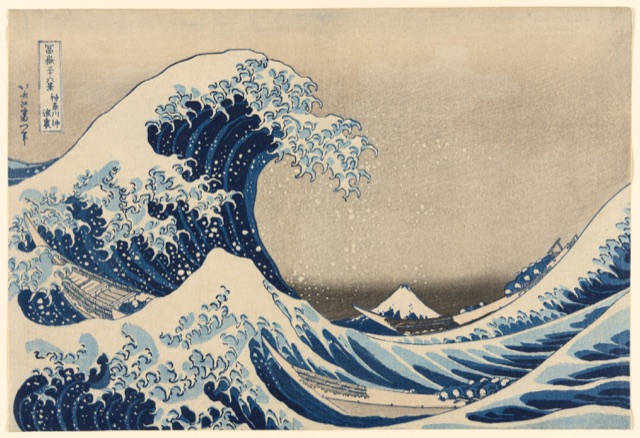
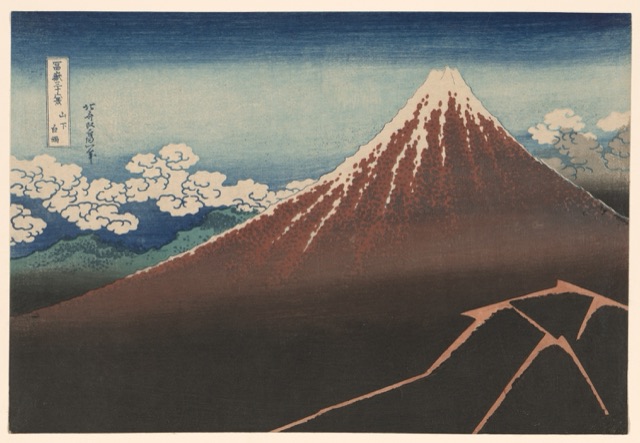
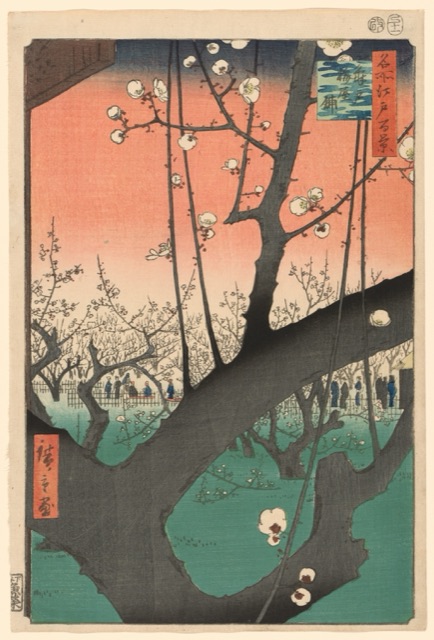
His best-known work came in his seventies: Thirty-Six Views of Mount Fuji, made around 1830 to 1833, which includes Under the Wave off Kanagawa, known as the Great Wave. The series made landscape a subject of its own in prints and helped inspire Hiroshige. He died in Edo in 1849, close to ninety. His prints later influenced Vincent van Gogh and Edgar Degas.