The Bedroom
Stop 1 · First look
First Look
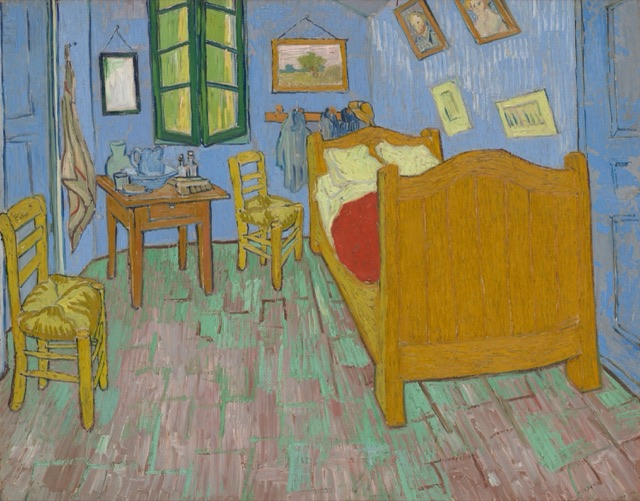
Look at the floor, and how steeply it tilts toward you. Everything in this room leans a little. It is Vincent van Gogh’s bedroom in the Yellow House at Arles, in the south of France. He painted it three times, and this is the second version, from eighteen eighty-nine. The colours are strong and the lines are sharp. Yet Van Gogh meant the picture to express utter repose.
Stop 2 · Technique
Closer Reading
Notice that nothing in the room casts a shadow. Van Gogh left shadows out on purpose, and laid the colour on in flat, thick areas. He described the first version in a letter to his brother Theo, colour by colour: walls of pale lilac, a floor of broken and faded red, a bed and chairs of chrome yellow, a blood-red bedspread, an orange table, a blue basin, a green window. He had moved into the house in September eighteen eighty-eight, hoping other painters would join him there, and he painted that first bedroom a month later. This second version was made nearly a year afterwards, in September eighteen eighty-nine, when he was living at Saint-Rémy. At the same time he painted a third, smaller one as a gift for his mother and sister. Look at the two portraits hanging above the bed. In each version of the bedroom, the pictures on the wall are different.
Stop 3 · Museum record
Catalog Summary
Van Gogh’s own bedroom in the Yellow House at Arles: a wooden bed, two chairs, a small table, pictures on the walls. He painted the room three times. This is the second version, made in September 1889, nearly a year after the first. Oil on canvas, 73.6 × 92.3 cm.
Recorded physical scale: 92.3 × 73.6 cm (36.3 × 29.0 in · 0.92 × 0.74 m).
Stop 4 · Historical Context
Vincent van Gogh (1853–1890)
Dutch painter who, in ten years of work, used strong colour and thick, visible brushstrokes to put feeling into landscapes, portraits and still lifes.
Post-Impressionism (about 1886 to the early 1900s): A later name for painters, chiefly Cézanne, Gauguin, Seurat and Van Gogh, who started from Impressionism around 1886 and each took it somewhere different.
First Look
Look at the floor, and how steeply it tilts toward you. Everything in this room leans a little. It is Vincent van Gogh’s bedroom in the Yellow House at Arles, in the south of France. He painted it three times, and this is the second version, from eighteen eighty-nine. The colours are strong and the lines are sharp. Yet Van Gogh meant the picture to express utter repose.
Closer Reading
Notice that nothing in the room casts a shadow. Van Gogh left shadows out on purpose, and laid the colour on in flat, thick areas. He described the first version in a letter to his brother Theo, colour by colour: walls of pale lilac, a floor of broken and faded red, a bed and chairs of chrome yellow, a blood-red bedspread, an orange table, a blue basin, a green window. He had moved into the house in September eighteen eighty-eight, hoping other painters would join him there, and he painted that first bedroom a month later. This second version was made nearly a year afterwards, in September eighteen eighty-nine, when he was living at Saint-Rémy. At the same time he painted a third, smaller one as a gift for his mother and sister. Look at the two portraits hanging above the bed. In each version of the bedroom, the pictures on the wall are different.
Catalog Summary
Van Gogh’s own bedroom in the Yellow House at Arles: a wooden bed, two chairs, a small table, pictures on the walls. He painted the room three times. This is the second version, made in September 1889, nearly a year after the first. Oil on canvas, 73.6 × 92.3 cm.
About the Artist
Vincent van Gogh (1853–1890)
Vincent van Gogh was born in Zundert, in the south of the Netherlands, the son of a pastor. He worked for an art dealer, taught in England and preached to coal miners in Belgium before deciding, at 27, to become an artist. He largely taught himself, beginning with dark pictures of farm workers such as The Potato Eaters.
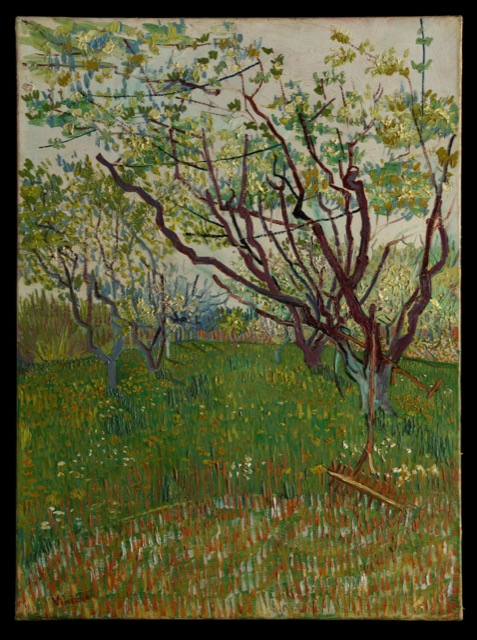
In 1886 he joined his brother Theo in Paris, where the work of Claude Monet and other modern painters brightened his colours. He answered the dotted technique of Georges Seurat with small, even strokes of his own, collected Japanese woodblock prints, and in 1887 painted copies after Hiroshige. In February 1888 he moved to Arles, in the south of France, and painted orchards in blossom, his bedroom and the Sunflowers.
After a crisis in which he cut off his ear, he spent a year in a hospital at Saint-Rémy and made about 150 paintings there. In May 1890 he moved to Auvers-sur-Oise. On 27 July he shot himself, and he died two days later, aged 37.